Q.Draw structures of the following derivatives.
🔒You're viewing a preview — the full solution, concept, methods & PYQ mapping are locked.
🔒 Start your 14-day free trial to unlock the full solution →Concept understanding — Oxidation Reactions
Alcohol Oxidation: The Intuition First
Imagine you have a molecule of ethanol — the alcohol in your hand sanitizer or a drink. It has a carbon atom bonded to an –OH group. Now picture that –OH group as a "handle" that can be transformed. Oxidation, in organic chemistry, doesn't always mean adding oxygen — it often means removing hydrogen from a carbon that already has a bond to oxygen. For alcohols, oxidation is like "stripping away" hydrogen atoms from the carbon that holds the –OH, turning the alcohol into a more oxidized functional group.
Think of it this way: a primary alcohol (R–CH₂–OH) has two hydrogens on the carbon with the –OH. If you remove one hydrogen and the hydrogen from the –OH, you get an aldehyde (R–CHO). Remove both hydrogens (and the –OH hydrogen), and you get a carboxylic acid (R–COOH). A secondary alcohol (R–CHOH–R') has only one hydrogen on that carbon — remove it, and you get a ketone (R–CO–R'). A tertiary alcohol has no hydrogen on that carbon — so it cannot be oxidized without breaking the carbon skeleton.
That's the core intuition: oxidation of an alcohol is about removing hydrogens from the carbon bearing the –OH group. The more hydrogens you can remove, the more oxidized the product.
The Precise Statement
Alcohol oxidation is the process in which an alcohol loses hydrogen atoms (dehydrogenation) from the carbon bonded to the –OH group, increasing the number of C–O bonds (or decreasing C–H bonds). The outcome depends on the class of the alcohol:
| Alcohol Class | Structure | Product after oxidation | Reagent example |
|---|---|---|---|
| Primary (1°) | R–CH₂–OH | Aldehyde (R–CHO) then Carboxylic acid (R–COOH) | PCC (stops at aldehyde); K₂Cr₂O₇/H⁺ (goes to acid) |
| Secondary (2°) | R–CHOH–R' | Ketone (R–CO–R') | K₂Cr₂O₇/H⁺, CrO₃, etc. |
| Tertiary (3°) | R₃C–OH | No reaction (under normal conditions) | — |
A common mistake: students think "oxidation" always adds oxygen. For alcohols, it's removal of hydrogen from the carbon with the –OH. The oxygen from the –OH stays — it's the hydrogens that leave.
Why Does Tertiary Alcohol Not Oxidize?
Look at the carbon with the –OH in a tertiary alcohol: it has three carbon groups attached and no hydrogen. To form a C=O bond, you'd need to remove a hydrogen from that carbon — but there is none. The only way to oxidize a tertiary alcohol is to break a C–C bond (strong and difficult), which is not typical oxidation. So in standard organic chemistry, tertiary alcohols are inert to mild oxidizing agents.
A Real-World Analogy
Think of the alcohol carbon as a "parking spot" with a certain number of hydrogen "cars." Primary alcohol has two cars parked. Oxidation is like towing away one car (→ aldehyde) or both cars (→ carboxylic acid). Secondary alcohol has one car — tow it away, and you get a ketone. Tertiary alcohol has zero cars — nothing to tow, so no reaction.
Key Reagents to Remember (for exams)
- PCC (pyridinium chlorochromate): oxidizes 1° alcohols to aldehydes only — stops there.
- K₂Cr₂O₇ / H₂SO₄ (Jones reagent): oxidizes 1° alcohols all the way to carboxylic acids; 2° alcohols to ketones.
- KMnO₄: similar to dichromate, but stronger — can over-oxidize. …
Why this formula?
Oxidation Reactions: Why the Key Principles Hold
Oxidation reactions are fundamental to chemistry, and understanding why they work the way they do is essential for mastering Indian board exams (Class 11, 12, JEE, NEET). Let's break down the core ideas from first principles.
1. The Core Definition: What Does "Oxidation" Really Mean?
Historically, oxidation meant "adding oxygen." But that's too narrow. The modern, exam-correct definition is:
Oxidation is the loss of electrons by a species.
This is the electronic concept (given by the ionic theory). The why behind this definition comes from the behavior of atoms during chemical reactions.
Why do atoms lose electrons?
Atoms seek stability. They achieve this by having a full outer electron shell (octet, duplet, or pseudo-inert gas configuration).
- Metals (like Na, Mg, Fe) have few valence electrons (1, 2, or 3). It's energetically easier for them to lose these electrons than to gain 5, 6, or 7.
- Non-metals (like O, Cl, F) have many valence electrons (5, 6, or 7). It's energetically easier for them to gain electrons.
So, when a metal reacts with a non-metal, the metal loses electrons (gets oxidized), and the non-metal gains electrons (gets reduced).
Example:
2Na+Cl2→2NaCl
- Na loses 1 electron: Na→Na++e− (Oxidation)
- Cl gains 1 electron: Cl2+2e−→2Cl− (Reduction)
Key takeaway: Oxidation and reduction always happen together (Redox reactions). You cannot have one without the other.
2. The Key Formula(e): Oxidation Number Rules
The oxidation number (O.N.) is a bookkeeping tool. It's not a real charge (except in ionic compounds), but it helps track electron flow.
Why do we assign oxidation numbers?
Because in covalent compounds (like CH4 or H2O), electrons are shared, not transferred. We need a way to pretend they are transferred to see which atom "owns" the electrons more.
The Rules (and why they exist)
| Rule | Statement | Why this rule? |
|---|---|---|
| 1 | O.N. of an element in its free state = 0 | No electron transfer has occurred. |
| 2 | O.N. of a monatomic ion = its charge | The atom has actually lost/gained that many electrons. |
| 3 | O.N. of H = +1 (except in metal hydrides where it's -1) | H is less electronegative than O, F, Cl, but more electronegative than metals. |
| 4 | O.N. of O = -2 (except in peroxides where it's -1, superoxides -1/2, and with F where it's +2) | O is highly electronegative (3.44 on Pauling scale). It "pulls" electrons toward itself. |
| 5 | Sum of O.N. in a neutral compound = 0 | The compound has no net charge. |
| 6 | Sum of O.N. in a polyatomic ion = charge of the ion | The ion's overall charge must be accounted for. |
The Derivation of a Key Formula: Finding O.N. of an Unknown Element
Suppose you need to find the O.N. of S in H2SO4.
Step 1: Write known O.N.s:
- H: +1 (rule 3)
- O: -2 (rule 4)
- S: let it be x (unknown)
Step 2: Apply rule 5 (neutral compound sum = 0):
2(+1)+x+4(−2)=0
Step 3: Solve:
2+x−8=0
x−6=0
x=+6
Why this works: The oxidation number is a mathematical consequence of the electronegativity hierarchy. Oxygen is more electronegative than sulfur, so it "takes" the electrons. Hydrogen is less electronegative than sulfur, so it "gives" electrons to sulfur. The net result is that sulfur appears to have lost 6 electrons.
3. The Key Formula(e): Balancing Redox Equations
Two methods are exam-critical: Oxidation Number Method and Ion-Electron Method (Half-Reaction Method).
Why do we need these methods?
Because in a redox reaction, the total number of electrons lost (oxidation) must equal the total number of electrons gained (reduction). This is the Law of Conservation of Charge.
The Ion-Electron Method (for acidic medium) — Step-by-step why
Example: Balance MnO4−+Fe2+→Mn2++Fe3+ (acidic)
Step 1: Write half-reactions.
-
Oxidation: Fe2+→Fe3++e−
Why? Fe loses 1 electron (O.N. goes from +2 to +3).
-
Reduction: MnO4−→Mn2+
Why? Mn gains electrons (O.N. goes from +7 to +2).
Step 2: Balance atoms other than H and O.
- Mn is already balanced (1 on each side).
Step 3: Balance O by adding H2O.
- Left: 4 O atoms. Right: 0 O atoms.
- Add 4 H2O to the right:
MnO4−→Mn2++4H2O
Step 4: Balance H by adding H+ (because acidic medium).
- Right: 8 H atoms (from 4 H2O). Left: 0 H atoms.
- Add 8 H+ to the left:
8H++MnO4−→Mn2++4H2O
Step 5: Balance charge by adding electrons.
- Left: 8(+1)+(−1)=+7 charge.
- Right: +2 charge.
- To make left = right, add 5 electrons to the left:
8H++MnO4−+5e−→Mn2++4H2O
Step 6: Multiply half-reactions to equalize electrons.
- Oxidation: Fe2+→Fe3++e− (×5)
- Reduction: 8H++MnO4−+5e−→Mn2++4H2O (×1)
Step 7: Add them:
5Fe2++8H++MnO4−→5Fe3++Mn2++4H2O
Why this works: Every step is driven by conservation laws:
- Mass balance: Same number of each atom on both sides.
- Charge balance: Net charge on left = net charge on right.
- Electron balance: Electrons lost = electrons gained.
4. The Key Formula(e): Electrochemical Series and Cell Potential
For a galvanic cell (voltaic cell), the cell potential Ecell∘ is:
Ecell∘=Ecathode∘−Eanode∘
Why this formula? …
Concept: Oxidation Reactions — but here we are drawing derivatives of carbonyl compounds, which are used to characterise aldehydes/ketones. Each derivative replaces the carbonyl oxygen with a specific nitrogen- or oxygen-containing group.
- 2,4-Dinitrophenylhydrazone of benzaldehyde The carbonyl oxygen is replaced by =N–NH–C6H3(NO2)2 (2,4-dinitrophenyl group). Structure: Ph–CH=N–NH–C6H3(NO2)2 (with NO2 at positions 2 and 4).
- Cyclopropanone oxime Oxime: C=N–OH. The cyclopropanone ring remains intact. Structure: cyclopropylidene=N–OH.
- Acetaldehydedimethylacetal Acetal: two –OCH3 groups on the same carbon. Structure: CH3–CH(OCH3)2.
- Semicarbazone of cyclobutanone Semicarbazone: C=N–NH–CO–NH2. Structure: cyclobutylidene=N–NH–CO–NH2.
- Ethylene ketal of hexan-3-one Ketal: a cyclic acetal from a diol (ethylene glycol). The carbonyl carbon becomes part of a 1,3-dioxolane ring. …
This question tests your ability to draw the products of carbonyl-group derivatisation reactions. Each derivative replaces the C=O oxygen with a specific nitrogen- or oxygen-containing group. The final structures are shown below.
The key idea is that every carbonyl compound (aldehyde or ketone) can be transformed into a derivative by reacting with a nucleophile that adds across the C=O bond, then usually eliminates water. The product retains the carbon skeleton of the original carbonyl compound, but the oxygen is replaced by a new functional group.
Let's work through each one systematically.
-
The 2,4-dinitrophenylhydrazone of benzaldehyde
Benzaldehyde is CX6HX5CHO. 2,4-Dinitrophenylhydrazine (2,4-DNP) has the structure HX2N−NH−CX6HX3(NOX2)X2 (with the nitro groups at positions 2 and 4). The reaction is a condensation: the -NH2 group attacks the carbonyl carbon, water is eliminated, and a C=N double bond (a hydrazone) forms.
The product is CX6HX5CH=N−NH−CX6HX3(NOX2)X2: the benzene ring of benzaldehyde is attached to a CH group, which is double-bonded to N, which is single-bonded to NH, which is attached to the 2,4-dinitrophenyl ring.
TipThe "2,4-dinitrophenylhydrazone" name tells you exactly which pieces connect: the carbonyl compound's carbon skeleton forms the "one" part, and the 2,4-DNP reagent forms the "hydrazone" part.
-
Cyclopropanone oxime
Cyclopropanone is a three-carbon ring with a C=O group. An oxime forms when a carbonyl reacts with hydroxylamine (NHX2OH). The product has a C=N-OH group.
The ring remains intact. The carbon that was the carbonyl carbon becomes a C=N-OH group. Draw a triangle (cyclopropane ring) with one corner being the carbon of the C=N-OH group.
CH2 / \ CH2 C = N - OH -
Acetaldehydedimethylacetal
This is an acetal: two ether groups attached to the same carbon. Acetaldehyde is CHX3CHO. Reacting it with two molecules of methanol (CHX3OH) in the presence of acid gives the dimethyl acetal. The carbonyl oxygen is replaced by two -OCH3 groups.
The product is CHX3CH(OCHX3)X2. Draw the central carbon with a hydrogen, a methyl group, and two methoxy groups.
     OCH3
      |
 CH3 - C - H
      |
     OCH3
Watch outDon't forget the hydrogen on the central carbon. Acetaldehyde has one H on the carbonyl carbon, and that H is retained in the acetal.
-
The semicarbazone of cyclobutanone
Cyclobutanone is a four-carbon ring with a C=O group. Semicarbazide is HX2N−NH−CO−NHX2. The reaction forms a semicarbazone: the carbonyl oxygen is replaced by =N-NH-CO-NH2.
The cyclobutanone ring (four CHX2/carbonyl-derived carbons in a closed ring) stays intact, with its former carbonyl carbon now bearing the =N−NH−CO−NHX2 semicarbazone group: cyclobutylidene=N–NH–CO–NH2.
-
The ethylene ketal of hexan-3-one
Hexan-3-one is CHX3CHX2COCHX2CHX2CHX3 (a six-carbon chain with the carbonyl at carbon 3). A ketal forms when a ketone reacts with a diol. Ethylene glycol (HOCHX2CHX2OH) is a diol, so the product is a cyclic ketal: a five-membered ring containing two oxygen atoms. …
Method: Functional Group Derivatization of Carbonyl Compounds
This method systematically converts a carbonyl group (C=O) into a specific derivative by reacting it with a nitrogen or oxygen nucleophile. The steps are:
- Identify the carbonyl compound (aldehyde or ketone) and its structure.
- Identify the reagent (e.g., 2,4-dinitrophenylhydrazine, hydroxylamine, alcohol, semicarbazide, diol).
- Determine the reaction site: The nucleophile attacks the electrophilic carbonyl carbon, replacing the C=O bond with a C=N or C−O bond.
- Draw the product by replacing the carbonyl oxygen with the appropriate group, maintaining the rest of the molecule unchanged.
(i) The 2,4-dinitrophenylhydrazone of benzaldehyde
- Carbonyl compound: Benzaldehyde (CX6HX5CHO)
- Reagent: 2,4-dinitrophenylhydrazine (HX2N−NH−CX6HX3(NOX2)X2)
- Product: CX6HX5CH=N−NH−CX6HX3(NOX2)X2
Structure:
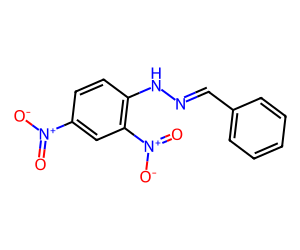
(The C=N double bond replaces the C=O of benzaldehyde.)
(ii) Cyclopropanone oxime
- Carbonyl compound: Cyclopropanone (a three-membered ring ketone)
- Reagent: Hydroxylamine (NHX2OH)
- Product: CX3HX4=NOH
Structure:
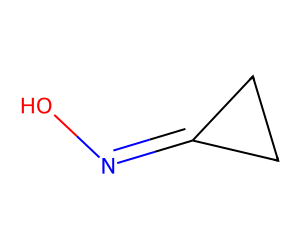
(The C=O becomes C=NOH.)
(iii) Acetaldehydedimethylacetal
- Carbonyl compound: Acetaldehyde (CHX3CHO)
- Reagent: Methanol (CHX3OH) in excess, with acid catalyst
- Product: CHX3CH(OCHX3)X2
Structure:
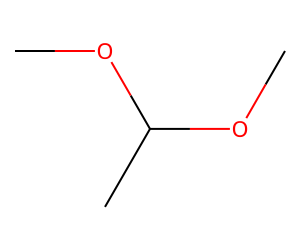
(Two OCHX3 groups replace the carbonyl oxygen; the carbon becomes tetrahedral.)
(iv) The semicarbazone of cyclobutanone
- Carbonyl compound: Cyclobutanone (a four-membered ring ketone)
- Reagent: Semicarbazide (HX2N−NH−CONHX2)
- Product: CX4HX7=N−NH−CONHX2
Structure:
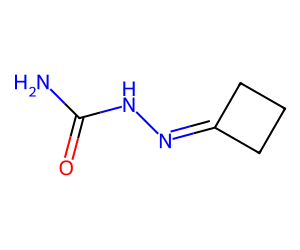
(The C=O becomes C=N−NH−CONHX2.)
(v) The ethylene ketal of hexan-3-one …
Here are the common mistakes students make when drawing these carbonyl derivatives, along with the conceptual fixes to avoid them.
General Mistake: Forgetting the Reaction Mechanism
Students often try to memorize the final structure without understanding why the atoms connect. This leads to errors in bond order and atom placement.
- The Fix: Always think of the nucleophilic addition-elimination mechanism. The carbonyl carbon (C=O) is electrophilic. The derivative's functional group attacks this carbon, the π bond breaks, and the oxygen is replaced or modified.
(i) The 2,4-dinitrophenylhydrazone of benzaldehyde
Common Mistake: Drawing the wrong connectivity for the hydrazone group (−NH−N=). Students often draw −N=N− (azo) or forget the C=N double bond, drawing a single bond instead.
- Why it happens: Confusion between hydrazine (HX2N−NHX2) and hydrazone (RX2C=N−NHX−).
- How to avoid: The derivative is formed by the loss of water (HX2O) between the carbonyl and the amine. The carbonyl oxygen leaves, and the two hydrogens from the amine leave. This creates a C=N double bond.
- Correct Structure:
- The benzaldehyde carbon (phenyl ring attached) is now a C=N .
- The nitrogen attached to this carbon has a single bond to the next nitrogen (−NH−).
- That second nitrogen is attached to the 2,4-dinitrophenyl ring.
- Key check: The C=N bond is not part of the benzene ring.
Correct Drawing:
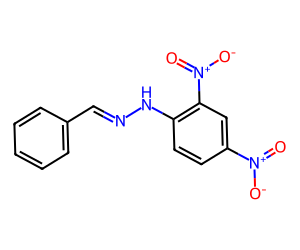
(The C=N is between the aldehyde carbon and the first nitrogen of the hydrazine.)
(ii) Cyclopropanone oxime
Common Mistake: Drawing the oxime group (C=N−OH) with a single bond (C−N−OH) or placing the −OH on the wrong atom.
- Why it happens: Forgetting that oximes are formed by condensation with hydroxylamine (NHX2OH). The =O is replaced by =N−OH.
- How to avoid: The carbonyl oxygen is replaced by the =N−OH group. The nitrogen forms a double bond with the carbonyl carbon.
- Correct Structure:
- A three-membered cyclopropane ring.
- One carbon of the ring has a =N−OH group attached (the oxime).
- The geometry around the C=N is usually E or Z, but for drawing, just show the connectivity.
Correct Drawing:
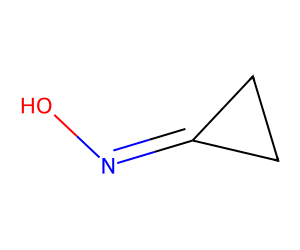
(The C=N is a double bond; the −OH is on the nitrogen.)
(iii) Acetaldehydedimethylacetal
Common Mistake: Drawing the acetal as a hemiacetal (only one −OR group) or forgetting the two ether linkages.
- Why it happens: Confusing the acetal (two −OR groups) with a hemiacetal (one −OH and one −OR).
- How to avoid: An acetal is formed when two alcohol molecules add to the carbonyl carbon, with the loss of one water molecule. The carbonyl carbon becomes a tetrahedral carbon with two −OR groups.
- Correct Structure:
- The central carbon (from acetaldehyde) has: one −H, one −CHX3, and two −OCHX3 groups.
- There is no C=O double bond.
Correct Drawing:
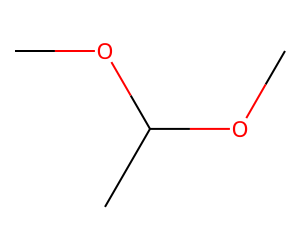
(The central carbon is spX3 hybridized, not spX2.)
(iv) The semicarbazone of cyclobutanone
Common Mistake: Drawing the semicarbazide group incorrectly (e.g., −NH−CO−NHX2 instead of −NH−CO−NH−N=).
- Why it happens: Semicarbazide is HX2N−NH−CO−NHX2. Students often forget that the terminal −NHX2 (the one on the −NH− side) is the one that reacts, not the one on the carbonyl.
- How to avoid: The amine (−NHX2) attached to the −NH− group attacks the carbonyl. The other −NHX2 (attached to C=O) remains free.
- Correct Structure:
- The cyclobutanone carbon becomes C=NX−.
- The nitrogen is attached to −NH−CO−NHX2.
- The C=O of the semicarbazide remains intact.
Correct Drawing:
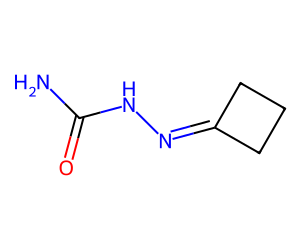
(The C=N is from the ketone; the −NH−CO−NHX2 is the rest of the semicarbazide.)
(v) The ethylene ketal of hexan-3-one
Common Mistake: Drawing the ketal as an open-chain structure or forgetting the ring.
- Why it happens: Ethylene glycol (HO−CHX2−CHX2−OH) is a diol. It forms a cyclic ketal (a 1,3-dioxolane ring).
- How to avoid: The two −OH groups of ethylene glycol both react with the same carbonyl carbon, forming a five-membered ring (including the two carbons of ethylene glycol and the carbonyl carbon). …
- COMEDK 2026Set 2026-M1 markMCQQ.Etard reaction is a method of preparation of benzaldehyde by oxidation of toluene. The oxidizing agent used in this reaction is: (A) Chromic oxide (B) Chromyl chloride (C) Potassium dichromate (D) Pyridinium chlorochromate
›Reveal solutionSolution
The Etard reaction uses chromyl chloride (CrO2Cl2) to selectively oxidize the methyl group of toluene to an aldehyde, stopping at benzaldehyde without overoxidation. The correct option is (B).
The Etard reaction is a classic, elegant method for converting a methyl group attached to an aromatic ring (like toluene) directly into an aldehyde group (like benzaldehyde). The key challenge in such oxidations is stopping at the aldehyde stage — most strong oxidizers (like potassium dichromate in acid) would push all the way to benzoic acid. The genius of the Etard reaction lies in using a specific, milder oxidizing agent that forms a stable intermediate complex, preventing overoxidation.
Why chromyl chloride?
Chromyl chloride (CrO2Cl2) is a powerful but selective oxidant. It reacts with the benzylic C–H bonds of toluene to form a solid, insoluble complex (often called the Etard complex). This complex can be isolated and then hydrolyzed (with water or dilute acid) to release benzaldehyde. The chromium is reduced, but the aldehyde is protected within the complex until workup. Other chromium(VI) reagents like chromic oxide or potassium dichromate are too aggressive in acidic media — they generate the aldehyde but immediately oxidize it further. Pyridinium chlorochromate (PCC) is milder but typically used in anhydrous conditions for alcohols, not for direct methyl-to-aldehyde conversion on toluene.
Let’s walk through the reasoning step by step.
-
Identify the goal: We need an oxidant that converts the methyl group (–CH3) of toluene to a formyl group (–CHO) without further oxidation to a carboxyl group (–COOH). This requires a reagent that either (a) forms a protective intermediate or (b) is inherently mild enough to stop at the aldehyde.
-
Evaluate option (A) – Chromic oxide (CrO3): In aqueous acidic conditions, chromic oxide is a very strong oxidizer. It would oxidize toluene first to benzyl alcohol, then to benzaldehyde, and then rapidly to benzoic acid. It does not form a stable isolable intermediate with the aldehyde. So this is not suitable for stopping at benzaldehyde.
-
Evaluate option (B) – Chromyl chloride (CrO2Cl2): This is the classic Etard reagent. It reacts with toluene in carbon disulfide or carbon tetrachloride to form a brownish-red precipitate — the Etard complex. The complex is thought to be a cyclic adduct where chromium is coordinated to the benzylic carbon and oxygen. Upon hydrolysis, this complex decomposes to give benzaldehyde. The key is that the aldehyde is “masked” in the complex until workup, preventing overoxidation. This is the correct reagent. …
-
- COMEDK 2025Set 2025-A1 markMCQQ.An Alkene " X " on reaction with hot acidified KMnO4 gave a mixture of Ethanoic acid and Propanone. Identify " X ". (A) Pent-2-ene (B) 2-Methylbut-2-ene. (C) But-2-ene (D) 2,3 -Dimethylbut-2-ene
›Reveal solutionSolution
The key idea is that hot acidic KMnO₄ cleaves alkenes at the double bond, turning each doubly bonded carbon into a carbonyl group (ketone or carboxylic acid). The products given — ethanoic acid and propanone — uniquely point to the alkene 2‑methylbut‑2‑ene, option (B).
Concept & Intuition
Hot acidic potassium permanganate (KMnO₄) is a strong oxidising agent. When it reacts with an alkene, it doesn’t just stop at a diol — it cleaves the carbon‑carbon double bond completely. Each carbon that was part of the double bond becomes a separate carbonyl compound:
- If that carbon had two alkyl groups attached, it becomes a ketone.
- If it had one alkyl group and one hydrogen, it becomes a carboxylic acid (which may further oxidise to CO₂ if it’s a terminal carbon, but here we have stable products).
- If it had two hydrogens (terminal =CH₂), it becomes CO₂ and water.
So the puzzle is: Which alkene, when cut at the double bond, gives exactly one molecule of ethanoic acid (CH₃COOH) and one molecule of propanone (CH₃COCH₃)?
Step‑by‑step reasoning
- Identify the fragments from the products Ethanoic acid is CH₃–COOH. That means one half of the original double bond must have been a carbon with a methyl group and a hydrogen:
CH3–CH=(the =C becomes –COOH after oxidation)
Propanone is CH₃–CO–CH₃. That means the other half of the double bond must have been a carbon with two methyl groups attached:
–C(CH3)2(the =C becomes >C=O)
- Reconstruct the alkene Join the two fragments at the double bond:
CH3–CH=C(CH3)2
This is 2‑methylbut‑2‑ene.
(Check the name: a 4‑carbon chain with a double bond between C2 and C3, and a methyl substituent on C2.)
- Verify with the options
- (A) Pent‑2‑ene: CH₃–CH=CH–CH₂–CH₃ → would give propanoic acid + ethanoic acid (not propanone). …
- COMEDK 2025Set 2025-E1 markMCQQ.An organic compound [X] (Molecular formula C6H12O2 ) reacts with dil. H2SO4 to form an alcohol [B] and a carboxylic acid [C]. Reaction of compound [B] with Jones reagent yielded compound [C]. When compound [C] was heated with P2O5 an Anhydride was formed. Compound [X] is ------------- -- (A) C2H5−COO−(CH2)2−CH3 (B) CH3−COO−(CH2)3−CH3 (C) CH3−COO−CH2−CH−(CH3)2 (D) CH3−COO−C−(CH3)3
›Reveal solutionSolution
[X] hydrolyses to an alcohol [B] and acid [C]; since [B] is oxidised (Jones reagent) to the same acid [C], and [C] forms an anhydride with P2O5, [X] is propyl propanoate, option (A).
Work through the clues.
- [X] (C6H12O2) dil. H2SO4 alcohol [B] + carboxylic acid [C] — so [X] is an ester.
- [B]Jones reagent[C]: the alcohol is oxidised to the acid. A primary alcohol R–CH2OH oxidises to R–COOH. For this product to be [C] itself, the acid and alcohol must share the same carbon skeleton — i.e. the ester is R–COO–CH2–R with both halves derived from the same acid.
- [C]P2O5, Δ anhydride, confirming [C] is a carboxylic acid.
Test option (A), C2H5–COO–(CH2)2–CH3 (propyl propanoate):
- Hydrolysis → propan-1-ol [B] + propanoic acid [C]. …
- KCET 2022Set B-31 markMCQQ.The test to differentiate between pentan-2-one and pentan-3-one is (A) Fehling’s test (B) Iodoform test (C) Baeyer’s test (D) Benedict’s test
›Reveal solutionSolution
Only a methyl ketone gives iodoform; pentan-2-one is one and pentan-3-one is not, so I2/NaOH separates the pair.
1. The two compounds
Pentan-2-one: CH3−C∣∣O−CH2−CH2−CH3
Pentan-3-one: CH3−CH2−C∣∣O−CH2−CH3
They are positional isomers (C5H10O) — same functional group, different position. So any test that merely detects a ketone will respond identically to both. We need a test sensitive to the position of the carbonyl.
2. Why the iodoform test discriminates
The iodoform reaction requires a CH3 group directly attached to the carbonyl carbon (a methyl ketone), or a CH3CH(OH)− group that can be oxidised to one. Mechanism: the three α-H's of that methyl group are successively replaced by iodine under basic conditions; the resulting −CI3 is an excellent leaving group and is expelled by hydroxide as CHI3 — a yellow crystalline precipitate with a characteristic antiseptic smell.
CH3COR+3I2+4NaOH⟶CHI3↓+RCOONa+3NaI+3H2O
- Pentan-2-one: the carbonyl carries a CH3 group ⇒ positive (yellow CHI3; the other product is sodium butanoate). …
- KCET 2019Set A-11 markMCQQ.Which of the following can be used to test the acidic nature of ethanol ? (A) Blue litmus solution (B) NaHCO3 (C) Na2CO3 (D) Na metal
›Reveal solutionSolution
Ethanol is too weak an acid for litmus or carbonate tests; only sodium metal is basic/reactive enough to pull off its −OH proton, releasing H2.
Step 1 — How weak is ethanol as an acid?
Ethanol ionises as C2H5OH⇌C2H5O−+H+, with pKa≈16 — it is even weaker than water (pKa≈14), and far weaker than carbonic acid (pKa≈6.4) or a carboxylic acid (pKa≈5). The alkyl group is electron-donating (+I effect), which destabilises the alkoxide ion C2H5O− and suppresses ionisation.
Step 2 — Why (A) fails.
Blue litmus turns red only for an acid strong enough to give an appreciable [H+] in water. Ethanol is neutral to litmus — a classic exam point.
Step 3 — Why (B) and (C) fail.
NaHCO3 and Na2CO3 liberate CO2 only with acids stronger than carbonic acid — that is the standard test that distinguishes carboxylic acids (which do effervesce) from alcohols and phenols (which do not). Ethanol, at pKa≈16, is nowhere near strong enough, so no brisk effervescence occurs. (Even phenol, pKa≈10, fails this test.) …
- KCET 2018Set A-11 markMCQQ.In the following reaction CHX3CrOX2ClX2HX3OX+ CSX2X⟶Z the compound Z is (A) Benzoic acid (B) Benzaldehyde (C) Acetophenone (D) Benzene
›Reveal solutionSolution
CrOX2ClX2 in CSX2 (Etard reaction) oxidises toluene's methyl group only to the aldehyde stage — the intermediate chromium complex X hydrolyses to benzaldehyde, Z.
Step 1 — Recognise the reagent.
CrOX2ClX2 is chromyl chloride; used in an inert solvent such as CSX2 or CClX4 on a methyl arene, this is the classic Etard reaction.
Step 2 — What X is.
Chromyl chloride attacks the benzylic −CHX3 group and forms a brown chromium complex (an addition complex at the benzylic carbon):
CX6HX5−CHX3+CrOX2ClX2CSX2CX6HX5−CH(OCrOHClX2)X2(= X, the Etard complex)
The key point is that the oxidation is arrested at this complex — the carbon is not oxidised further while it is tied up in the complex.
Step 3 — What Z is.
Hydrolysis of the Etard complex with HX3OX+ liberates the carbonyl compound at the aldehyde oxidation level:
CX6HX5−CH(OCrOHClX2)X2HX3OX+CX6HX5−CHO …
🎓Unlock everything free for 14 days
- ✓Full step-by-step solutions
- ✓Concept-first explanations
- ✓Methods, shortcuts & mistakes
- ✓PYQ mapping + timed mock tests
Full access for 14 days. No credit card required.