Q.Write chemical equations for the following reactions:
🔒You're viewing a preview — the full solution, concept, methods & PYQ mapping are locked.
🔒 Start your 14-day free trial to unlock the full solution →Concept understanding — Nucleophilic Substitution Reactions
Nucleophilic Addition – From Intuition to Precision
Imagine you have a molecule with a carbon–oxygen double bond — a carbonyl group (C=O). That oxygen is greedy for electrons; it pulls them away from carbon, leaving the carbon slightly positive (δ+) and the oxygen slightly negative (δ−). Now, if you bring a species that is rich in electrons (a nucleophile, meaning "nucleus-loving"), it will naturally be attracted to that electron-deficient carbon. The nucleophile attacks the carbon, the π bond breaks, and the oxygen picks up a proton (or some other electrophile) to become stable. That, in a nutshell, is nucleophilic addition.
The key idea: a nucleophile adds across a polar multiple bond (usually C=O or C≡N), breaking the π bond and forming two new sigma bonds.
The Precise Statement
Nucleophilic addition is a reaction in which a nucleophile (an electron-rich species) forms a sigma bond with an electrophilic carbon atom of a polar multiple bond (typically a carbonyl group, C=O, or a nitrile, C≡N), while the π bond breaks. The resulting intermediate then captures a proton (or another electrophile) to give a neutral product.
In general form:
RX2C=O+NuX−HX+RX2C(OH)Nu
The nucleophile (NuX−) attacks the carbonyl carbon; the oxygen becomes negatively charged; then a proton (HX+) from the medium attaches to the oxygen, yielding an alcohol.
Why It Happens – The Driving Force
The carbonyl carbon is electrophilic because:
- Oxygen is more electronegative than carbon, so the C=O bond is polarised: CXδ+=OXδ−.
- The π bond is weaker than a σ bond, so it can break relatively easily.
A nucleophile (like OHX−, CNX−, or NHX3) has a lone pair or a negative charge. It seeks positive centres. The attack forms a new σ bond, and the π electrons move entirely to oxygen, creating an alkoxide ion (RX2C−OX−). This intermediate is then quenched by a proton.
A common mistake: thinking the nucleophile attacks the oxygen. No — oxygen is already electron-rich; the nucleophile goes to the carbon because it is electron-deficient.
A Concrete Example – Addition of HCN to a Ketone
Take acetone (CHX3COCHX3) and hydrogen cyanide (HCN). In the presence of a base, CNX− (the nucleophile) attacks the carbonyl carbon:
CHX3COCHX3+CNX−CHX3C(OX−)(CN)CHX3
The alkoxide intermediate then picks up a proton from HCN (or from water) to give a cyanohydrin:
CHX3C(OX−)(CN)CHX3+HX+CHX3C(OH)(CN)CHX3
The product is acetone cyanohydrin. Notice: two new sigma bonds formed (C−CN and O−H), and the π bond is gone.
What Makes a Good Nucleophile?
Strong nucleophiles are usually negatively charged or have lone pairs:
- OHX−, CNX−, NHX2X−, CHX3OX−, HX− (from hydride reagents like NaBHX4 or LiAlHX4)
- Neutral but polarisable: NHX3, HX2O (weaker, but can add under acidic conditions) …
Why this formula?
Nucleophilic Substitution Reactions: Why the Key Formulas Hold
Nucleophilic substitution reactions are a cornerstone of organic chemistry. Instead of just memorizing the rate laws, let's understand why they arise from the molecular events.
1. The Two Main Mechanisms: A Tale of Timing
The key formulas (rate laws) for nucleophilic substitution come directly from how many molecules are involved in the rate-determining step (RDS) — the slowest step that controls the overall reaction speed.
SN1: Unimolecular — The Leaving Group Goes First
The Rate Law:
Rate=k[RX]
Why?
The reaction happens in two steps:
- Slow step (RDS): The C–X bond breaks spontaneously, forming a carbocation intermediate. Only the substrate (RX) is involved.
RXslowR++X−
- Fast step: The nucleophile (Nu−) attacks the carbocation.
R++Nu−fastRNu
Since the slow step depends only on the concentration of RX, the rate law has no dependence on [Nu−]. The nucleophile arrives after the carbocation is formed — it cannot affect the speed of the first step.
Key insight: The rate is determined by how easily the leaving group leaves, not by how fast the nucleophile attacks.
SN2: Bimolecular — Simultaneous Attack and Departure
The Rate Law:
Rate=k[RX][Nu−]
Why?
The reaction occurs in one concerted step:
- The nucleophile attacks the carbon from one side at the same time as the leaving group departs from the opposite side.
- Both RX and Nu− must collide with the correct orientation and sufficient energy.
The rate depends on the frequency of productive collisions between the two molecules. This is directly proportional to the product of their concentrations:
Rate∝[RX]×[Nu−]
Key insight: Both partners are involved in the transition state simultaneously — if either is missing, the reaction cannot proceed.
2. The Transition State: Why the Formulas Are Not Just "Given"
For SN2, the transition state has a pentavalent carbon (five bonds partially formed/broken). The energy barrier depends on steric hindrance — bulkier groups around carbon make it harder for the nucleophile to approach, which is why SN2 is favored at primary carbons. …
The key idea is ammonolysis with successive alkylation — ammonia is a nucleophile, and every amine it produces is a still better nucleophile, so alkylation does not stop cleanly at one stage.
(i) Ethanolic NH3 attacks chloroethane (SN2) to give ethanamine — but ethanamine reacts further with more C2H5Cl, and the substitution continues through the secondary and tertiary amines right up to the quaternary ammonium salt:
C2H5ClNH3C2H5NH2C2H5Cl(C2H5)2NHC2H5Cl(C2H5)3NC2H5Cl(C2H5)4N+Cl−
(chloroethane → ethanamine → N-ethylethanamine → N,N-diethylethanamine → quaternary ammonium salt)
(ii) Ammonolysis of benzyl chloride gives benzylamine, which the two moles of CH3Cl then methylate twice, stopping at the tertiary amine:
C6H5CH2ClNH3C6H5CH2NH22CH3ClC6H5CH2N(CH3)2
(benzyl chloride → benzylamine → N,N-dimethylbenzylamine, i.e. N,N-dimethylphenylmethanamine) …
Both parts are nucleophilic substitution (SN2) by nitrogen nucleophiles. (i) Ethanolic NH3 with C2H5Cl gives ethanamine, but the alkylation does not stop there — the amines formed are themselves nucleophiles, so the reaction runs through N-ethylethanamine and N,N-diethylethanamine all the way to the quaternary ammonium salt (C2H5)4N+Cl−.
(ii) Benzyl chloride with NH3 gives benzylamine (C6H5CH2NH2), which two moles of CH3Cl methylate twice to N,N-dimethylbenzylamine (C6H5CH2N(CH3)2).
The Concept: Nucleophilic Substitution by Ammonia — and Why It Doesn't Stop
Ammonia (NH3) has a lone pair of electrons on nitrogen, making it a good nucleophile. In an alkyl halide like chloroethane (C2H5Cl) or benzyl chloride (C6H5CH2Cl), the carbon attached to chlorine is electrophilic, so ammonia attacks it and displaces chloride in an SN2 reaction. This process is called ammonolysis.
The crucial point: the amine produced still carries a lone pair, and the alkyl group's +I effect makes it an even better nucleophile than ammonia. So the primary amine attacks another molecule of the alkyl halide, giving a secondary amine; the secondary amine attacks again, giving a tertiary amine; and the tertiary amine can attack once more to give a quaternary ammonium salt, which has four carbon groups on nitrogen and can react no further. In each substitution step, the HCl produced is taken up by the excess ammonia/amine present in the mixture (as an ammonium salt).
Where the chain stops depends on the question. In (i), nothing limits the alkyl halide, so the full successive-alkylation chain to the quaternary salt is the answer. In (ii), the question fixes the amount — two moles of CH3Cl — so the chain stops at the tertiary amine; do not continue to a quaternary salt there.
Step-by-Step Solution
(i) Reaction of ethanolic NH3 with C2H5Cl
Step 1 — Ammonolysis. The lone pair on nitrogen attacks the carbon bearing chlorine; chloride leaves.
C2H5Cl+NH3→C2H5NH2+HCl
Product: ethanamine (ethylamine, a 1∘ amine). The HCl is taken up by excess NH3 as NH4Cl.
Step 2 — Second alkylation. Ethanamine, a better nucleophile than NH3, attacks another molecule of chloroethane.
C2H5NH2+C2H5Cl→(C2H5)2NH+HCl
Product: N-ethylethanamine (diethylamine, a 2∘ amine).
Step 3 — Third alkylation.
(C2H5)2NH+C2H5Cl→(C2H5)3N+HCl
Product: N,N-diethylethanamine (triethylamine, a 3∘ amine).
Step 4 — Quaternisation. The tertiary amine attacks one last molecule of chloroethane. There is no N–H left to lose, so the product is the salt itself.
(C2H5)3N+C2H5Cl→(C2H5)4N+Cl−
Product: the quaternary ammonium salt (tetraethylammonium chloride).
The whole cascade in one line:
C2H5ClNH3C2H5NH2C2H5Cl(C2H5)2NHC2H5Cl(C2H5)3NC2H5Cl(C2H5)4N+Cl−
The textbook's printed Solution (2026-27 reprint) shows the final formula of this cascade as (C2H5)3N+Cl− — an apparent misprint. The fourth alkylation adds a fourth ethyl group to triethylamine, so the quaternary ammonium salt is (C2H5)4N+Cl−: four carbon groups on nitrogen, which is exactly what the book's own caption, “Quaternary ammonium salt”, describes.
This cascade is the standard illustration of why ammonolysis gives a mixture of 1∘, 2∘ and 3∘ amines plus the quaternary salt. A primary amine is obtained as the major product only when a large excess of ammonia is deliberately used — that condition is not part of this question. …
Method: Nucleophilic Substitution (SN2) with Successive Alkylation
The governing idea for both parts: a nitrogen nucleophile (first NH3, then each amine it produces) attacks the electrophilic carbon bearing the halide, displacing Cl−. Because every amine formed is itself a nucleophile, alkylation continues stage by stage until either (a) the nitrogen has no capacity left — the quaternary salt — or (b) the question limits the moles of alkyl halide.
Steps for solving any ammonolysis/alkylation problem:
- Identify the nucleophile (NH3 or an amine — the species with the lone pair).
- Identify the substrate (the alkyl halide with the leaving group).
- Write the substitution — one alkyl group transfers to nitrogen per step, releasing HCl (taken up by the excess amine/ammonia present).
- Ask: does the chain continue? If the alkyl halide is not limited, carry the cascade to the quaternary ammonium salt. If the question fixes the moles, stop at the corresponding stage.
(i) Reaction of ethanolic NH3 with C2H5Cl
Nothing limits the chloroethane here, so write the full successive-alkylation chain:
C2H5ClNH3C2H5NH2C2H5Cl(C2H5)2NHC2H5Cl(C2H5)3NC2H5Cl(C2H5)4N+Cl−
Stage by stage (each substitution also releases HCl, neutralised by the excess base in the mixture):
- C2H5Cl+NH3→C2H5NH2+HCl — ethanamine (1∘)
- C2H5NH2+C2H5Cl→(C2H5)2NH+HCl — N-ethylethanamine (2∘)
- (C2H5)2NH+C2H5Cl→(C2H5)3N+HCl — N,N-diethylethanamine (3∘)
- (C2H5)3N+C2H5Cl→(C2H5)4N+Cl− — quaternary ammonium salt
(ii) Ammonolysis of benzyl chloride, then two moles of CH3Cl
The question fixes the amount of methyl chloride at two moles, so the chain stops at the tertiary amine: …
Here are the common mistakes students make with this specific question, along with the conceptual fixes to avoid them.
Mistake 1: Stopping part (i) at ethylamine
The Mistake:
Writing only the first step —
C2H5Cl+NH3→C2H5NH2+HCl
— and presenting ethanamine as the answer.
Why it happens:
Students memorise "ammonolysis gives a primary amine" and forget that the primary amine is itself a better nucleophile than ammonia. Nothing in this question limits the amount of chloroethane, so the alkylation keeps going. (A primary amine is the major product only when a large excess of ammonia is deliberately used — a condition this question does not state.)
How to avoid it:
Write the full successive-alkylation cascade:
C2H5ClNH3C2H5NH2C2H5Cl(C2H5)2NHC2H5Cl(C2H5)3NC2H5Cl(C2H5)4N+Cl−
ending at the quaternary ammonium salt.
Mistake 2: Calling the intermediates in (ii) "quaternary ammonium salts"
The Mistake:
Referring to the protonated intermediates formed during (ii)'s methylation (e.g. C6H5CH2NH3+Cl− or C6H5CH2NH2CH3+Cl−) as "quaternary ammonium salt intermediates".
Why it happens:
Any positively charged nitrogen looks "ammonium-like", so the words get mixed up.
How to avoid it:
- Quaternary means four carbon groups bonded to nitrogen (R4N+) — no N–H at all. Such a salt cannot be deprotonated back to an amine.
- The intermediates in (ii) are simple alkylammonium salts (protonated amines): they still carry N–H bonds and are freed to the amine by the excess base present.
- In this question, a genuine quaternary salt appears only at the end of part (i): (C2H5)4N+Cl−.
Mistake 3: Running part (ii) past the tertiary amine
The Mistake:
Adding a third methylation and answering C6H5CH2N(CH3)3+Cl−.
Why it happens:
Students who have just learned the "cascade runs to the quaternary salt" idea from part (i) apply it blindly to part (ii).
How to avoid it:
Read the stoichiometry the question fixes: two moles of CH3Cl means exactly two methylations —
C6H5CH2NH2+CH3Cl→C6H5CH2NHCH3+HCl
C6H5CH2NHCH3+CH3Cl→C6H5CH2N(CH3)2+HCl
— stopping at N,N-dimethylbenzylamine, a tertiary amine.
Mistake 4: Worrying about SN1 vs SN2 instead of the products
The Mistake:
Spending time debating the mechanism for benzyl chloride and writing no clear product sequence.
How to avoid it: …
- COMEDK 2026Set 2026-A1 markMCQQ. A compound [X] undergoes reactions as given. Identify compounds [C] and [D] formed in these reactions. [A]Cr2O72−/H+[C] $$ [\text { B }] \xrightarrow[\text {(ii) } \mathrm{Na}2 \mathrm{CO}{3(\text { aq })}+\mathrm{I}_2]{\text { (i)aq. } \mathrm{KOH}} [\mathrm{D}] \quad+\mathrm{CH}_3 \mathrm{COONa}(A) \text { [C]: Benzoquinone [D]: lodoform } (B)[C]:Benzene[D]:2−iodo−propane(C)[C]:Benzoicacid[D]:lodoform(D) \text { [C]: 4-lodophenol [D]: 1-iodo-propane } $$
![Stem figure (it defines compound [X] and the first reaction): a benzene ring (hexagon with](/figures/comedk/2026-A-chemistry-q55.svg)
›Reveal solutionSolution
The compound [X] is isopropyl phenyl ether (C₆H₅–O–CH(CH₃)₂). Cleavage with concentrated HI gives phenol ([A]) and isopropyl iodide ([B]). Oxidation of phenol yields benzoquinone ([C]), and the iodoform reaction on isopropyl iodide gives iodoform ([D]) and sodium acetate. Thus the correct option is (A).
Concept & Intuition
This problem tests two classic organic reactions: ether cleavage by HI and the iodoform reaction. The key is to recognize that the ether [X] is an aryl alkyl ether (phenol derivative). When treated with concentrated HI, the C–O bond breaks selectively at the alkyl side (since the aryl–O bond is stronger due to resonance), producing phenol and an alkyl iodide. Then, phenol can be oxidized to benzoquinone, and the alkyl iodide (if it has a methyl group adjacent to the carbonyl or a secondary alcohol that can be oxidized to a methyl ketone) will undergo the iodoform test.
Let’s walk through each step.
Step-by-step reasoning
-
Identify [X] and its cleavage products
The figure shows a benzene ring with an –O–CH(CH₃)₂ group. That is isopropyl phenyl ether (C₆H₅–O–CH(CH₃)₂).
With concentrated HI, the ether bond breaks. The mechanism: HI protonates the oxygen, then iodide attacks the less hindered carbon (the isopropyl carbon, since it’s primary-like in the sense of being less sterically hindered than the aromatic ring). This gives phenol (C₆H₅OH) as the aromatic product [A] and isopropyl iodide (CH₃–CHI–CH₃) as [B].
Watch outA common mistake is to think the aromatic ring gets iodinated. But under these conditions, the C–O bond on the alkyl side breaks, not the aryl–O bond. The aromatic ring remains intact as phenol.
-
Reaction of [A] (phenol) with Cr₂O₇²⁻/H⁺ → [C]
Phenol is easily oxidized. Chromic acid (Cr₂O₇²⁻/H⁺) is a strong oxidizing agent. It oxidizes phenol to 1,4-benzoquinone (often just called benzoquinone). The reaction involves two-electron oxidation: the –OH group becomes a carbonyl, and the ring is rearranged to a quinoid structure.
So [C] = Benzoquinone.
-
Reaction of [B] (isopropyl iodide) with (i) aq. KOH, then (ii) Na₂CO₃(aq) + I₂ → [D] + CH₃COONa
- Step (i): Aqueous KOH will hydrolyze the alkyl iodide to an alcohol. Isopropyl iodide gives isopropyl alcohol (propan-2-ol, CH₃–CHOH–CH₃). …
-
- KCET 2025Set D-41 markMCQQ.Match the compounds given in List – I with the items given in List – II. List – I (I) Benzenesulphonyl Chloride (II) Sulphanilic acid (III) Alkyl Diazonium salts (IV) Aryl Diazonium salts List – II(a) Zwitterion(b) Hinsberg reagent(c) Dyes(d) Conversion to alcohols (A) 1 – c, II – b, III – a, IV – d (B) 1 – a, II – c, III – b, IV – d (C) 1 – c, II – a, III – d, IV – b (D) 1 – b, II – a, III – d, IV – c
›Reveal solutionSolution
Benzenesulphonyl chloride = Hinsberg reagent, sulphanilic acid = zwitterion, alkyl diazonium salts → alcohols, aryl diazonium salts → azo dyes.
Step 1 — (I) Benzenesulphonyl chloride → (b) Hinsberg reagent.
C6H5SO2Cl is known as Hinsberg's reagent. It reacts with 1° amines to give a sulphonamide with an acidic N–H (soluble in alkali), with 2° amines to give a sulphonamide with no N–H (insoluble in alkali), and does not react with 3° amines — the classical test for distinguishing the three classes.
Step 2 — (II) Sulphanilic acid → (a) Zwitterion.
The −SO3H group is strongly acidic and the −NH2 group is basic, so an internal proton transfer occurs:
H2N−C6H4−SO3H⇌+H3N−C6H4−SO3−
This dipolar internal salt is a zwitterion (which is why sulphanilic acid has a high melting point and low solubility in organic solvents).
Step 3 — (III) Alkyl diazonium salts → (d) Conversion to alcohols.
Alkyl diazonium ions (R−N2+) are extremely unstable because N2 is an excellent leaving group and there is no resonance stabilisation. They decompose at once, and water traps the resulting carbocation: …
- KCET 2024Set B-21 markMCQQ.In the reaction Aniline NaNO2/dil.HCl P Phenol/NaOH Q, ‘Q’ is: (A) C6H5N2Cl (B) ortho-hydroxyazobenzene (C) para-hydroxyazobenzene (D) meta-hydroxyazobenzene
›Reveal solutionSolution
Diazotisation of aniline gives the benzenediazonium salt (P); azo-coupling of that weak electrophile with phenoxide occurs at the para position, so Q is para-hydroxyazobenzene.
1. Step 1 — Diazotisation gives P
A primary aromatic amine treated with nitrous acid (generated in situ from NaNO2+dil. HCl) at 273–278 K gives an arenediazonium salt:
C6H5NH2NaNO2/dil. HCl273−278 KC6H5N+≡N Cl−
So P= benzenediazonium chloride. (The aryl diazonium ion is stabilised by delocalisation into the ring — this is why it survives, unlike an alkyl diazonium ion.) Note that option (A) is P, not Q — a classic distractor.
2. Step 2 — Azo coupling gives Q
The diazonium ion is only a weak electrophile, so it can attack a ring only if that ring is strongly activated. Phenol in NaOH is deprotonated to the phenoxide ion, C6H5O−, whose −O− is a very powerful electron-releasing group (strong +M), pumping electron density onto the ortho and para carbons.
Electrophilic substitution therefore occurs at those positions, but coupling takes place essentially exclusively at the para position because:
- the para carbon is sterically unhindered, whereas an ortho attack would place the bulky −N=N−C6H5 group right next to the −OH;
- the para-coupled azo product is the thermodynamically favoured, fully conjugated dye. …
- COMEDK 2023Set 2023-M1 markMCQQ.Identify A, B and C. (A) (B) (C) (D)
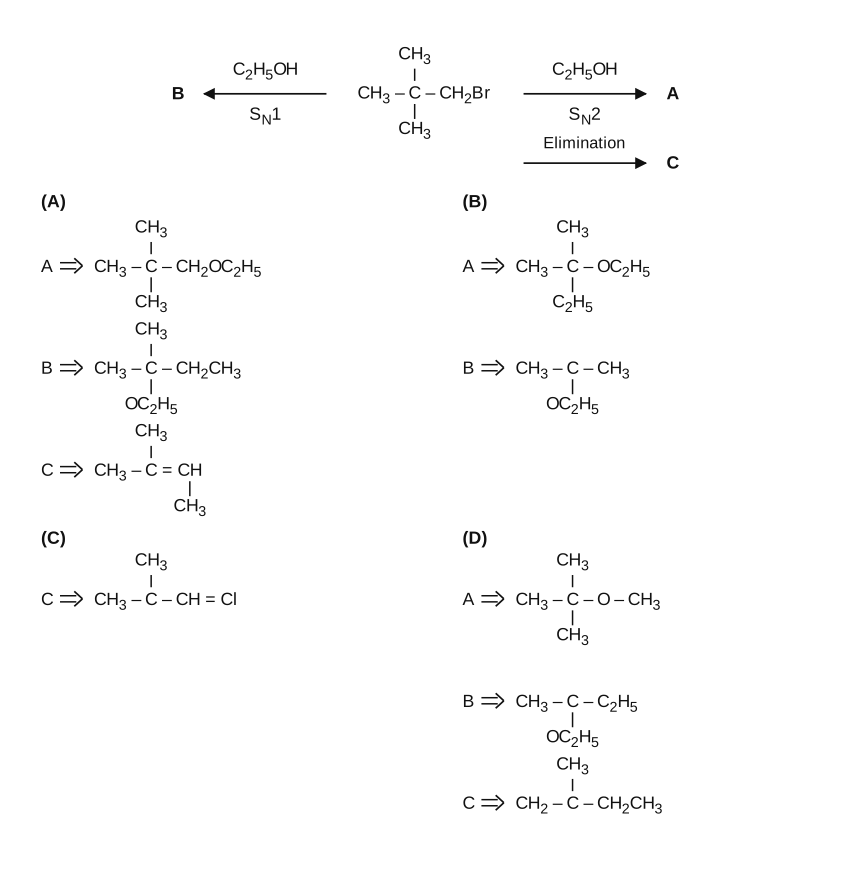
›Reveal solutionSolution
The reaction scheme shows a neopentyl bromide undergoing SN1 (to B), SN2 (to A), and elimination (to C). The correct products are: A = neopentyl ethyl ether, B = 2-ethoxy-2-methylbutane (rearranged), C = 2-methyl-2-butene. Only option (A) matches all three.
Concept & Intuition
Neopentyl bromide (1-bromo-2,2-dimethylpropane) is a classic case where the substrate’s structure dictates reaction pathways. The carbon bearing bromine is primary, but it’s attached to a quaternary carbon (three methyl groups). For SN2, the backside attack is severely hindered by the bulky neopentyl group, making it very slow. For SN1, the primary carbocation would normally be unstable, but under solvolytic conditions (ethanol), the reaction proceeds via a rearranged tertiary carbocation (a methyl shift), giving a more stable intermediate. Elimination also favors the more substituted alkene (Zaitsev product). The question tests recognition of these rearrangements and the correct structures.
Step-by-step reasoning
- Identify the substrate The central structure is neopentyl bromide:
CH3–C(CH3)2–CH2Br
The bromine is on a primary carbon, but the carbon is neopentyl (tert-butylmethyl). This is crucial.
- SN2 pathway (→ A) SN2 requires a clean backside attack. The neopentyl group is extremely bulky, so SN2 is very slow. However, in ethanol (C₂H₅OH) as solvent, the ethoxide ion (from ethanol) can act as a nucleophile. The product is the unrearranged ethyl ether:
CH3–C(CH3)2–CH2–O–C2H5
This is neopentyl ethyl ether. No rearrangement occurs because SN2 is concerted.
Check options: Only option (A) shows this exact structure for A.
- SN1 pathway (→ B) SN1 proceeds via carbocation formation. The primary carbocation (CH₃–C(CH₃)₂–CH₂⁺) is very unstable. It immediately undergoes a 1,2-methyl shift to form the more stable tertiary carbocation:
CH3–C+(CH3)–CH2CH3
This tertiary carbocation is then trapped by ethanol (solvent) to give the ethyl ether:
CH3–C(OC2H5)(CH3)–CH2CH3
This is 2-ethoxy-2-methylbutane.
Check options: Only option (A) shows B as exactly this structure (with OC₂H₅ on the quaternary carbon and an ethyl group on the adjacent carbon).
- Elimination pathway (→ C) …
- KCET 2022Set B-31 markMCQQ.A secondary amine is (A) a compound with an NH2 group on the carbon atom in number 2 position (B) a compound in which 2 of the hydrogen of NH3 have been replaced by organic groups (C) an organic compound with two NH2 group (D) a compound with two carbon atom and an NH2 group
›Reveal solutionSolution
A secondary amine is defined by the number of alkyl/aryl groups attached to nitrogen — specifically, two organic groups replace two hydrogens of ammonia. The correct answer is (B).
The key to this question is understanding how amines are classified. Amines are derivatives of ammonia (NH3), and the classification — primary, secondary, or tertiary — depends entirely on how many of the three hydrogen atoms on nitrogen have been replaced by carbon-containing groups (alkyl or aryl). It has nothing to do with the position of a carbon atom, the number of carbon atoms in the molecule, or the count of NH2 groups.
Let’s examine each option carefully.
-
Option (A) says “a compound with an NH2 group on the carbon atom in number 2 position.” This describes a structural detail about where an amino group is attached on a carbon chain (like on C-2 of propane). That is a matter of positional isomerism, not amine classification. A primary amine can have its NH2 on carbon-2, and so can a secondary or tertiary amine if they also have other groups. This definition misses the point entirely.
-
Option (B) says “a compound in which 2 of the hydrogen of NH3 have been replaced by organic groups.” This is exactly the definition. Ammonia has three hydrogens. Replace one → primary amine (RNH2). Replace two → secondary amine (R2NH). Replace three → tertiary amine (R3N). So a secondary amine has two alkyl/aryl groups attached to nitrogen, with one hydrogen remaining. …
-
- COMEDK 2021Set 2021-B1 markMCQQ.What are the products formed when Anisole is reacted with Hydroiodic acid and heated? (A) Iodobenzene + Methane (B) Phenol + Methanol (C) Phenol + Iodomethane (D) Iodobenzene + Methanol
›Reveal solutionSolution
Anisole C6H5−O−CH3+HI→C6H5OH (phenol) +CH3I (iodomethane).
In cleavage of aryl alkyl ethers by HI, the bond broken is the O−alkyl bond, not the O−aryl bond, because forming an aryl cation/attack at the aromatic carbon is very unfavourable. I− attacks the methyl carbon (SN2), …
- KCET 2019Set A-11 markMCQQ.The metal nitrate that liberates NO2 on heating (A) NaNO3 (B) KNO3 (C) LiNO3 (D) RbNO3
›Reveal solutionSolution
Li+ is tiny and highly polarising, so it distorts the nitrate ion enough to break it right down to the oxide + NO2; the bigger alkali cations only take it as far as the nitrite.
Step 1 — The two possible decomposition routes
Alkali-metal nitrates decompose on heating by one of two paths:
Path 1 — to the nitrite (Na, K, Rb, Cs):
2MNO3Δ2MNO2+O2↑
Only oxygen is evolved — no brown fumes.
Path 2 — to the oxide (Li):
4LiNO3Δ2Li2O+4NO2↑+O2↑
Here the nitrate ion is destroyed completely, giving the characteristic brown NO2 gas.
Step 2 — Why lithium is the odd one out (Fajans' rules)
The polarising power of a cation scales as (radius)2charge. Among the alkali metals:
Li+(76 pm)<Na+(102)<K+(138)<Rb+(152 pm)
So Li+ is by far the smallest and therefore the most polarising. It pulls electron density out of the large, soft NO3− anion, weakening the N–O bonds so much that the anion breaks apart entirely into O2− (which stays with Li as Li2O) and NO2.
The larger cations Na+,K+,Rb+ cannot distort the nitrate that strongly. Their nitrates only shed one oxygen atom, stopping at the stable nitrite.
Step 3 — The wider pattern (worth remembering) …
🎓Unlock everything free for 14 days
- ✓Full step-by-step solutions
- ✓Concept-first explanations
- ✓Methods, shortcuts & mistakes
- ✓PYQ mapping + timed mock tests
Full access for 14 days. No credit card required.