Q.(a) Write reasons for the following :
🔒You're viewing a preview — the full solution, concept, methods & PYQ mapping are locked.
🔒 Start your 14-day free trial to unlock the full solution →Part (a)Concept understanding — Ortho Para Directing
The Intuition: Why Some Groups "Point" the Next Attack
Imagine you're trying to add a second substituent to a benzene ring that already has one group attached. The ring already has six hydrogens, but they aren't all equal anymore — the first group has changed the electron density at different positions. Some positions become more "attractive" to an incoming electrophile (a positive or electron-seeking species), while others become less attractive.
Ortho-para directing groups are substituents that make the next electrophile prefer to attack the positions next to the group (ortho, positions 2 and 6) or directly opposite it (para, position 4), rather than the meta position (position 3 and 5).
The terms come from Greek: ortho = straight/correct (adjacent), meta = after (one carbon away), para = beside/opposite (two carbons away, directly across).
The Precise Statement
Ortho-para directing groups are substituents that, when present on a benzene ring, cause the next electrophilic aromatic substitution (EAS) reaction to occur predominantly at the ortho and para positions relative to themselves. These groups are typically electron-donating (activating) or weakly deactivating (like halogens).
The Mechanism: How They Work
The key lies in the stability of the intermediate carbocation (the arenium ion / sigma complex) formed during the attack.
When an electrophile attacks benzene, the ring temporarily loses its aromaticity and becomes a positively charged carbocation. This intermediate is stabilised if the positive charge can be delocalised onto the substituent. Ortho-para directing groups are able to donate electron density into the ring, either through:
- Resonance effect (most important): The group has lone pairs or pi electrons that can be pushed into the ring, creating extra resonance structures where the positive charge is on the substituent (which is more stable).
- Inductive effect: The group is electron-donating through sigma bonds (e.g., alkyl groups like methyl).
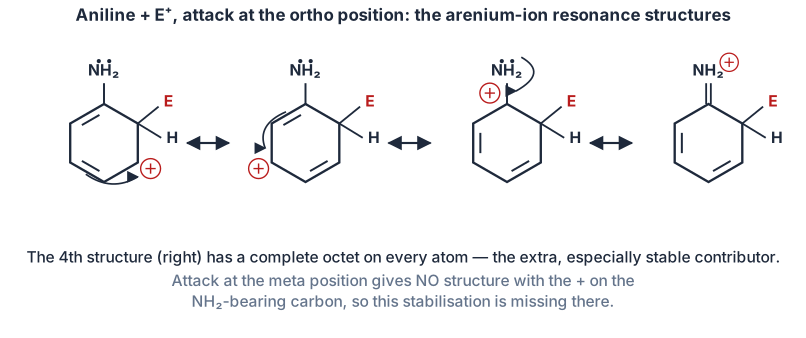
Let's see what happens when an electrophile attacks the ortho position of aniline (NH₂ group):
›Proof
Resonance stabilisation for ortho attack (aniline)
The NH₂ group donates its lone pair into the ring. When the electrophile attacks ortho, the positive charge can be delocalised onto the nitrogen atom (which is very happy to carry a positive charge because it's electronegative and has a lone pair). This gives an extra, highly stable resonance structure that is not available for meta attack.
For meta attack, the positive charge stays on the ring carbons — no extra stabilisation from the substituent. Hence ortho/para attack is favoured.
The Two Categories of Ortho-Para Directors
| Type | Examples | Effect | Why? |
|---|---|---|---|
| Strongly activating | -OH, -NH₂, -OCH₃, -NHR | Strong ortho-para directing | Strong resonance donation (lone pairs) |
| Moderately activating | -CH₃, -C₂H₅, -R (alkyl) | Ortho-para directing | Inductive electron donation (no lone pairs, but pushes electrons through sigma bonds) |
| Weakly deactivating | -F, -Cl, -Br, -I | Ortho-para directing (surprisingly!) | Halogens are electron-withdrawing inductively but electron-donating by resonance (lone pairs). The resonance effect wins for directing, but the inductive withdrawal makes the ring less reactive overall. |
Common mistake: Students think "deactivating" means "meta directing". Halogens are the exception — they deactivate the ring (slower reaction) but still direct ortho/para. The resonance donation of lone pairs is strong enough to stabilise the ortho/para intermediate, but the inductive withdrawal makes the ring less electron-rich overall. …
Why this formula?
Ortho-Para Directing: The Why Behind the Rule
Let’s build this from first principles. The question is: Why do certain groups on a benzene ring direct new substituents to the ortho and para positions, while others direct to the meta position?
The answer lies in resonance stabilization of the intermediate carbocation (the arenium ion / σ-complex) during electrophilic aromatic substitution (EAS).
1. The Core Mechanism: EAS Forms a Carbocation Intermediate
In EAS, the electrophile (E+) attacks the benzene ring. The ring temporarily loses aromaticity, forming a resonance-stabilized carbocation:
benzene+EX+[arenium ion]product
The arenium ion has three resonance forms. The stability of this intermediate determines how fast the reaction proceeds and where the electrophile attacks.
2. What Makes a Group Ortho-Para Directing?
A group is ortho-para directing if it donates electron density into the ring, especially at the ortho and para positions. This donation stabilizes the carbocation when the electrophile attacks those positions.
The Key: Resonance Structures of the Intermediate
Consider an activating group like −OH (phenol). When the electrophile attacks the ortho position, one resonance form places the positive charge directly on the carbon bearing the −OH group. The oxygen’s lone pair can then donate into that empty p-orbital, creating an extra, highly stable resonance structure:
ortho attack: ...[resonance form with C+-OH][resonance form with O+=C]
This extra resonance contributor (with a positive charge on the electronegative oxygen) is not possible for meta attack. For meta attack, the positive charge never lands on the carbon attached to the −OH group — so no extra stabilization.
The donation itself, drawn for phenol:
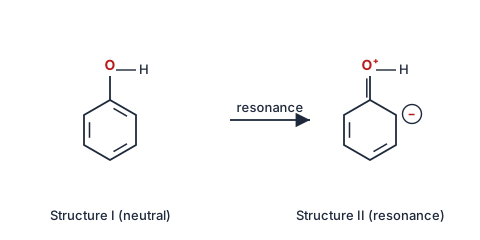
Result: The ortho/para intermediates are more stable (lower energy) than the meta intermediate. Hence, the reaction is faster at ortho/para positions.
3. The Formula: Why Ortho and Para Specifically?
The resonance structures of the arenium ion reveal the pattern:
- For ortho attack: The positive charge can be delocalized to the carbon bearing the substituent (position 1).
- For para attack: The positive charge can also be delocalized to the carbon bearing the substituent (position 1).
- For meta attack: The positive charge never reaches the carbon with the substituent.
Mathematically, if the substituent is at position 1, the positions that can stabilize the positive charge via resonance are positions 2, 4, and 6 (ortho and para). Positions 3 and 5 (meta) cannot.
4. The Deactivating Ortho-Para Directors: The Halogen Exception
Halogens (−F,−Cl,−Br,−I) are deactivating (they withdraw electron density inductively) but ortho-para directing. Why?
- Inductive effect: Halogens are electronegative → pull electron density away from the ring → deactivate (slow down EAS).
- Resonance effect: Halogens have lone pairs → can donate into the ring via resonance → stabilize the ortho/para intermediates (just like −OH).
Drawn out for chlorobenzene: …
Part (b)Concept understanding — Hofmann Bromamide Reaction
Hofmann Bromamide Degradation
Imagine you have an amide — a molecule with a carbonyl group (−CO−) attached to a nitrogen. You want to turn it into a primary amine, but you also want to chop off one carbon from the chain. That is exactly what the Hofmann bromamide reaction does: it shortens the carbon skeleton by one carbon and gives you an amine.
The Intuition
The reaction uses bromine (BrX2) in the presence of a strong alkali (like NaOH or KOH). The alkali first deprotonates the amide nitrogen, making it a strong nucleophile. This nucleophile attacks bromine, forming an N-bromoamide. Under the strongly basic conditions, this intermediate loses a bromide ion and undergoes a rearrangement — the alkyl group attached to the carbonyl carbon migrates from carbon to nitrogen. The result is an isocyanate intermediate (R−N=C=O). Finally, the isocyanate is hydrolysed by the aqueous alkali to give a primary amine and carbon dioxide.
The net effect: the carbonyl carbon is lost as COX2, and the alkyl group ends up attached to the nitrogen.
The product amine has one fewer carbon than the starting amide. The lost carbon is the carbonyl carbon.
The Precise Statement
Hofmann bromamide degradation (also called Hofmann rearrangement) is the conversion of a primary amide to a primary amine with one fewer carbon atom, using bromine and an aqueous alkali (usually NaOH or KOH).
The general reaction is:
R−CONHX2+BrX2+4NaOHR−NHX2+2NaBr+NaX2COX3+2HX2O
Or, in a more compact form:
R−CONHX2BrX2,NaOHR−NHX2+COX2
Step-by-Step Mechanism
- Deprotonation: The amide nitrogen is deprotonated by the strong base, forming an amide anion.
R−CONHX2+OHX−R−CONHX−+HX2O
- Bromination: The amide anion attacks bromine, forming an N-bromoamide.
R−CONHX−+BrX2R−CONHBr+BrX−
- Second deprotonation: The N-bromoamide is deprotonated again by the base.
R−CONHBr+OHX−R−CONBrX−+HX2O
- Rearrangement: The alkyl group migrates from the carbonyl carbon to the nitrogen, with simultaneous loss of bromide ion. This forms an isocyanate.
R−CONBrX−R−N=C=O+BrX−
- Hydrolysis: The isocyanate reacts with water to form a carbamic acid, which spontaneously decarboxylates (loses COX2) to give the primary amine.
R−N=C=O+HX2OR−NH−COOHR−NHX2+COX2
The rearrangement step (step 4) is the key. The alkyl group migrates with its bonding electrons — it is a 1,2-shift from carbon to the electron-deficient nitrogen. This is why the carbon skeleton shortens by one carbon.
Key Points for Exams
- Starting material: Primary amide (R−CONHX2) only. Secondary or tertiary amides do not undergo this reaction.
- Reagents: BrX2 and NaOH (or KOH). Sometimes ClX2 can be used instead of BrX2, but bromine is more common.
- Product: Primary amine with one fewer carbon.
- By-products: NaBr, NaX2COX3, HX2O (or COX2 if written in the simplified form). …
Part (a)
(i) Ethylamine's small –NH₂ H-bonds strongly with water and its ethyl group is small, so it dissolves; aniline's large hydrophobic benzene ring dominates (and its N lone pair is partly delocalised into the ring), so it is water-insoluble.
(ii) –NH₂ is o/p-directing by resonance, but nitration uses acidic HNO3/H2SO4 which protonates it to −N+H3 — a meta-directing, deactivating group — so a substantial amount of m-nitroaniline forms. …
Part (a): ethylamine is water-soluble (effective H-bonding, small chain) while aniline is not (bulky hydrophobic ring); in acidic nitration aniline is protonated to the meta-directing −NHX3X+, giving substantial m-nitroaniline; amines are nucleophilic because of the N lone pair. Part (b): nitrobenzene → aniline (Sn/HCl then NaOH); ethanamide → methanamine (Hofmann bromamide, one C less); ethanenitrile → ethanamine (LiAlH₄).
Part (a)
- Ethylamine soluble, aniline insoluble. Ethylamine's small –NH₂ group hydrogen-bonds strongly with water, and its short ethyl chain barely disrupts the water structure — so it is very soluble. In aniline the same –NH₂ can H-bond, but the large hydrophobic benzene ring dominates and its lone pair is partly delocalised into the ring (less available for H-bonding), so aniline is only sparingly soluble.
- o/p-directing but gives m-nitroaniline. Free –NH₂ donates its lone pair by resonance and is strongly activating, o/p-directing. Nitration, however, is done in a strongly acidic HNOX3/HX2SOX4 mixture that protonates the amine:
The −NHX3X+ group is electron-withdrawing, deactivating and meta-directing, so a substantial fraction of the product is m-nitroaniline (the o/p isomers come from the small amount of free aniline present). …
CX6HX5NHX2+HX+CX6HX5NHX3X+
- COMEDK 2025Set 2025-E1 markMCQQ.Two statements, one Assertion and the other Reason are given. Identify the correct option Assertion : Primary and secondary amides on treatment with Br2 and alcoholic NaOH yield primary and secondary amines respectively and the reaction involves stepping down the series. Reason : The reaction occurs due to the migration of alkyl group from Carbonyl carbon atom to the Nitrogen atom with elimination of carbonyl group as the carbonate salt. (A) Assertion is correct but Reason is incorrect. (B) Both Assertion and Reason are incorrect. (C) Both Assertion and Reason are correct. (D) Assertion is incorrect but Reason is correct.
›Reveal solutionSolution
Hofmann bromamide degradation works only on primary amides (giving primary amines, one C shorter) — secondary amides do NOT give secondary amines, so the Assertion is wrong; but the Reason's account of the mechanism (alkyl migration from carbonyl C to N, loss of the carbonyl as carbonate) is correct. Hence Assertion incorrect, Reason correct.
Assertion. In the Hofmann bromamide reaction, R-CONH2Br2/alc. NaOHR-NH2. It requires an unsubstituted primary amide (−CONH2, which has the N–H bonds the mechanism needs). N-substituted (secondary) amides cannot form the intermediate N-bromoamide/nitrene and so do NOT give secondary amines. The "stepping-down" (product has one fewer carbon) is true for the primary case, but the claim that secondary amides give secondary amines makes the Assertion incorrect. …
- COMEDK 2025Set 2025-M1 markMCQQ.An organic compound [X] (molecular formula- C5H11NO when reacted with Br2 / aq. NaOH yielded [Y] which reacts with CHCl3 and Ethanolic KOH to produce a foul smelling compound. Compound [Y] also reacts with HONO to produce Butan-1-ol with liberation of N2( g). Identify [X]. (A) CH3−(CH2)3−CONH2 (B) CH3−(CH2)2−CO−CH2−NH2 (C) CH3−CH2−CO−(CH2)2−NH2 (D) CH3−(CH2)2−CH(NH2)−CHO
›Reveal solutionSolution
The key is that [Y] must be a primary amine (C₄H₉NH₂) that gives butan-1-ol with HONO and a foul-smelling isocyanide with CHCl₃/KOH. Tracing back, [X] is a primary amide that undergoes Hofmann degradation to yield that amine. The correct option is (A).
Concept & Intuition
We are given a sequence of reactions starting from an organic compound X (C₅H₁₁NO). The reactions are classic name reactions:
- Hofmann bromamide degradation: A primary amide (RCONH₂) reacts with Br₂/aq. NaOH to give a primary amine with one fewer carbon atom.
- Carbylamine reaction: A primary amine reacts with CHCl₃ and alcoholic KOH to give a foul-smelling isocyanide (carbylamine).
- Reaction with nitrous acid (HONO): A primary aliphatic amine gives an alcohol with loss of N₂ gas.
Since [Y] reacts with HONO to give butan-1-ol (C₄H₉OH) and N₂, [Y] must be butan-1-amine (n-butylamine, C₄H₉NH₂). That means [Y] is a primary amine with four carbons.
Now, [Y] comes from [X] via Hofmann degradation. In that reaction, the amide loses its carbonyl carbon as CO₂, so the amine has one fewer carbon than the amide. Therefore, [X] must be a primary amide with five carbons (C₅H₁₁NO). The only option that is a primary amide is (A).
Let’s verify step by step.
Step-by-step reasoning
- Identify [Y] from its reactions
- [Y] reacts with CHCl₃/ethanolic KOH → foul-smelling compound. This is the carbylamine reaction, characteristic of primary amines (R–NH₂).
- [Y] reacts with HONO → butan-1-ol + N₂ gas. For primary aliphatic amines, HONO gives nitrogen gas and an alcohol (via diazonium intermediate). The product is butan-1-ol, so [Y] must be butan-1-amine:
CH3CH2CH2CH2NH2
(Molecular formula: C₄H₁₁N)2. Work backwards to [X] via Hofmann degradation
- Hofmann degradation:
RCONH2+Br2+4NaOH→RNH2+2NaBr+Na2CO3+2H2O
The amide loses its carbonyl carbon, so the amine has one fewer carbon.- Since [Y] is C₄H₉NH₂ (4 carbons), [X] must be a C₅ amide: RCONH₂ where R = C₄H₉.
- The molecular formula of [X] is given as C₅H₁₁NO, which matches a saturated primary amide (C₅H₁₁NO).
- Check the options
- (A) CH₃–(CH₂)₃–CONH₂: This is pentanamide (valeramide). Hofmann degradation gives butan-1-amine. ✓ …
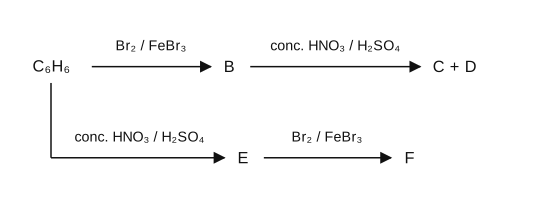
- COMEDK 2024Set 2024-E1 markMCQQ.Identify the products C, D and F formed in the following sets of reactions. (A) C=p-nitrobromobenzene D=m-nitrobromobenzene F= o-nitrobromobenzene (B) C= o-nitrobromobenzene D=m-nitrobromobenzene F=p-nitrobromobenzene (C) C=o-nitrobromobenzene D=p-nitrobromobenzene F=m-nitrobromobenzene (D) C=m-nitrobromobenzene D=p-nitrobromobenzene F= o-nitrobromobenzene
›Reveal solutionSolution
Br (o/p-director) gives the o- and p-isomers (C, D); NO2 (m-director) gives the m-isomer (F).
Upper path — bromination then nitration:
C6H6Br2/FeBr3C6H5Br (B)HNO3/H2SO4C+D
Bromine is an ortho/para-directing group, so nitration of bromobenzene gives o-nitrobromobenzene and p-nitrobromobenzene → C and D.
Lower path — nitration then bromination:
C6H6HNO3/H2SO4C6H5NO2 (E)Br2/FeBr3F …
- COMEDK 2023Set 2023-M1 markMCQQ.In Friedal-Crafts alkylation reaction of phenol with chloromethane, the product formed will be (A) p-cresol only (B) m-cresol only (C) mixture of o-and p-cresol (D) o-cresol only
›Reveal solutionSolution
The phenolic –OH is strongly activating and ortho/para directing. Introducing a methyl group (from CH3Cl/AlCl3) therefore substitutes mainly at the ortho and para positions, giving a mixture of o- and p-cresol.
In phenol, the –OH group donates electron density into the ring by resonance, activating it and directing incoming electrophiles to the ortho and para positions. …
🎓Unlock everything free for 14 days
- ✓Full step-by-step solutions
- ✓Concept-first explanations
- ✓Methods, shortcuts & mistakes
- ✓PYQ mapping + timed mock tests
Full access for 14 days. No credit card required.