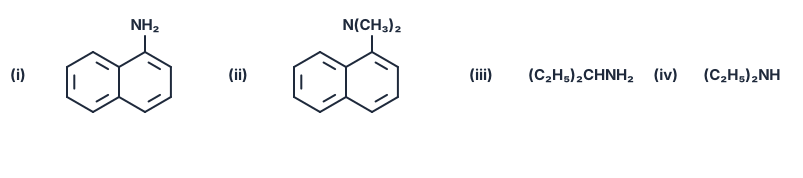
Q.Classify the following amines as primary, secondary or tertiary:
Concept understanding — Basicity Order Amines
Basicity of Amines: From Intuition to Precision
Imagine you have a nitrogen atom with a lone pair of electrons — that pair is like a key that can grab a proton (H+). The more willing the nitrogen is to share that pair, the stronger the base. That's the core idea.
The Intuition: What Makes a Nitrogen "Want" a Proton?
Amines are organic derivatives of ammonia (NH3), where one or more hydrogen atoms are replaced by alkyl groups (R). Alkyl groups are electron-donating — they push electron density toward the nitrogen. More alkyl groups = more electron density on nitrogen = stronger base.
So you'd expect: tertiary > secondary > primary > ammonia. That's the inductive effect argument.
But reality is more interesting. In water (the usual solvent for basicity measurements), the order is:
Secondary > Primary > Tertiary > Ammonia
Why the reversal for tertiary amines? Because basicity isn't just about the free amine — it's about the stability of the conjugate acid (the ammonium ion RNH3+) once the proton is grabbed.
The Precise Explanation: Three Factors at Play
1. Inductive Effect (pushes electron density)
Alkyl groups donate electrons through sigma bonds. More alkyl groups = more electron density on N = stronger base. This favours: tertiary > secondary > primary > ammonia.
2. Solvation Effect (stabilises the conjugate acid)
Once the amine grabs a proton, the resulting ammonium ion is positively charged. Water molecules surround it, stabilising the charge through hydrogen bonding. The more hydrogens on the nitrogen, the more H-bonds can form.
Primary ammonium (RNH3+) has 3 H's → best solvation.
Secondary (R2NH2+) has 2 H's → good solvation.
Tertiary (R3NH+) has 1 H → poor solvation.
This favours: primary > secondary > tertiary.
3. Steric Hindrance (blocks solvation)
Bulkier alkyl groups physically block water molecules from approaching the charged nitrogen. This further reduces solvation in tertiary amines.
The Net Result: The Actual Order in Water
| Amine Type | Inductive Effect | Solvation | Steric Hindrance | Net Basicity (pKb) |
|---|---|---|---|---|
| Ammonia (NH3) | Weakest | Best (3 H's) | None | 4.75 |
| Primary (RNH2) | Moderate | Good (2 H's) | Minimal | ~3.4 |
| Secondary (R2NH) | Strong | Moderate (1 H) | Some | ~3.2 |
| Tertiary (R3N) | Strongest | Poor (0 H's) | Significant | ~4.2 |
pKb is the negative log of the base dissociation constant. Lower pKb = stronger base. So secondary (pKb ≈ 3.2) is the strongest, then primary (≈3.4), then tertiary (≈4.2), then ammonia (4.75).
The Final Answer
The basicity order of amines in aqueous solution is:
Secondary > Primary > Tertiary > Ammonia
This is the standard order for simple alkyl amines (methyl, ethyl, etc.). The inductive effect dominates from ammonia to secondary, but the loss of solvation and steric hindrance in tertiary amines drops them below primary.
A Quick Check: Why Not Tertiary?
If you only considered electron donation, tertiary would win. But the ammonium ion R3NH+ has only one hydrogen to hydrogen-bond with water, and the three bulky alkyl groups physically block water molecules. The conjugate acid is poorly stabilised, so the equilibrium shifts back toward the free amine — making it a weaker base than expected.
This order applies to aliphatic amines in water. Aromatic amines (like aniline) are much weaker bases because the lone pair is delocalised into the benzene ring. Also, in the gas phase (no solvent), the order reverts to tertiary > secondary > primary > ammonia — confirming that solvation is the key reason for the reversal.
The Takeaway
Basicity is a tug-of-war between:
- Inductive effect (wants tertiary to win)
- Solvation + sterics (wants primary to win)
Secondary amines hit the sweet spot — strong inductive donation and decent solvation — making them the strongest bases in water.
The basicity order of amines in aqueous solution is one of the most frequently asked comparison-type questions in the NCERT Class 12 Chemistry chapter on amines, regularly appearing in CBSE boards, JEE Main and NEET. Anyone searching "basicity order of amines class 12 chemistry" or trying to understand why secondary amines outrank primary and tertiary amines will find the inductive-versus-solvation trade-off above is the standard NCERT-aligned explanation.
Why this formula?
Basicity Order of Amines: Why It Holds
Let's build this from first principles — understanding why amines have different basicities is essential for exams and for deeper chemistry.
1. What Does "Basicity" Mean Here?
Basicity of an amine is its ability to accept a proton (H+).
The stronger the base, the more readily it grabs H+.
The equilibrium is:
R3N+H2O⇌R3NH++OH−
The base dissociation constant Kb measures this:
Kb=[R3N][R3NH+][OH−]
A larger Kb means a stronger base.
2. The Key Factor: Electron Density on Nitrogen
The lone pair on nitrogen is what accepts H+.
More electron density on nitrogen → stronger base.
Why? Because a proton (H+) is attracted to negative charge. If the nitrogen's lone pair is more "available" (less tightly held), it binds H+ more easily.
3. The Two Competing Effects
✓ Inductive Effect (Electron-Donating)
Alkyl groups (−CH3, −C2H5, etc.) are electron-donating via the inductive effect.
They push electron density toward nitrogen.
- More alkyl groups → more electron density on N → stronger base.
This suggests:
3∘>2∘>1∘>NH3
✗ Solvation Effect (Hydration of the Conjugate Acid)
When the amine accepts H+, it forms R3NH+ (a positively charged ion).
This ion is stabilized by water molecules (hydration).
- More H atoms on the NH+ group → more hydrogen bonding with water → better stabilization of the conjugate acid.
- Better stabilization of R3NH+ → stronger base (because the equilibrium shifts toward protonation).
This suggests:
1∘>2∘>3∘ (since 1∘ has 3 H's, 2∘ has 2, 3∘ has 1)
4. The Actual Order (Aqueous Solution)
In water, the observed order for aliphatic amines is:
2° > 1° > 3° > NH3
Wait — that's not simply "more alkyl = stronger". Why?
The Reasoning (Step by Step)
-
From NH3 to 1∘: Adding one alkyl group increases electron density (inductive effect) → stronger base.
So 1∘>NH3.
-
From 1∘ to 2∘: Adding a second alkyl group further increases electron density → even stronger base.
So 2∘>1∘.
-
From 2∘ to 3∘: Here, the solvation effect becomes dominant.
The 3∘ amine has only one H on the NH+ group → poor hydration of the conjugate acid.
The inductive effect is still present, but the loss of solvation outweighs the gain in electron density.
So 3∘ is weaker than 2∘.
Thus, the net order is:
2° > 1° > 3° > NH3
5. The Key Formula(e) to Remember
For gas phase (no solvent):
Only inductive effect matters:
3° > 2° > 1° > NH3
For aqueous solution (common in exams):
Both effects matter — solvation dominates for 3∘:
2° > 1° > 3° > NH3
For aromatic amines (e.g., aniline):
The lone pair is delocalized into the benzene ring → much weaker base.
Aliphatic amines > Aromatic amines
6. Quick Exam Tip
If a question asks "basicity order of amines in water", always write:
2° > 1° > 3° > NH3
And explain:
- Inductive effect increases from NH3 to 3∘
- But solvation of the conjugate acid decreases from 1∘ to 3∘
- The balance gives the above order.
7. Summary Table
| Amine Type | Inductive Effect | Solvation of R3NH+ | Net Basicity (aq) |
|---|---|---|---|
| NH3 | Weakest | Best (3 H's) | Weakest |
| 1∘ | Moderate | Good (2 H's) | Moderate |
| 2∘ | Strong | Moderate (1 H) | Strongest |
| 3∘ | Strongest | Poor (0 H's) | Weaker than 2∘ |
Final takeaway:
Basicity is not just about "more alkyl = stronger". The solvation of the conjugate acid is the deciding factor in water. Always reason from both effects.
Count how many carbon atoms are attached to the nitrogen: one C = primary, two C = secondary, three C = tertiary.
- naphthalen-1-amine: N bonded to one aryl carbon (plus two H) → primary.
- N,N-dimethylnaphthalen-1-amine: N bonded to one aryl C and two CH3 carbons → tertiary.
- (C2H5)2CHNH2: N bonded to the single CH carbon (plus two H) → primary.
- (C2H5)2NH: N bonded to two ethyl carbons (plus one H) → secondary.
✓Final answer
- primary,
- tertiary,
- primary,
- secondary.
An amine is classed by how many carbon atoms are joined directly to its nitrogen: one → primary (1°), two → secondary (2°), three → tertiary (3°). The number of hydrogens on nitrogen (2, 1, 0) mirrors this. Applying the rule gives (i) 1°,
(ii) 3°,
(iii) 1°,
(iv) 2°.
Concept
Amines are viewed as derivatives of ammonia, NH3, in which one, two or three of the N–H bonds are replaced by N–C bonds. The classification depends only on how many carbon atoms are bonded to nitrogen, not on whether those carbons are part of a ring or a chain, and not on the size of the group:
- Primary (1°): R–NH2 (one C on N)
- Secondary (2°): R2NH (two C on N)
- Tertiary (3°): R3N (three C on N)
Applying the rule to each compound
- naphthalen-1-amine, C10H7–NH2. The nitrogen is joined to a single carbon — the C-1 of the naphthalene ring — and still carries two hydrogens (–NH2). One carbon on nitrogen ⇒ primary amine (an aromatic/aryl amine).
- N,N-dimethylnaphthalen-1-amine, C10H7–N(CH3)2. Here the nitrogen is bonded to the aryl carbon of the naphthalene ring and to the two carbons of the two methyl groups. Three carbons on nitrogen, no N–H left ⇒ tertiary amine.
- (C2H5)2CHNH2 (pentan-3-amine). The –NH2 is attached to the central methine carbon (the CH), which itself bears two ethyl groups. Nitrogen sees only that one carbon and keeps two hydrogens; the ethyl groups are further out on the carbon skeleton, not on nitrogen ⇒ primary amine. (This part tests whether you count carbons on N, not carbons in the molecule.)
- (C2H5)2NH (diethylamine). Nitrogen is bonded to the two carbons of two ethyl groups and retains one hydrogen ⇒ secondary amine.
✓Final answer
- naphthalen-1-amine — primary (1°);
- N,N-dimethylnaphthalen-1-amine — tertiary (3°);
- (C2H5)2CHNH2 (pentan-3-amine) — primary (1°);
- (C2H5)2NH (diethylamine) — secondary (2°).
Method: Classifying Amines (Primary/Secondary/Tertiary) by Counting C-N Bonds
Core Concept
An amine's class depends ONLY on how many carbon atoms are bonded directly to the nitrogen atom - one carbon on N gives a primary amine, two gives secondary, three gives tertiary - regardless of whether those carbons belong to a ring, a chain, or how large the attached groups are.
Steps
- Locate the nitrogen atom in the given structure.
- Count only the bonds going from N directly to a carbon atom (ignore N-H bonds and ignore carbons further away in the molecule that are not bonded to N itself).
- Map the count to a class: 1 carbon on N gives primary (1 degree); 2 carbons give secondary (2 degree); 3 carbons give tertiary (3 degree).
- Repeat independently for every compound in the set - classification never depends on comparing compounds to each other.
Applying the Method to Each Sub-Part
- naphthalen-1-amine, C10H7-NH2: N is bonded to exactly one carbon (the aryl C-1 of naphthalene) and keeps two H -> primary.
- N,N-dimethylnaphthalen-1-amine, C10H7-N(CH3)2: N is bonded to the aryl C-1 AND to the two methyl carbons - three C-N bonds, no N-H left -> tertiary.
- (C2H5)2CHNH2: the -NH2 is bonded only to the single central CH carbon; the two ethyl groups are attached to THAT carbon, not to nitrogen, so N still sees only one carbon -> primary (the trap here is counting the ethyl carbons as if they were on N).
- (C2H5)2NH: N is bonded to the two ethyl carbons and keeps one H -> secondary.
Key Exam Point
Sub-part (iii) is specifically designed to catch students who classify by "how many carbons are in the molecule" instead of "how many carbons are bonded to N" - always trace only the bonds directly touching the nitrogen atom.
Here are the common mistakes students make when classifying amines from drawn structures and condensed formulas, along with how to avoid each.
Mistake 1: Counting all the carbons in the molecule instead of the carbons bonded to nitrogen
Students see a big structure (like the naphthalene ring in part (i)) or a heavily branched formula and assume "many carbons = higher class."
- The Error: Calling naphthalen-1-amine "tertiary" because the ring has ten carbons.
- How to Avoid: The classification rule looks at one atom only — the nitrogen. Count the carbon atoms bonded directly to N:
- one C on N → primary (1°)
- two C on N → secondary (2°)
- three C on N → tertiary (3°)
- Example: In part (i), the nitrogen is bonded to a single ring carbon (C-1 of naphthalene) and two hydrogens → primary, no matter how large the ring system is.
Mistake 2: Classifying by the carbon skeleton next to the amine carbon (the "alcohol/haloalkane habit")
Students carry over the alkyl-halide/alcohol convention — where 1°/2°/3° describes the carbon bearing the functional group — and apply it to the amine.
- The Error: Calling (C2H5)2CHNH2 (part (iii)) a "secondary amine" because the CH carbon bearing the NH2 carries two ethyl groups (it is a secondary carbon).
- How to Avoid: For amines, the degree is a property of the nitrogen, not of the carbon it sits on. In (C2H5)2CHNH2, nitrogen sees only one carbon (the CH) and keeps two hydrogens → primary amine. The two ethyl groups are further out on the skeleton, not on nitrogen.
Mistake 3: Misreading −N(CH3)2 as "two substituents, so secondary"
- The Error: For part (ii), counting the two methyl groups of −N(CH3)2 and stopping there → "secondary."
- How to Avoid: Count every C–N bond, including the bond to the ring/parent chain. In N,N-dimethylnaphthalen-1-amine the nitrogen is bonded to the aryl carbon and to two methyl carbons — three C–N bonds, no N–H left → tertiary (3°). The "N,N-" prefix in a name is itself a signal that nitrogen carries two extra groups besides the parent.
Mistake 4: Thinking aryl amines classify differently from alkyl amines
- The Error: Treating a ring carbon on N as "not counting" (or counting it differently) because it is aromatic.
- How to Avoid: An aryl carbon bonded to nitrogen counts exactly like an alkyl carbon. Aniline (C6H5NH2) and naphthalen-1-amine are both primary amines — one C on N, two H on N — just aromatic ones.
Mistake 5: Not using the N–H count as a cross-check
- The Error: Deciding the class from the drawing alone and never verifying.
- How to Avoid: The hydrogens on nitrogen mirror the classification: 2 H → 1°, 1 H → 2°, 0 H → 3°. In part (iv), (C2H5)2NH has exactly one N–H → secondary, consistent with its two C–N bonds. If your carbon count and hydrogen count disagree, you have misread the structure — recount.
Quick Reference Table
| Part | Compound | C atoms on N | H atoms on N | Class |
|---|---|---|---|---|
| (i) | naphthalen-1-amine | 1 (aryl C) | 2 | Primary (1°) |
| (ii) | N,N-dimethylnaphthalen-1-amine | 3 (aryl C + 2 CH₃) | 0 | Tertiary (3°) |
| (iii) | (C2H5)2CHNH2 | 1 (the CH carbon) | 2 | Primary (1°) |
| (iv) | (C2H5)2NH | 2 (two ethyl C) | 1 | Secondary (2°) |
Final tip: Circle the nitrogen atom and draw only its four bonds before classifying. Everything outside those bonds — ring size, branching, chain length — is irrelevant to whether the amine is 1°, 2° or 3°.
Showing the 12 most recent of 14 on this concept.
- COMEDK 2026Set 2026-A1 markMCQQ.Choose the incorrect statement. (A) Propan-2-amine can be obtained by reacting acetoxime with Na/C2H5OH (B) Aniline cannot be prepared by Phthalimide reaction (C) The decreasing order of basic strength of amines in aqueous solution is Ethanamine > N,N-Dimethylaniline > Benzenamine (D) Fluorobenzene cannot be prepared from Benzenediazonium chloride by Sandmeyer's reaction because Fluorination of the Diazonium salt is highly endothermic in nature
›Reveal solutionSolution
Checking each statement, A, B and C are correct; D is the incorrect statement — fluorobenzene is not made by Sandmeyer's reaction (it is made by the Balz–Schiemann route), but the reason given ("fluorination of the diazonium salt is highly endothermic") is not the valid explanation, so the statement is wrong.
(A) Correct. Acetoxime (CH3)2C=NOH on reduction with Na/C2H5OH gives (CH3)2CH-NH2, propan-2-amine. Oximes reduce to primary amines. ✓
(B) Correct. The Gabriel (phthalimide) synthesis needs an SN2 displacement on the alkyl halide; aryl halides do not undergo this, so aniline cannot be prepared by the phthalimide reaction. The statement is true. ✓
(C) Correct. Basicity in water: ethanamine (aliphatic 1° amine) is the strongest; among the aromatics, N,N-dimethylaniline is more basic than aniline (two +I methyl groups on N). Order ethanamine > N,N-dimethylaniline > benzenamine. ✓
(D) Incorrect. It is true that fluorobenzene is not obtained by Sandmeyer's reaction (Sandmeyer uses Cu(I) salts for Cl, Br, CN). But aryl fluorides are made by the Balz–Schiemann reaction (heating the diazonium tetrafluoroborate), not blocked by any "highly endothermic fluorination" of the diazonium salt — indeed C–F bond formation is strongly exothermic. The reasoning is false, making this the incorrect statement.
✓Final answerThe correct option is (D) — Fluorobenzene cannot be prepared from Benzenediazonium chloride by Sandmeyer's reaction because Fluorination of the Diazonium salt is highly endothermic in nature.
- KCET 2025Set D-41 markMCQQ.Match the following with their pKa values
Acid pKa (I) Phenol (a) 16 | | (II) p-Nitrophenol |(b) 0.78 | | (III) Ethyl alcohol |(c) 10 | | (IV) Picric acid |(d) 7.1 | (A) I – c, II – d, III – a, IV – b (B) I – a, II – d, III – c, IV – b (C) I – a, II – b, III – c, IV – d (D) I – b, II – a, III – d, IV – c›Reveal solutionSolution
Rank the four compounds by acid strength using resonance and the −NO2 electron-withdrawing effect, then assign the pKa values in the reverse order (stronger acid ⇒ smaller pKa).
Step 1 — The governing principle.
pKa=−logKa
So a stronger acid has a larger Ka and therefore a SMALLER pKa. An acid is strong when its conjugate base is stable — i.e. when the negative charge left behind after losing H+ can be spread out.
Step 2 — Rank the four species by conjugate-base stability.
(III) Ethyl alcohol, C2H5OH — the ethoxide ion C2H5O− has its negative charge localised entirely on oxygen, with no resonance at all. Worse, the ethyl group is electron-releasing (+I), which pushes electron density onto the already-negative oxygen and destabilises it further. ⇒ weakest acid ⇒ highest pKa = 16 (a).
(I) Phenol, C6H5OH — the phenoxide ion delocalises its negative charge into the benzene ring by resonance (onto the ortho and para carbons). This resonance stabilisation makes phenol far more acidic than an alcohol — about 106 times so. ⇒ pKa = 10 (c).
(II) p-Nitrophenol — a −NO2 group at the para position is strongly electron-withdrawing by both −I and −R effects. Crucially, at the para position the nitro group can accept the negative charge by resonance directly onto its own oxygen atoms, giving the phenoxide extra stabilisation on top of the ring delocalisation. ⇒ markedly more acidic than phenol ⇒ pKa = 7.1 (d).
(IV) Picric acid (2,4,6-trinitrophenol) — three nitro groups (two ortho, one para), all withdrawing electrons and all able to delocalise the negative charge of the phenoxide. Their effects add up, making the conjugate base extremely stable. Picric acid is so acidic it rivals a mineral acid. ⇒ strongest acid ⇒ lowest pKa = 0.78 (b).
Step 3 — Assemble the acidity order and the matching.
0.78Picric acid>7.1p-nitrophenol>10Phenol>16Ethyl alcohol(decreasing acid strength)
Acid pKa Label I Phenol 10 c II p-Nitrophenol 7.1 d III Ethyl alcohol 16 a IV Picric acid 0.78 b So the matching is I – c, II – d, III – a, IV – b, which is option (A).
Quick elimination check: every wrong option assigns ethyl alcohol (III) something other than 16, or gives phenol the picric-acid value — both chemically impossible.
✓Final answerThe correct option is (A) — I – c, II – d, III – a, IV – b.
ANSWER: A
- KCET 2025Set D-41 markMCQQ.Arrange the following compounds in their decreasing order of reactivity towards Nucleop addition reaction. CH3COCH3,CH3COC2H5,CH3CHO (A) CH3CHO>CH3COCH3>CH3COC2H5 (B) CH3COCH3>CH3CHO>CH3COC2H5 (C) CH3COC2H5>CH3COCH3>CH3CHO (D) CH3CHO>CH3COC2H5>CH3COCH3
›Reveal solutionSolution
Rank by the two effects that control nucleophilic addition — the +I (electron-releasing) effect of alkyl groups and their steric bulk. Both make more/larger alkyl groups less reactive, so aldehyde > methyl ketone > ethyl ketone.
Step 1 — What makes a carbonyl reactive towards a nucleophile.
The C=O bond is polarised because oxygen is far more electronegative than carbon:
δ+C=Oδ−
A nucleophile attacks the electron-deficient carbonyl carbon, and in doing so the carbon rehybridises from planar sp2 to tetrahedral sp3. Two factors therefore govern the rate:
- Electronic factor: the greater the positive charge (δ+) on the carbonyl carbon, the more strongly it attracts the nucleophile → faster.
- Steric factor: the more crowded the carbonyl carbon, the harder it is for the nucleophile to approach, and the more strained the resulting crowded sp3 (tetrahedral) product → slower.
Step 2 — Compare the three compounds by their substituents.
Compound Groups on the carbonyl C CH3CHO (ethanal) one CH3 + one H CH3COCH3 (propanone) two CH3 CH3COC2H5 (butan-2-one) one CH3 + one C2H5 Step 3 — Apply the electronic (+I) factor.
Alkyl groups are electron-releasing (+I effect). Pushing electron density towards the carbonyl carbon reduces its δ+, making it less attractive to a nucleophile.
- CH3CHO has only one alkyl group (the H contributes no +I) → largest δ+ → most reactive.
- CH3COCH3 has two alkyl groups → δ+ reduced further.
- CH3COC2H5 has two alkyl groups, and ethyl has a stronger +I effect than methyl → δ+ reduced the most → least reactive.
Step 4 — Apply the steric factor.
The same ordering emerges independently:
- Ethanal's carbonyl carbon bears a tiny H — nearly unhindered.
- Propanone bears two methyls — moderately hindered.
- Butan-2-one bears a methyl and a bulkier ethyl — the most hindered.
Both effects reinforce each other (which is why the trend is so reliable), giving:
CH3CHO>CH3COCH3>CH3COC2H5
Step 5 — The general rule this illustrates.
HCHO>RCHO>RCOR′
i.e. formaldehyde > other aldehydes > ketones towards nucleophilic addition — and within each class, reactivity falls as the alkyl groups get larger and more numerous.
Step 6 — Rejecting the distractors.
- (B) puts a ketone above the aldehyde — contradicts both the +I and steric arguments.
- (C) is the complete reverse of the correct order.
- (D) correctly places the aldehyde first but then ranks the bulkier, more electron-rich ethyl methyl ketone above propanone, which is backwards.
✓Final answerThe correct option is (A) — CH3CHO>CH3COCH3>CH3COC2H5.
ANSWER: A
- KCET 2025Set D-41 markMCQQ.Which of the following reaction/s does not yield an amine? I. R−X+NH3Δ(alc) II. R−C≡NH2/Ni,Na(Hg)/C2H5OH III. R−C≡N+H2OH+ IV. R−C=NH2+4[H]i)LiAlH4,ii)H2O (A) Both I and III (B) Only II (C) Only III (D) Both II and IV
›Reveal solutionSolution
Check each route: three are amine-forming reductions/substitutions; nitrile hydrolysis (III) gives a carboxylic acid, so it is the only one that fails.
Step 1 — Reaction I: R−X+NH3Δ, alc.
This is ammonolysis of an alkyl halide — a nucleophilic substitution in which ammonia attacks the carbon bearing the halogen:
R−X+NH3⟶R−NH2+HX
It does give an amine (in practice a mixture of 1∘, 2∘, 3∘ amines and the quaternary salt, because the product amine is itself nucleophilic). Since the question only asks whether an amine is obtained, I yields an amine.
Step 2 — Reaction II: R−C≡NH2/Ni or Na(Hg)/C2H5OH
This is the reduction (Mendius reaction) of a nitrile. Catalytic hydrogenation over Ni, or nascent hydrogen from sodium amalgam in ethanol, adds hydrogen across the C≡N triple bond:
R−C≡N [H] R−CH2−NH2
This is a standard preparation of a primary amine with one carbon more than the parent halide. II yields an amine.
Step 3 — Reaction III: R−C≡N+H2OH+
Here water, not hydrogen, is the reagent, and the conditions are acidic hydrolysis. The nitrogen leaves as ammonia/ammonium and the carbon ends up as a carboxyl group:
R−C≡NH+ H2O R−CONH2H+ H2O R−COOH+NH4+
The product is a carboxylic acid. No amine is formed — the nitrogen is expelled as ammonium salt. III does NOT yield an amine.
Step 4 — Reaction IV: R−C=NH (imine/amide)+4[H]i) LiAlH4, ii) H2O
LiAlH4 is a powerful hydride reducing agent; the aqueous work-up then liberates the free base. Reduction of a C=N (imine) — or of an amide, which is what this route amounts to — delivers the corresponding amine:
R−CONH2i) LiAlH4ii) H2OR−CH2−NH2
IV yields an amine.
Step 5 — Collect.
Amine formed: I ✓, II ✓, IV ✓. Amine not formed: III only.
Option (A) wrongly includes I, (B) wrongly names II, and (D) wrongly names II and IV — all of which do produce amines.
✓Final answerThe correct option is (C) — Only III (acidic hydrolysis of a nitrile gives a carboxylic acid, not an amine).
ANSWER: C
- COMEDK 2025Set 2025-A1 markMCQQ.Choose the correct statement: (A) Aliphatic amines are weaker bases than NH3 while aromatic amines are stronger bases than NH3. (B) Gabriel phthalimide synthesis is used for preparing both Ethyl amine and Aniline. (C) Anilinium ion is less resonance stabilised than Aniline. (D) Sec-butylamine is optically inactive because Nitrogen atom of the −NH2 group is achiral.
›Reveal solutionSolution
The key idea is to evaluate each statement about amine basicity, synthesis, resonance, and chirality. Only statement (C) is correct: anilinium ion is less resonance-stabilized than aniline.
Concept & Intuition
Amines are organic derivatives of ammonia. Their basicity depends on how well the lone pair on nitrogen is available for protonation. Resonance, inductive effects, and hybridization all matter. Gabriel phthalimide synthesis is a classic method for making primary amines, but it fails for aromatic amines like aniline. Chirality at nitrogen is tricky because nitrogen inverts rapidly, so sec-butylamine is not optically active due to that inversion, not because the nitrogen is achiral. Let’s check each option.
-
Option (A): Aliphatic amines are stronger bases than NH₃ because alkyl groups donate electron density (inductive effect), making the lone pair more available. Aromatic amines are weaker bases than NH₃ because the lone pair is delocalized into the benzene ring (resonance), reducing availability. So the statement says the opposite — false.
-
Option (B): Gabriel phthalimide synthesis uses phthalimide and an alkyl halide to make primary amines. It works for alkyl halides (e.g., ethyl bromide → ethylamine). But aniline cannot be made this way because aryl halides (like chlorobenzene) do not undergo nucleophilic substitution easily under these conditions. So false.
-
Option (C): Aniline has resonance between the nitrogen lone pair and the benzene ring, stabilizing the molecule. When aniline is protonated to form anilinium ion, the lone pair is used to bind H⁺, so resonance is lost. The anilinium ion is therefore less resonance-stabilized than aniline. This is correct.
-
Option (D): Sec-butylamine has a chiral carbon (the carbon attached to NH₂ has four different groups), so the molecule is optically active. The nitrogen atom itself is not a chiral center because the lone pair inverts rapidly (like an umbrella flipping), so optical activity is not due to nitrogen chirality. But the statement says sec-butylamine is optically inactive — false, because the carbon is chiral.
Watch outA common mistake is thinking that nitrogen inversion makes a molecule optically inactive even when a chiral carbon is present. In sec-butylamine, the carbon is the chiral center, not the nitrogen.
TipFor basicity comparisons: alkyl groups push electrons → stronger base; resonance with an aromatic ring pulls electron density → weaker base.
✓Final answerThe correct option is (C).
ANSWER: C
-
- COMEDK 2025Set 2025-E1 markMCQQ.Choose the correct statement from the options given (A) The decreasing order of basic nature of the following amines is: Methylamine > Dimethylamine > Trimethylamine > Aniline. (B) The intermolecular bonding in primary amines is stronger than in secondary amines. (C) Benzene diazonium chloride when reacted with Aniline in presence of dil. HCl at 273 K yields C6H5−N=N−NH−C6H5 (D) On heating an aliphatic primary amine with CHCl3 in presence of Ethanolic KOH , a Nitrile is formed
›Reveal solutionSolution
Primary amines (two N–H bonds) hydrogen-bond more strongly than secondary amines (one N–H), so statement (B) is the correct one.
Assess each option:
- (A) In aqueous solution the basicity order of methylamines is (CH3)2NH > CH3NH2 > (CH3)3N > aniline (a balance of +I, solvation and steric effects). The stated order MeNH2 > Me2NH is wrong.
- (B) A primary amine R–NH2 has two N–H bonds and can form more hydrogen bonds than a secondary amine R2NH (only one N–H). Hence primary amines have stronger intermolecular H-bonding (and higher boiling points than secondary amines of comparable mass) — correct.
- (C) Coupling of benzene diazonium chloride with aniline gives, under the usual conditions, an azo dye (p-aminoazobenzene, C-coupling), not simply the stated diazoamino product — statement not correct.
- (D) The carbylamine (isocyanide) reaction of a primary amine with CHCl3 + ethanolic KOH gives an isocyanide (R–NC), not a nitrile (R–CN) — incorrect.
The correct statement is (B).
✓Final answerThe correct option is (B) — The intermolecular bonding in primary amines is stronger than in secondary amines.
- COMEDK 2024Set 2024-M1 markMCQQ.Which one of the following shows the correct increasing order of basic nature of the given compounds? A: Phenylmethanamine B: N-Ethylethanamine C:N, N-Dimethylaniline D : N, N-Dimethylmethanamine (A) B<C<A<D (B) A < D < B < C (C) D < B < A < C (D) C < A < D < B
›Reveal solutionSolution
Ranking the four amines by the availability of the nitrogen lone pair gives C<A<D<B (aromatic amine weakest, secondary aliphatic strongest) — option (D).
Identify the compounds
- A — Phenylmethanamine (benzylamine), C6H5CH2NH2: a primary aliphatic amine; the ring is one carbon away, so the lone pair is not delocalised.
- B — N-Ethylethanamine (diethylamine), (C2H5)2NH: a secondary aliphatic amine.
- C — N,N-Dimethylaniline, C6H5N(CH3)2: an aromatic amine; the N lone pair is delocalised into the ring, making it much less available.
- D — N,N-Dimethylmethanamine (trimethylamine), (CH3)3N: a tertiary aliphatic amine.
Reasoning
The more available the nitrogen lone pair, the stronger the base.
- C is weakest. In N,N-dimethylaniline the lone pair is conjugated into the benzene ring, so it is least available — aromatic amines are far weaker bases than aliphatic amines (pKaH≈5.1).
- A next. Benzylamine is a primary aliphatic amine; the ring is insulated by the CH2, so it behaves as an ordinary primary amine (pKaH≈9.3).
- D next. Trimethylamine (tertiary) is a stronger base than a primary amine but suffers reduced solvation of its conjugate acid (pKaH≈9.8).
- B strongest. Diethylamine (secondary) has the best balance of inductive donation and cation solvation, giving the highest basicity (pKaH≈11).
Increasing basic strength: C<A<D<B.
✓Final answerIncreasing order of basic nature is C<A<D<B — option (D).
- COMEDK 2023Set 2023-E1 markMCQQ.Select the strongest base from the given compounds: [A] p- NO2−C6H4NH2 [B] C6H5−CH2−NH2 [C] m−NO2−C6H4NH2 [D] C6H5NH2 (A) [A] (B) [C] (C) [B] (D) [D]
›Reveal solutionSolution
Strongest base = [B] = benzylamine, which is listed as option (C).
Concept: basicity of amines depends on the availability of the lone pair on nitrogen.
[D] Aniline, C6H5-NH2: the N lone pair is delocalised into the benzene ring -> weak base.
[A] p-Nitroaniline: the -NO2 group withdraws electrons by both -I and -R (and para -R is strongly deactivating) -> even weaker base (weakest).
[C] m-Nitroaniline: -NO2 withdraws by -I only from the meta position -> weaker than aniline but stronger than the para isomer.
[B] Benzylamine, C6H5-CH2-NH2: the nitrogen is attached to an sp3 CH2, NOT directly to the ring, so its lone pair is NOT in conjugation with the ring and remains fully available. It behaves essentially like an aliphatic amine -> STRONGEST base of the set.
Strongest base = [B] = benzylamine, which is listed as option (C).
✓Final answerThe correct option is (C) — [B]
ANSWER: C
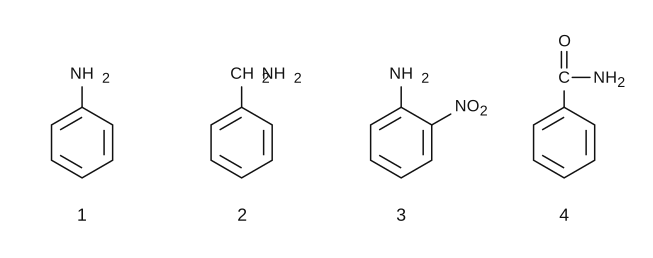
- COMEDK 2023Set 2023-M1 markMCQQ.Rank the following compounds in order of increasing basicity. (A) 4 < 2 < 1 < 3 (B) 4 < 1 < 3 < 2 (C) 4 < 3 < 1 < 2 (D) 2 < 1 < 3 < 4
›Reveal solutionSolution
Basicity depends on the availability of the nitrogen lone pair for protonation. The order of increasing basicity is benzamide (4) < o‑nitroaniline (3) < aniline (1) < benzylamine (2), so the correct ranking is 4 < 3 < 1 < 2, which corresponds to option (C).
The key concept is lone‑pair availability. A base is strong when its lone pair is “free” to accept a proton. Anything that stabilizes the lone pair (by delocalization or electron withdrawal) makes the compound less basic; anything that pushes electron density toward nitrogen makes it more basic. Here, all four compounds have a nitrogen that can be protonated, but the groups attached to the benzene ring dramatically affect how much that lone pair is tied up in resonance or pulled away by inductive effects.
Let’s work through each compound step by step.
- Compound 4 – Benzamide (C₆H₅CONH₂) The nitrogen is part of an amide group. The lone pair on nitrogen is strongly delocalized into the adjacent carbonyl (C=O) via resonance:
R–C(=O)–NH2⟷R–C(O⁻)–NH2+
This resonance makes the lone pair much less available for protonation. Additionally, the carbonyl oxygen is more electronegative and pulls electron density inductively. Result: benzamide is the least basic of the four.
-
Compound 3 – o‑Nitroaniline (2‑nitroaniline)
Here the NH₂ is directly on the ring, but an ortho nitro group (NO₂) is present. The nitro group is strongly electron‑withdrawing both inductively (through σ‑bonds) and by resonance (it can accept electron density from the ring). This withdrawal reduces electron density on the NH₂ nitrogen. Moreover, the ortho position allows a direct resonance interaction: the lone pair on NH₂ can be delocalized into the nitro group, further stabilizing the neutral amine and making it harder to protonate. So o‑nitroaniline is less basic than aniline (compound 1), but still more basic than benzamide because the amide resonance is even more effective at tying up the lone pair.
-
Compound 1 – Aniline (C₆H₅NH₂)
The NH₂ is directly attached to the benzene ring. The lone pair on nitrogen can be delocalized into the aromatic ring (resonance with the π‑system). This delocalization makes aniline a weaker base than aliphatic amines (like benzylamine). However, there is no strong electron‑withdrawing group like NO₂ or C=O to further reduce basicity. Aniline is therefore more basic than compounds 3 and 4, but less basic than benzylamine.
-
Compound 2 – Benzylamine (C₆H₅CH₂NH₂)
Here the nitrogen is separated from the benzene ring by a CH₂ group. This insulating methylene group prevents direct resonance between the nitrogen lone pair and the aromatic ring. The only effect of the benzene ring is a weak inductive withdrawal through the CH₂, which is very small. Benzylamine behaves essentially like a primary aliphatic amine (e.g., methylamine) and is the most basic of the four.
Watch outA common mistake is to think that because aniline’s lone pair is delocalized into the ring, it is “very weak.” But compared to amides and nitroanilines, aniline is actually moderately basic. The amide resonance is far more effective at stabilizing the neutral form than simple aromatic delocalization.
TipA quick mental shortcut: Amide < Nitroaniline < Aniline < Benzylamine — the farther the nitrogen is from the ring (and from electron‑withdrawing groups), the stronger the base.
Now assemble the order from least basic to most basic:
4 (benzamide) < 3 (o‑nitroaniline) < 1 (aniline) < 2 (benzylamine).
This matches option (C).
✓Final answerThe correct option is (C).
ANSWER: C
- COMEDK 2022Set 20221 markMCQQ.Which of the following is highly basic? (A) Diphenylamine (B) Benzylamine (C) Aniline (D) Triphenylamine
›Reveal solutionSolution
Most basic = benzylamine.
Concept: basicity of amines depends on the availability of the nitrogen lone pair.
- Benzylamine, C6H5-CH2-NH2: the ring is insulated from N by an sp3 CH2, so the lone pair is NOT delocalised into the ring. It behaves like an aliphatic amine and is strongly basic (pKb ~ 4.7).
- Aniline, C6H5-NH2: the lone pair is delocalised into the ring -> weakly basic (pKb ~ 9.4).
- Diphenylamine: two rings pull the lone pair -> far weaker base.
- Triphenylamine: three rings + steric crowding -> essentially non-basic.
Most basic = benzylamine.
✓Final answerThe correct option is (B) — Benzylamine
ANSWER: B
- KCET 2021Set B-21 markMCQQ.Which of the following compound on heating given N2O? (A) Pb(NO3)2 (B) NH4NO3 (C) NH4NO2 (D) NaNO3
›Reveal solutionSolution
Gentle thermal decomposition of ammonium nitrate is the lab preparation of nitrous oxide: NH4NO3→N2O+2H2O.
1. The concept — internal redox in an ammonium salt.
In NH4NO3 the same compound contains nitrogen in two very different oxidation states: −3 in the NH4+ cation and +5 in the NO3− anion. On heating they undergo an intramolecular redox reaction, meeting at the intermediate state +1 — which is exactly the oxidation state of N in N2O:
NH4NO3Δ(∼250∘C)N2O+2H2O
This is the standard laboratory preparation of nitrous oxide ("laughing gas").
2. Why the other three do not give N2O.
- (A) Pb(NO3)2 — a heavy-metal nitrate; it decomposes to the oxide, giving brown NO2 and O2:
2Pb(NO3)2Δ2PbO+4NO2+O2
- (C) NH4NO2 — here the nitrogen states are −3 and +3; they meet at 0, giving dinitrogen, not N2O (this is the lab preparation of pure N2):
NH4NO2ΔN2+2H2O
- (D) NaNO3 — an alkali-metal nitrate; it merely loses oxygen to become the nitrite:
2NaNO3Δ2NaNO2+O2
3. The distinction to remember.
NH4NO2→N2 (nitrite → nitrogen); NH4NO3→N2O (nitrate → nitrous oxide). The extra oxygen in the nitrate is what raises the product's nitrogen from 0 to +1.
✓Final answerThe correct option is (B) — NH4NO3.
ANSWER: B
- KCET 2021Set B-21 markMCQQ.Ka values for acids H2SO3, HNO2, CH3COOH and HCN are respectively 1.3×10⁻², 4×10⁻⁴, 1.8×10⁻⁵ and 4×10⁻¹⁰, which of the above acids produces stronger conjugate base in aqueous solution? (A) H2SO3 (B) HNO2 (C) CH3COOH (D) HCN
›Reveal solutionSolution
The strength of a conjugate base is inversely related to the acid’s Ka — the weakest acid gives the strongest conjugate base. HCN has the smallest Ka (4×10⁻¹⁰), so its conjugate base (CN−) is the strongest. The correct option is (D).
The key idea is the conjugate acid–base relationship: for any acid HA, its conjugate base A⁻ is what remains after the acid donates a proton. A strong acid readily gives up its proton, leaving behind a weak, stable conjugate base that has little tendency to re-accept a proton. Conversely, a weak acid holds its proton tightly, so its conjugate base is much more eager to grab a proton — that is, it is a stronger base.
Quantitatively, for a conjugate pair in water, the product of the acid dissociation constant Ka and the base dissociation constant Kb of the conjugate base equals Kw (1.0×10⁻¹⁴ at 25°C):
Ka×Kb=Kw
So Kb=Kw/Ka. A smaller Ka means a larger Kb — a stronger conjugate base. Therefore, to find which acid produces the strongest conjugate base, we simply look for the acid with the smallest Ka.
-
List the given Ka values clearly:
- H2SO3: 1.3×10⁻²
- HNO2: 4×10⁻⁴
- CH3COOH: 1.8×10⁻⁵
- HCN: 4×10⁻¹⁰
-
Compare the magnitudes. The smallest Ka is 4×10⁻¹⁰, belonging to HCN. It is many orders of magnitude smaller than the next smallest (1.8×10⁻⁵). This means HCN is by far the weakest acid in the list.
-
Apply the inverse relationship. Since Kb∝1/Ka, the conjugate base of HCN (CN−) has the largest Kb and is therefore the strongest base among the four conjugate bases.
Watch outA common mistake is to pick the acid with the largest Ka (strongest acid) thinking it produces a strong conjugate base. The opposite is true: the stronger the acid, the weaker its conjugate base. Here, H2SO3 has the largest Ka, so its conjugate base (HSO3−) is the weakest base — not what the question asks.
TipYou don’t need to calculate Kb values at all. Just rank the acids by Ka: the smallest Ka wins. If the numbers are given in scientific notation, compare the exponents first — here 10−10 is clearly smaller than 10−2, 10−4, or 10−5.
✓Final answerThe acid that produces the strongest conjugate base is HCN, so the correct option is (D).
-
🎓Unlock everything free for 14 days
- ✓Full step-by-step solutions
- ✓Concept-first explanations
- ✓Methods, shortcuts & mistakes
- ✓PYQ mapping + timed mock tests
Full access for 14 days. No credit card required.