Q.How do you explain the presence of five —OH groups in glucose molecule?
🔒You're viewing a preview — the full solution, concept, methods & PYQ mapping are locked.
🔒 Start your 14-day free trial to unlock the full solution →Concept understanding — Glucose Cyclization
Glucose Cyclization: From a Straight Chain to a Ring
Imagine you have a long, flexible chain with a hook at one end and an eyelet at the other. If you swing that chain around, the hook can snap into the eyelet, forming a loop. That's the core idea behind glucose cyclization.
Glucose in its simplest written form is a straight chain of six carbon atoms with an aldehyde group (−CHO) at one end. But in water (like in your blood), this chain doesn't stay straight. The aldehyde group reacts with the alcohol group on the fifth carbon, forming a stable six-membered ring.
Why does this happen?
The aldehyde carbon is electrophilic (electron-poor), and the oxygen on carbon-5 has lone pairs (nucleophilic). They attack each other, forming a new bond. This creates a hemiacetal — a carbon bonded to both an −OH and an −OR group. The ring is more stable than the open chain in solution.
The open-chain form of glucose exists in equilibrium with the cyclic form, but at any given time, over 99% of glucose molecules are in the cyclic form.
The precise statement
Glucose cyclization is an intramolecular nucleophilic addition where the aldehyde group at C1 reacts with the hydroxyl group at C5, forming a six-membered pyranose ring (named after pyran, a six-membered oxygen heterocycle). This reaction creates a new chiral center at C1, giving two possible stereoisomers called anomers: α and β.
The two anomers
When the ring forms, the oxygen from C5 becomes part of the ring. The carbon that was the aldehyde (now C1) becomes a new chiral center. The −OH group at this new center can point:
- Down (relative to the ring plane) → α-D-glucose
- Up → β-D-glucose
The α and β anomers are diastereomers, not enantiomers. They differ only at the anomeric carbon (C1). In solution, they interconvert through the open-chain form — a process called mutarotation.
How to draw it (Haworth projection)
- Draw a hexagon with an oxygen atom at the top-right corner.
- Number the carbons clockwise from the oxygen: C1 is the carbon to the right of oxygen, C2 next, and so on.
- For α-D-glucose, the −OH at C1 points down (opposite to the CH2OH group at C5).
- For β-D-glucose, the −OH at C1 points up (same side as the CH2OH group). …
Why this formula?
Glucose Cyclization: Why the Ring Forms
Glucose cyclization is a classic example of an intramolecular reaction — a molecule reacting with itself. Let's build the understanding step by step.
1. The Starting Point: Open-Chain Glucose
Glucose (C6H12O6) in its open-chain form has:
- An aldehyde group (−CHO) at carbon 1 (C1)
- A hydroxyl group (−OH) at carbon 5 (C5)
The aldehyde is electrophilic (electron-deficient at the carbonyl carbon), and the hydroxyl is nucleophilic (electron-rich oxygen with lone pairs).
2. Why Cyclization Happens: Thermodynamic & Kinetic Favorability
The Key Insight
The molecule is flexible — it can bend so that the C5 hydroxyl oxygen approaches the C1 aldehyde carbon. This brings two reactive groups into close proximity.
- Entropy is favorable: One molecule becomes one ring — no loss of translational entropy (unlike two separate molecules reacting).
- Ring strain is manageable: A 5- or 6-membered ring (furanose or pyranose) has minimal angle strain (close to tetrahedral angles).
Result: The reaction is reversible but strongly favors the cyclic form — in aqueous solution, >99% of glucose exists as the ring.
3. The Reaction: Hemiacetal Formation
The nucleophilic oxygen of the C5 hydroxyl attacks the electrophilic carbonyl carbon of C1:
R-CHO+R’-OH⇌R-CH(OH)(OR’)
This is a hemiacetal — a carbon bonded to both an −OH and an −OR group.
Mechanism (simplified)
- Protonation of the carbonyl oxygen (acid-catalyzed) makes C1 more electrophilic.
- Nucleophilic attack by the C5 oxygen.
- Deprotonation yields the cyclic hemiacetal.
4. The Key Formula(e): Ring Size & Anomeric Carbon
Ring Size Determination
The ring size depends on which hydroxyl attacks:
- C5 hydroxyl → pyranose (6-membered ring: 5 carbons + 1 oxygen)
- C4 hydroxyl → furanose (5-membered ring: 4 carbons + 1 oxygen)
For D-glucose, the C5 attack is overwhelmingly favored, giving the pyranose form.
The Anomeric Carbon
The new chiral center formed at C1 is called the anomeric carbon. Two stereoisomers arise:
- α-anomer: −OH at C1 is trans to the −CH2OH group (axial in the chair conformation)
- β-anomer: −OH at C1 is cis to the −CH2OH group (equatorial in the chair conformation)
Why two forms? The attack can occur from either face of the planar carbonyl group — leading to two possible configurations at the new stereocenter.
5. The Equilibrium Constant & Mutarotation
The interconversion between α and β anomers is called mutarotation:
α-D-glucopyranose⇌open chain⇌β-D-glucopyranose
At equilibrium (in water at 20°C):
- β-D-glucopyranose: ~64%
- α-D-glucopyranose: ~36%
- Open chain: <0.1% …
The key idea is that glucose exists primarily as a cyclic hemiacetal, not as a straight-chain aldehyde. In the open-chain form, glucose has four chiral carbons and one aldehyde group — but the aldehyde reacts with the C5 hydroxyl to form a six-membered pyranose ring.
Reasoning:
- The open-chain structure of glucose is CHO–(CHOH)4–CH2OH, which contains four secondary alcohols and one primary alcohol — that’s five —OH groups in total.
- In solution, the aldehyde group (–CHO) at C1 reacts intramolecularly with the –OH at C5, forming a cyclic hemiacetal. This reaction does not change the number of hydroxyl groups: the aldehyde oxygen becomes a ring oxygen, and a new –OH appears at the anomeric carbon (C1). …
The five —OH groups in glucose arise because its open-chain form is an aldohexose (a six-carbon aldehyde sugar), and when it cyclizes into a pyranose ring, the aldehyde group reacts with the C5 hydroxyl to form a hemiacetal, leaving all other hydroxyls intact — so the cyclic structure still shows five —OH groups, one of which is the anomeric —OH.
Glucose is an aldohexose — that means it has six carbons and an aldehyde group. In its open-chain (Fischer projection) form, each carbon except the first (the aldehyde carbon) carries a hydroxyl group. That gives you five —OH groups straight away: one on each of C2 through C6. The aldehyde group at C1 is a carbonyl, not an —OH.
But here’s the twist: glucose in solution is almost entirely cyclic, not open-chain. The cyclization happens when the aldehyde group at C1 reacts with the hydroxyl on C5, forming a six-membered ring (a pyranose ring). This reaction creates a new —OH group at C1 (the anomeric hydroxyl), while the —OH on C5 is now part of the ring oxygen bridge. So the cyclic structure still has five —OH groups: one at each of C1, C2, C3, C4, and C6. The C5 oxygen is now an ether linkage, not an —OH.
Let’s walk through it step by step.
-
Open-chain glucose has five —OH groups.
In the straight-chain form, glucose is written as:
CHO–(CHOH)4–CH2OH
Carbons 2, 3, 4, and 5 each carry one —OH, and carbon 6 carries a primary alcohol group (—CH2OH). That’s 4+1=5 hydroxyls. The aldehyde at C1 has no —OH.
-
Cyclization creates a hemiacetal at C1.
The aldehyde group (C1) reacts with the —OH on C5. The oxygen of the C5—OH becomes part of the ring, and the hydrogen from that —OH moves to the carbonyl oxygen of the aldehyde. This forms a new —OH group at C1 (the anomeric —OH). The C5 oxygen is now an ether bridge, so C5 no longer has an —OH.
-
Count the —OH groups in the cyclic form.
After cyclization:
- C1: one —OH (anomeric)
- C2: one —OH
- C3: one —OH
- C4: one —OH
- C5: no —OH (now part of the ring)
- C6: one —OH (primary alcohol) That’s still five —OH groups. The ring oxygen is at C5, but the hydroxyl count remains unchanged.
A quick way to remember: an aldohexose always has five —OH groups in both open-chain and cyclic forms. The cyclization just relocates one —OH from C5 to C1 — it doesn’t change the total number.
- Why doesn’t the ring reduce the count? …
Method: Open-Chain to Cyclic Conversion (Hemiacetal Formation)
This method explains how the five —OH groups in glucose arise from its cyclic structure, not from the open-chain form.
Step 1 – Recall the open-chain structure
- Glucose has the molecular formula C6H12O6.
- In the open-chain (Fischer projection) form, it contains:
- One aldehyde group (−CHO) at C1
- Four secondary alcohol groups (−OH) on C2, C3, C4, C5
- One primary alcohol group (−CH2OH) on C6
That gives five —OH groups in the open chain.
Step 2 – Understand why cyclization happens
- The aldehyde group at C1 reacts with the —OH group on C5 (which is five atoms away).
- This is an intramolecular nucleophilic addition forming a hemiacetal (cyclic ether).
Step 3 – Count the —OH groups in the cyclic form
- When the ring closes, the C1 aldehyde oxygen becomes a new —OH group (called the anomeric hydroxyl).
- The original —OH on C5 is now part of the ring (oxygen bridge), so it is no longer a free —OH.
- The remaining —OH groups on C2, C3, C4 stay as they are.
- The —CH2OH on C6 remains a primary alcohol.
So in the cyclic form:
- C1: one —OH (new)
- C2, C3, C4: three —OH groups
- C6: one —OH
Total = 5 —OH groups in the cyclic structure.
Step 4 – Key exam point …
Common Mistakes: Explaining Five —OH Groups in Glucose
Students often struggle to connect the open-chain structure of glucose with its cyclic form. Here are the most frequent errors and how to avoid them.
✗ Mistake 1: Counting —OH groups from the open-chain formula only
The error:
Students write glucose as C6H12O6 and say "there are 5 OH groups because the formula has 6 oxygens, one is in the aldehyde group, so 5 are OH." This is incomplete — it doesn't explain why the cyclic form also has 5 OH groups.
Why it's wrong:
In the cyclic (pyranose) form, the aldehyde carbon (C1) becomes a hemiacetal carbon and still carries an —OH group. So the total number of —OH groups remains 5, but the explanation must account for the ring closure.
✓ How to avoid:
Always draw both forms side-by-side:
-
Open chain:
CHO at C1, then CHOH at C2 through C5, and CH2OH at C6 → 5 OH groups (one on each of C2, C3, C4, C5, and C6).
-
Cyclic (pyranose):
C1 now has an —OH (hemiacetal), C2, C3, C4 each have one —OH, and C6 still has CH2OH → still 5 OH groups.
Key point: The —OH on C5 is used to form the ring (oxygen bridge), so it disappears as an —OH, but a new —OH appears on C1. Count remains 5.
✗ Mistake 2: Forgetting the hemiacetal —OH
The error:
Students say "in the ring, C5 loses its OH to form the ring, so there are only 4 OH groups left."
Why it's wrong:
The oxygen of the C5 —OH becomes the ring oxygen, but the hydrogen from that —OH and the carbonyl oxygen of C1 combine to form a new —OH on C1. So no net loss.
✓ How to avoid:
Memorise the hemiacetal formation mechanism:
Aldehyde+Alcohol→Hemiacetal
In glucose:
- C1 (aldehyde) + C5 —OH (alcohol) → ring closes
- C1 gets a new —OH (hemiacetal OH)
- C5 —OH is now part of the ring (O atom)
Visual trick: Write the open chain, then draw an arrow from C5 —OH to C1 =O. The =O becomes —OH, the —OH becomes O in ring.
✗ Mistake 3: Confusing —OH count with —CH2OH
The error:
Some students count the CH2OH group at C6 as "one OH" but then also count the carbon it's attached to separately, leading to double-counting or missing it.
Why it's wrong:
C6 has a CH2OH group — that's one —OH group (on a primary carbon). It is not two OH groups.
✓ How to avoid:
List the five carbons that carry —OH explicitly:
| Carbon | Group | Type of —OH |
|---|---|---|
| C1 | —OH (hemiacetal) | Secondary (in ring) |
| C2 | —OH | Secondary |
| C3 | —OH | Secondary |
| C4 | —OH | Secondary |
| C6 | CH2OH | Primary |
Total = 5. Never count C5 — it has no free —OH in the ring.
--- …
- KCET 2024Set B-21 markMCQQ.α–D–(+)–glucose and β–D–(+)–glucose are: (A) Enantiomers (B) Conformers (C) Epimers (D) Anomers
›Reveal solutionSolution
α- and β-D-glucose differ in configuration at exactly one carbon — C-1, the anomeric carbon created on ring closure — so by definition they are anomers.
1. Where the α/β difference comes from
Open-chain D-glucose is an aldohexose. Its C-5 –OH attacks the C-1 aldehyde carbon intramolecularly, forming a six-membered cyclic hemiacetal (the pyranose ring):
CHO (C-1, planar, sp2)⟶HCOH(C-1, sp3, a NEW stereocentre)
Because the carbonyl carbon is planar, the ring oxygen can close from either face, so the new –OH at C-1 ends up either:
- down (trans to the CH2OH; on the same side as the C-2 OH in Fischer projection) ⇒ α-D-(+)-glucose, or
- up ⇒ β-D-(+)-glucose.
The carbon whose configuration is fixed by this ring closure is called the anomeric carbon, and the two products are anomers. In solution they interconvert through the open-chain form — the phenomenon of mutarotation ([α]D drifting from +111∘ for pure α and +19∘ for pure β to the equilibrium +52.7∘).
2. Eliminate the other terms precisely
- (A) Enantiomers — non-superimposable mirror images: they must differ at every stereocentre. α- and β-D-glucose share the same configuration at C-2, C-3, C-4 and C-5, so they are not mirror images (they are diastereomers). ✗ …
- COMEDK 2024Set 2024-A1 markMCQQ.Which of the following statement is not true about glucose? (A) Glucose does not give Schiff's reagent test (B) Glucose on reaction with HI and red P at 373 K gives a mixture of cyclohexane and 1-iodohexane (C) Both α-D-glucose and β-D-glucose undergo mutarotation in aqueous solutions (D) Glucose reacts with hydroxylamine to form an oxime
›Reveal solutionSolution
The question asks which statement about glucose is false. By checking each option against known glucose chemistry, we find that option (B) is incorrect because the reaction with HI and red P at 373 K yields n-hexane, not a mixture of cyclohexane and 1-iodohexane.
Concept & Intuition
Glucose is an aldohexose — a six-carbon sugar with an aldehyde group (in open-chain form) and multiple hydroxyl groups. Its reactions depend on these functional groups: the aldehyde gives typical carbonyl reactions (oxime formation, no Schiff’s test because it’s usually cyclic), the hydroxyls can be reduced, and the anomeric carbon allows mutarotation. To spot the false statement, we need to recall the specific outcome of each reaction, especially the drastic reduction with HI and red phosphorus, which removes all oxygen atoms.
Step-by-step reasoning
-
Option (A): Glucose does not give Schiff’s reagent test
Schiff’s reagent tests for aldehydes, but glucose exists predominantly in cyclic hemiacetal form, where the aldehyde group is masked. The equilibrium concentration of free aldehyde is too low to give a positive test under normal conditions. Thus, this statement is true.
-
Option (B): Glucose on reaction with HI and red P at 373 K gives a mixture of cyclohexane and 1-iodohexane
HI and red phosphorus are a powerful reducing agent that removes all hydroxyl groups (as water) and reduces any carbonyl to methylene. For glucose (C₆H₁₂O₆), the complete reduction yields straight-chain n-hexane (C₆H₁₄). No cyclohexane forms because the carbon skeleton remains unbranched and no ring closure occurs under these conditions. Also, 1-iodohexane would be an intermediate, but excess HI and red P drive reduction all the way to the alkane. So the product is n-hexane, not a mixture of cyclohexane and 1-iodohexane. This statement is false.
-
Option (C): Both α-D-glucose and β-D-glucose undergo mutarotation in aqueous solutions …
-
- COMEDK 2024Set 2024-E1 markMCQQ.Given are 4 statements related to the chemical properties of Glucose. Identify the two incorrect statements from the following. A. It reacts with Br2 (aq) to form Saccharic acid. B. Reacts with Acetic anhydride to form Glucose tetraacetate. C. Reacts with Hydroxylamine to give Glucose oxime. D. It reacts with ammoniacal AgNO3 to form ammonium salt of Gluconic acid with deposition of silver. (A) A & B (B) C & D (C) B & D (D) A & C
›Reveal solutionSolution
Statements A (Br2 water → saccharic acid) and B (acetic anhydride → tetraacetate) are the incorrect ones; C and D correctly describe glucose chemistry.
A. Br2(aq) → Saccharic acid — INCORRECT. Bromine water is a mild oxidising agent; it oxidises only the –CHO group of glucose to –COOH, giving gluconic acid. Saccharic (glucaric) acid, a dicarboxylic acid, requires the stronger oxidant conc. HNO3.
B. Acetic anhydride → Glucose tetraacetate — INCORRECT. Glucose has five –OH groups, all acetylated, giving glucose pentaacetate, not tetraacetate. …
- COMEDK 2024Set 2024-M1 markMCQQ.Identify the 2 chemical tests which is not answered by Glucose having an open chain structure [A] Reaction with Schiff's reagent and with Sodium bisulphite [B] Reaction with HCN and with HI [C] Reaction with HNO3 and with Acetic anhydride [D] Reaction with aqueous Bromine and with Hydroxylamine (A) [D] (B) [B] (C) [C] (D) [A]
›Reveal solutionSolution
Glucose’s open-chain aldehyde structure explains most of its reactions, but two tests—reaction with Schiff’s reagent and with sodium bisulphite—are not given by the open-chain form because in solution glucose exists predominantly as a cyclic hemiacetal, which lacks a free aldehyde group.
The key concept here is mutarotation and the equilibrium between open-chain and cyclic forms of glucose. In water, glucose is almost entirely (over 99%) in its cyclic pyranose form. Only a tiny fraction exists as the free aldehyde. Many aldehyde-specific tests require a high enough concentration of the free aldehyde to give a visible positive result. Some tests are so sensitive that even the trace amount of open-chain form suffices; others are not.
Let’s examine each pair of tests.
-
Reaction with Schiff’s reagent and with Sodium bisulphite
- Schiff’s reagent (fuchsine decolorized by SO₂) gives a magenta color with aldehydes. However, glucose gives a very slow or no color change because the equilibrium concentration of the free aldehyde is too low to react quickly.
- Sodium bisulphite (NaHSO₃) adds to aldehydes to form a crystalline bisulphite addition product. Glucose does not form such a solid adduct under normal conditions, again because the open-chain form is too scarce.
- Conclusion: These two tests are not answered by the open-chain structure in practice.
-
Reaction with HCN and with HI
- HCN adds to the carbonyl group of the open-chain form to give a cyanohydrin. This reaction does occur (though slowly) because the equilibrium shifts as the open-chain form is consumed.
- HI reduces the aldehyde group (and also the alcohol groups) under drastic conditions, but the aldehyde is still the reactive site.
- Conclusion: Both are possible via the open-chain form.
-
Reaction with HNO₃ and with Acetic anhydride
- HNO₃ oxidizes the aldehyde group to a carboxylic acid (giving gluconic acid) and also the terminal CH₂OH to COOH (giving glucaric acid). This clearly involves the open-chain aldehyde.
- Acetic anhydride reacts with all –OH groups (including the hemiacetal OH) to form an acetate. This does not require the open-chain form; it reacts with the cyclic form as well. So this test is not exclusive to the open-chain structure, but the question asks which tests are not answered by the open-chain structure — meaning which tests fail if only the open-chain form is considered. Acetic anhydride works fine, so it’s not a “not answered” case.
- Conclusion: HNO₃ works via the open-chain; acetic anhydride works anyway.
-
Reaction with aqueous Bromine and with Hydroxylamine …
-
- COMEDK 2023Set 2023-E1 markMCQQ.Structures of 3 Monosaccharides are given below. Two of them are Anomers. Identify the two Anomers. (A) II is the anomer of both I and II (B) I and II are Anomers. (C) II and III are Anomers. (D) I and III are Anomers
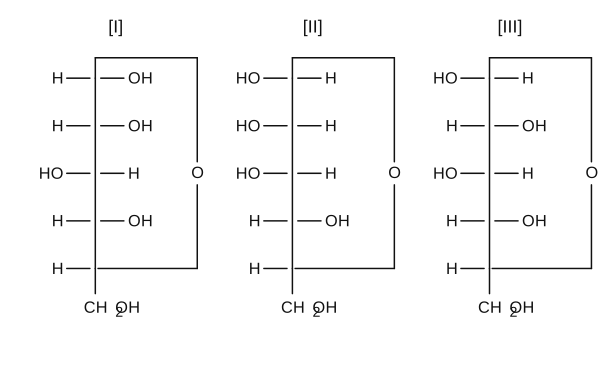
›Reveal solutionSolution
[I] and [III] differ only at the anomeric carbon C1 (identical at C2–C4), so they are anomers; [II] also differs at C2 and is not an anomer of either.
Definition: anomers are a special pair of epimers (cyclic monosaccharides) that differ in configuration only at the anomeric carbon (C1, the former carbonyl carbon).
Compare the structures at C1–C4 (left/right substituents):
- [I]: C1 = H/OH, C2 = H/OH, C3 = HO/H, C4 = H/OH
- [III]: C1 = HO/H, C2 = H/OH, C3 = HO/H, C4 = H/OH
- [II]: C1 = HO/H, C2 = HO/H, C3 = HO/H, C4 = H/OH …
- COMEDK 2023Set 2023-M1 markMCQQ.Pick out the incorrect statement(s) from the following. 1. Glucose exists in two different crystalline forms, α-D-glucose and β-D-glucose. 2. α-D-glucose and β-D-glucose are anomers. 3. α-D-glucose and β-D-glucose are enantiomers. 4. Cellulose is a straight chain polysaccharide made of only β-D-glucose units. 5. Starch is a mixture of amylase and amylopectin, both contain unbranched chain of α-D-glucose units. (A) 1 and 2 only (B) 2 and 3 only (C) 3 and 4 only (D) 3 and 5 only
›Reveal solutionSolution
Statements 3 (anomers, not enantiomers) and 5 (amylopectin is branched) are the incorrect ones.
Evaluating each statement:
- Glucose exists as two crystalline forms α- and β-D-glucose — correct.
- α- and β-D-glucose are anomers (differ only in configuration at the anomeric C-1) — correct.
- α- and β-D-glucose are enantiomers — incorrect; they are anomers/diastereomers, not mirror images.
- Cellulose is a straight (unbranched) chain of only β-D-glucose units — correct. …
- KCET 2020Set A-11 markMCQQ.C1−C4 glycosidic bond is NOT found in (A) starch (B) maltose (C) sucrose (D) lactose
›Reveal solutionSolution
A C1−C4 glycosidic bond links carbon-1 of one sugar to carbon-4 of another. Sucrose has a C1−C2 bond instead, so it is the one that does not contain a C1−C4 linkage. The correct option is (C).
The key to this question is understanding what a glycosidic bond is and how the numbering of carbon atoms works in sugars. A glycosidic bond is a covalent bond that joins a carbohydrate molecule to another group, which could be another carbohydrate. The notation C1−C4 tells us exactly which carbon atoms are involved: the anomeric carbon (C1) of one monosaccharide is linked to the C4 carbon of another.
Let's check each option.
-
Starch is a polymer of glucose. The main linkage in starch (both amylose and amylopectin) is an α-1,4-glycosidic bond — that is, a C1−C4 bond. So starch definitely contains this bond.
-
Maltose is a disaccharide made of two glucose units. They are joined by an α-1,4-glycosidic bond. Again, this is a C1−C4 linkage.
-
Sucrose is a disaccharide of glucose and fructose. The glycosidic bond here is between the C1 of glucose and the C2 of fructose. This is a C1−C2 bond, not C1−C4. This is the odd one out.
-
Lactose is a disaccharide of galactose and glucose. The bond is a β-1,4-glycosidic bond — the C1 of galactose links to the C4 of glucose. So it does have a C1−C4 linkage. …
-
- KCET 2020Set A-11 markMCQQ.Which of the following monomers can undergo condensation polymerization ? (A) Propene (B) Styrene (C) Glycine (D) Isoprene
›Reveal solutionSolution
Condensation polymerisation requires a bifunctional monomer; only glycine carries two functional groups (−NH2 and −COOH) and can polymerise with loss of water.
Step 1 — The two modes of polymerisation (the concept).
- Addition polymerisation: monomers must contain a multiple bond (usually C=C). The π bond opens and the units simply add on; nothing is eliminated, so the polymer's empirical formula equals the monomer's. (Polythene, PVC, polystyrene, rubber.)
- Condensation polymerisation: monomers must be bi- or poly-functional — carrying two reactive groups such as −OH, −COOH, −NH2. Repeated condensation between these groups builds the chain and eliminates a small molecule (usually H2O, sometimes HCl or CH3OH). (Nylon-6,6, Terylene, Bakelite.)
So the question is really: which monomer has two functional groups rather than a double bond?
Step 2 — Examine each option.
- (A) Propene, CH3−CH=CH2 — a single C=C, no functional groups → addition polymerisation → polypropylene.
- (B) Styrene, C6H5−CH=CH2 — vinyl double bond → addition → polystyrene.
- (C) Glycine, H2N−CH2−COOH — an α-amino acid carrying two different functional groups: an amino group −NH2 and a carboxyl group −COOH. ✓ …
- KCET 2018Set A-11 markMCQQ.The two forms of D-Glucopyranose are called (A) Diastereomers (B) Anomers (C) Epimers (D) Enantiomers
›Reveal solutionSolution
The two forms of D-glucopyranose differ only at the anomeric carbon (C1) when the ring closes, making them anomers — the correct answer is (B).
The concept: why the ring creates a special pair
D-Glucose exists predominantly as a six-membered pyranose ring. When the open-chain aldehyde form cyclises, the carbonyl carbon (C1) becomes a new chiral centre — the anomeric carbon. The two possible configurations at this carbon (OH pointing down or up in the standard Haworth projection) give rise to α and β forms. These are not mirror images, nor do they differ at any other single carbon; they are a specific subclass of diastereomers called anomers.
Watch outA common mistake is to confuse anomers with epimers. Epimers differ at any one chiral carbon except the anomeric carbon. Anomers differ only at the anomeric carbon — that is the defining feature.
Step-by-step reasoning
-
Identify the two forms.
D-Glucopyranose exists as α-D-glucopyranose and β-D-glucopyranose. In the α form, the OH at C1 is trans to the CH2OH group (axial in the chair conformation); in the β form, it is cis (equatorial).
-
Check the relationship.
- Are they mirror images? No — they are not enantiomers (option D).
- Do they differ at a single chiral carbon other than C1? No — they differ only at C1, so they are not epimers (option C). …
-
- KCET 2018Set A-11 markMCQQ.The glycosidic linkage involved in linking the glucose units in amylose part of starch is (A) C1−C4 β-linkage (B) C1−C6 α-linkage (C) C1−C6 β-linkage (D) C1−C4 α-linkage
›Reveal solutionSolution
Amylose is a linear polymer of glucose linked by C1−C4 α-glycosidic bonds. The correct option is (D).
The question is about the specific type of glycosidic bond that joins glucose units in amylose, which is the linear component of starch. Starch is a mixture of two polysaccharides: amylose (unbranched) and amylopectin (branched). The key is to recall the stereochemistry and position of the linkage.
Glucose can exist in two anomeric forms: α and β, depending on the orientation of the -OH group at carbon 1. In starch, the glucose units are all in the α-D-glucopyranose form. The linkage between them always involves carbon 1 of one glucose and a specific carbon of the next glucose.
-
Identify the structure of amylose. Amylose is a long, unbranched chain of glucose molecules. Each glucose is connected to the next by a bond that forms between the anomeric carbon (C1) of one unit and the hydroxyl group on carbon 4 of the next unit. This is a C1−C4 linkage.
-
Determine the stereochemistry of the bond. Because the glucose units in starch are α-D-glucose, the glycosidic bond is formed with the α configuration at C1. This means the oxygen bridge is oriented downward (in the standard Haworth projection) from C1. This is called an α-linkage. …
-
🎓Unlock everything free for 14 days
- ✓Full step-by-step solutions
- ✓Concept-first explanations
- ✓Methods, shortcuts & mistakes
- ✓PYQ mapping + timed mock tests
Full access for 14 days. No credit card required.