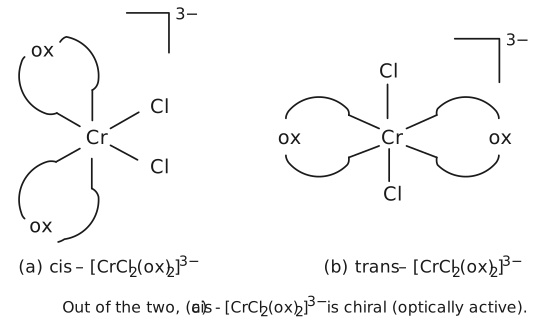
Q.Out of the following two coordination entities which is chiral (optically active)?
🔒You're viewing a preview — the full solution, concept, methods & PYQ mapping are locked.
🔒 Start your 14-day free trial to unlock the full solution →Concept understanding — Geometrical Isomerism Conditions
Geometrical Isomerism: The Intuition
Imagine you have two friends standing on opposite sides of a door. If the door is open, they can walk around and swap places easily — there's no real difference between who is on the left and who is on the right. But if the door is locked shut, they are stuck. One is permanently on the left side, the other on the right. That locked door creates two distinct arrangements: Friend A on the left, Friend B on the right versus Friend A on the right, Friend B on the left.
That locked door is the key idea behind geometrical isomerism.
In chemistry, molecules are three-dimensional. Atoms connected by a single bond can rotate freely — like an open door. But a double bond (or a ring structure) locks the atoms in place. If you have two different groups attached to each carbon of a double bond, you get two distinct spatial arrangements that cannot interconvert without breaking the bond. These are geometrical isomers (also called cis-trans or E-Z isomers).
The Precise Conditions
For a molecule to show geometrical isomerism, it must satisfy two conditions simultaneously:
Condition 1: There must be a restricted rotation around a bond — typically a carbon-carbon double bond (C=C) or a ring structure.
Condition 2: Each of the two atoms (or groups) involved in that restricted rotation must have two different substituents attached to it.
Let's unpack each.
Condition 1: Restricted Rotation
A single bond (C−C) allows free rotation — the atoms spin around the bond axis like a wheel. So no geometrical isomers exist there. A double bond (C=C) has a pi (π) bond that locks the molecule flat. Rotation would break the π bond, which requires a lot of energy (about 250–270 kJ/mol). At room temperature, this rotation simply does not happen.
Rings (like cyclopropane, cyclobutane, etc.) also restrict rotation because the ring is a closed loop — atoms cannot rotate past each other without breaking the ring.
Condition 2: Two Different Substituents on Each End
This is the "different groups" rule. Look at each carbon of the double bond (or each ring carbon involved). If both carbons have two different groups attached, geometrical isomers exist. If even one carbon has two identical groups, there is only one possible arrangement.
A common mistake: students check only one carbon. Both carbons must have two different substituents. If one carbon has two identical groups (like two hydrogens), the molecule is identical in both arrangements — no isomerism.
How to Check: A Step-by-Step Method
Take any molecule with a double bond. Follow these steps:
- Identify the double bond (or ring). Mark the two carbon atoms involved.
- List the two groups attached to the first carbon. Are they different from each other? If yes, proceed. If no → no geometrical isomerism.
- List the two groups attached to the second carbon. Are they different from each other? If yes → geometrical isomerism exists. If no → no geometrical isomerism.
If the two groups on a carbon are identical, the molecule is symmetric about that carbon. Flipping the other side gives the same molecule — no isomers.
Examples to Cement the Idea
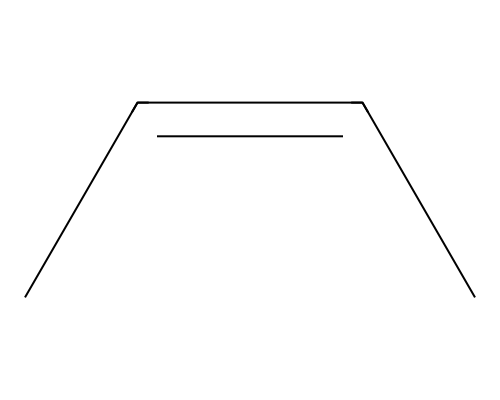
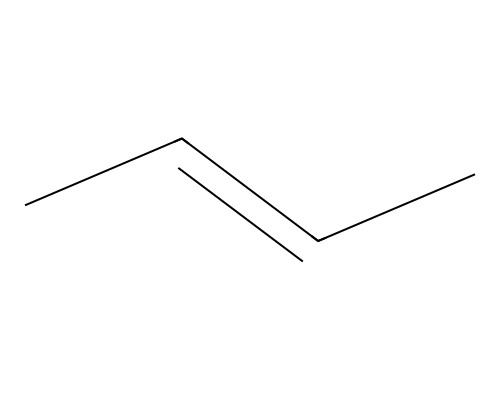
Example 1: But-2-ene (CH3CH=CHCH3)
- Carbon 1 of the double bond: attached to CH3 and H → different ✓
- Carbon 2 of the double bond: attached to CH3 and H → different ✓
Result: Two geometrical isomers exist — cis (both methyl groups on the same side) and trans (methyl groups on opposite sides).
Example 2: 1,2-Dichloroethene (ClCH=CHCl)
- Carbon 1: attached to Cl and H → different ✓
- Carbon 2: attached to Cl and H → different ✓
Result: cis and trans isomers exist.
Example 3: 1,1-Dichloroethene (Cl2C=CH2)
- Carbon 1: attached to Cl and Cl → identical ✗ …
Why this formula?
Geometrical Isomerism: Why the Conditions Hold
Geometrical isomerism (also called cis-trans or E-Z isomerism) arises when atoms or groups are arranged differently in space around a rigid part of a molecule — typically a double bond or a ring. The key is that rotation is restricted, so the spatial positions become fixed and distinct.
Let’s break down why the conditions are what they are.
1. The Core Requirement: Restricted Rotation
For two molecules to be geometrical isomers, they must have the same connectivity but different spatial arrangement due to a barrier to rotation.
- Double bonds (C=C): The π-bond locks the two carbons in place — rotation requires breaking the π-bond (energy ~250 kJ/mol), so it doesn’t happen at room temperature.
- Rings (e.g., cycloalkanes): The ring structure physically prevents free rotation about C–C single bonds within the ring.
Why this matters: Without restricted rotation, the molecule would freely interconvert between arrangements — no distinct isomers exist.
2. Condition 1: Two Different Groups on Each Carbon (for C=C)
Consider a general alkene:
C=C
Each carbon must have two different substituents (not counting the other carbon of the double bond).
Why?
- If one carbon has two identical groups (e.g., both H), then swapping the groups on that carbon produces the same molecule — no isomerism.
Example:
- 1,2-dichloroethene (ClHC=CHCl): Each carbon has H and Cl (different) → geometrical isomers exist.
- 1,1-dichloroethene (Cl2C=CH2): One carbon has two Cl (identical) → no geometrical isomers.
Formal condition:
For a C=C bond, geometrical isomerism is possible iff each doubly bonded carbon bears two different substituents.
3. Condition 2: For Rings — Similar Logic
In a ring (e.g., cyclopropane, cyclohexane), the ring itself restricts rotation. Here, geometrical isomerism occurs when two substituents on different ring carbons can be on the same side (cis) or opposite sides (trans).
Why?
- The ring is a closed loop — you cannot rotate one carbon relative to another without breaking bonds.
- If the two substituents are on different carbons, their relative orientation (same side / opposite sides) is fixed.
Condition:
- The ring must have at least two substituents (could be same or different) on different carbons.
- If both substituents are on the same carbon, swapping them doesn’t change the molecule (no isomerism).
Example:
- 1,2-dimethylcyclopropane: Two methyl groups on adjacent carbons → cis and trans isomers exist.
- 1,1-dimethylcyclopropane: Both methyls on same carbon → no geometrical isomerism.
4. The E-Z Notation (Why It’s Needed)
When the four substituents on a C=C are all different, cis-trans naming fails. The Cahn-Ingold-Prelog priority rules assign E (opposite sides) or Z (same side).
Why this works:
- Priority is based on atomic number (higher = higher priority). …
Concept: Geometrical isomerism and chirality in octahedral complexes — a complex is chiral if it lacks any improper axis of rotation (Sn), i.e., it is non-superimposable on its mirror image.
Reasoning:
- Both complexes are octahedral with two identical monodentate ligands (Cl) and two identical bidentate ligands (oxalate, ox). The key difference is the relative positions of the Cl ligands: cis (adjacent, 90°) or trans (opposite, 180°). …
Optical activity in coordination compounds arises from the absence of a plane of symmetry. For the complex [CrCl2(ox)2]3−, the cis isomer lacks any symmetry plane and is chiral, while the trans isomer has a plane of symmetry and is achiral. The chiral entity is (a).
Why Chirality Matters in Coordination Chemistry
A molecule is chiral (optically active) if it is non-superimposable on its mirror image. In coordination chemistry, this usually happens when the complex lacks an improper axis of rotation — most commonly, a plane of symmetry or a centre of inversion. For octahedral complexes with bidentate ligands, chirality often appears when the arrangement of ligands creates a "handedness," like a left-handed vs. right-handed screw.
The key question here: does the cis or trans isomer of [CrCl2(ox)2]3− have a plane of symmetry? The oxalate ion (ox2−) is a bidentate ligand — it binds through two oxygen atoms, forming a five-membered chelate ring. Chromium(III) is in the +3 oxidation state, and the complex is octahedral.
Step-by-Step Analysis
-
Draw the cis isomer.
In the cis arrangement, the two chloride ligands are adjacent (90° apart). The two oxalate ligands occupy the remaining four positions. Each oxalate spans two adjacent sites, forming a chelate ring.
Visualise the structure: imagine the two Cl atoms at, say, positions 1 and 2 of an octahedron. One oxalate can occupy positions 3 and 4, the other oxalate positions 5 and 6.
Now check for symmetry: is there any plane that cuts through the molecule and reflects one half onto the other?
- A plane containing the two Cl atoms and the metal centre? That plane would cut through the oxalate rings — but the rings are not symmetric about that plane because each oxalate is a flat, planar unit that lies at an angle.
- A plane perpendicular to the Cl–Cr–Cl axis? The two oxalates are oriented differently; one is "above" and one "below" relative to any such plane. In fact, the cis isomer has no plane of symmetry and no centre of inversion. Its mirror image cannot be superimposed on the original — it is chiral. This is analogous to the classic case of cis−[Co(en)2Cl2]+, which is optically active.
-
Draw the trans isomer.
In the trans arrangement, the two chloride ligands are opposite each other (180° apart). The two oxalate ligands then occupy the four equatorial positions in a plane.
Now look for symmetry:
- There is a plane of symmetry that contains the two Cl atoms and the metal centre, and bisects the angle between the two oxalate ligands. This plane cuts through the centre of each oxalate ring, reflecting one half of the molecule onto the other.
- Additionally, there is a centre of inversion at the chromium atom. …
Method: Symmetry & Mirror Image Test for Optical Activity
Concept: A coordination compound is chiral (optically active) if it lacks any plane of symmetry, centre of symmetry, or improper rotation axis — i.e., it is non-superimposable on its mirror image.
Step 1 — Draw the structures
Both complexes have:
- Central metal: Cr3+
- Ligands: two Cl− (monodentate) and two ox2− (bidentate, oxalate)
- Coordination number = 6 → octahedral geometry
(a) cis-[CrCl2(ox)2]3−
- Two Cl are adjacent (90° apart)
- Two oxalate rings occupy the remaining four positions
(b) trans-[CrCl2(ox)2]3−
- Two Cl are opposite (180° apart)
- Two oxalate rings lie in the equatorial plane
Step 2 — Check for plane of symmetry
| Complex | Plane of symmetry? | Result |
|---|---|---|
| cis | ✗ No plane of symmetry — the two oxalate rings are twisted relative to each other | Chiral |
| trans | ✓ Yes — a plane passes through both Cl atoms and bisects the oxalate rings | Achiral |
Step 3 — Mirror image test …
Common Mistakes & How to Avoid Them
Mistake 1: Assuming all cis-isomers are chiral
The error: Students often memorise "cis = chiral, trans = achiral" as a blanket rule. This is not always true — it depends on the symmetry of the complex.
Why it fails here:
In [CrCl2(ox)2]3−, the oxalate ligand (ox) is a bidentate ligand. In the cis-isomer, the two oxalate rings lie in different planes, and the complex has no plane of symmetry — so it is chiral.
But if the bidentate ligand were symmetrical and planar (like oxalate), the trans-isomer can still have a plane of symmetry.
How to avoid:
- Never rely on "cis = chiral" blindly.
- Always draw the structure and check for:
- A plane of symmetry
- A centre of inversion
- An improper axis of rotation (Sn)
Mistake 2: Forgetting that bidentate ligands create rings
The error: Students treat [CrCl2(ox)2]3− as if it were [CrCl2(A−A)2] where A−A is just two donor atoms — ignoring that the oxalate backbone locks the geometry.
Why it matters:
Oxalate (CX2OX4X2−) is a rigid, planar bidentate ligand. In the cis isomer, the two oxalate rings are not coplanar — they are oriented at an angle, breaking symmetry.
In the trans isomer, the two oxalate rings lie in the same plane, giving a plane of symmetry.
How to avoid:
- Always sketch the chelate rings — don't just draw dots for donor atoms.
- Remember: bidentate ligands restrict rotation and create ring planes that affect symmetry.
Mistake 3: Confusing optical activity with geometric isomerism
The error: Students think "cis and trans are geometric isomers, so optical activity is separate" — and then forget to check chirality within each geometric isomer.
The truth:
- Geometric isomerism (cis/trans) is about different spatial arrangements of identical ligands.
- Optical activity is about non-superimposable mirror images (chirality).
- A complex can be cis but achiral (if it has a plane of symmetry) or trans but chiral (rare, but possible with asymmetric ligands).
How to avoid:
- Treat chirality as a separate check after identifying cis/trans.
- For each geometric isomer, ask: Does this structure have any symmetry element that makes it superimposable on its mirror image?
Mistake 4: Not drawing the mirror image and checking superimposability
The error: Students try to decide chirality by "looking" at the formula or by vague memory.
The fix:
- Draw the complex in 3D (use wedge-dash or Fischer-type projection).
- Draw its mirror image.
- Try to rotate the mirror image to see if it matches the original.
- If no rotation makes them identical → chiral.
For this question: …
- COMEDK 2026Set 2026-A1 markMCQQ.Which one of the following complex-isomerism pair matches correctly? (A) [CrCl2(ox)2]3− - Exhibits cis- trans isomerism and cis isomer is optically active (B) [PtCl2(NH3)2] - Exhibits both cis- trans and optical isomerism (C) [Fe(CN)4(NH3)2]−- Exhibits cis- trans isomerism and both exhibit optical isomerism (D) [Cr(C2O4)3]3− - Exhibits cis- trans isomerism but is optically inactive
›Reveal solutionSolution
The key is to check each complex for possible geometric (cis/trans) and optical isomerism based on its coordination geometry and ligand arrangement. Only option (A) correctly pairs a complex that exhibits cis-trans isomerism with the cis isomer being optically active.
-
Understand the coordination geometries and isomerism rules
- For octahedral complexes with two identical bidentate ligands (like oxalate, ox²⁻) and two monodentate ligands, the two monodentate ligands can be adjacent (cis) or opposite (trans).
- Optical activity arises when the complex lacks a plane of symmetry — the cis isomer of such a complex is often chiral (non-superimposable mirror image), while the trans isomer is usually achiral.
-
Analyze option (A): [CrCl2(ox)2]3−
- Chromium(III) is octahedral. Two oxalate (ox²⁻) ligands are bidentate, occupying four coordination sites. The two chloride ligands occupy the remaining two sites.
- The two Cl⁻ can be cis (adjacent) or trans (opposite). So cis-trans isomerism exists.
- The cis isomer has no plane of symmetry (the two oxalate rings create a chiral arrangement), so it is optically active. The trans isomer has a plane of symmetry and is optically inactive.
- This matches the statement exactly.
-
Analyze option (B): [PtCl2(NH3)2]
- Platinum(II) is square planar. It exhibits cis-trans isomerism (cis and trans isomers are well-known).
- However, square planar complexes with two identical monodentate ligands and two identical other monodentate ligands are never optically active — they have a plane of symmetry in both isomers.
- So the claim “exhibits both cis-trans and optical isomerism” is false.
-
Analyze option (C): [Fe(CN)4(NH3)2]−
- Iron in this complex is likely low-spin Fe(II) or Fe(III), octahedral. Four CN⁻ and two NH₃ ligands.
- The two NH₃ can be cis or trans, so cis-trans isomerism is possible.
- However, the cis isomer of an octahedral complex with four identical monodentate ligands and two identical others does have a plane of symmetry (the plane containing the two NH₃ and two opposite CN⁻). Thus, neither cis nor trans is chiral.
- The statement “both exhibit optical isomerism” is false. …
-
- COMEDK 2026Set 2026-M1 markMCQQ. Match the Coordination compounds in Column I with the type of stereoisomerism given in Column II exhibited by them. .tg {border-collapse:collapse;border-spacing:0;} .tg td{border-color:black;border-style:solid;border-width:1px;font-family:Arial, sans-serif;font-size:14px; overflow:hidden;padding:10px 5px;word-break:normal;} .tg th{border-color:black;border-style:solid;border-width:1px;font-family:Arial, sans-serif;font-size:14px; font-weight:normal;overflow:hidden;padding:10px 5px;word-break:normal;} .tg .tg-baqh{text-align:center;vertical-align:top} Column I Column I A [Pt(NH3)2Cl2] P fac-mer B Ni[(NH3)2Cl2] Q cis -trans C [Co(NH3)3(NO2)3] R only cis isomer shows optical isomerism D [PtCl2(en)2]2+ S does not exhibit isomerism. (A) A−SB−RC−QD−P (B) A−SB−PC−QD−R (C) A−QB−SC−OD−R (D) A−RB−PC−SD−Q
›Reveal solutionSolution
The key is to identify the geometry and ligand arrangement of each complex, then match it to the stereoisomerism type: square planar [Pt(NH₃)₂Cl₂] shows cis‑trans; tetrahedral Ni[(NH₃)₂Cl₂] is achiral and shows no isomerism; octahedral [Co(NH₃)₃(NO₂)₃] gives fac‑mer; and octahedral [PtCl₂(en)₂]²⁺ has only the cis isomer optically active. The correct match is A‑Q, B‑S, C‑P, D‑R, which corresponds to option (C).
Concept & Intuition
Stereoisomerism in coordination compounds depends on the coordination number, geometry, and the symmetry of the ligand arrangement.
- Square planar complexes (d⁸ metals like Pt²⁺) with two identical bidentate or two pairs of monodentate ligands can show cis‑trans isomerism.
- Tetrahedral complexes (like Ni²⁺ with four monodentate ligands) are almost always achiral and show no stereoisomerism because all vertices are equivalent.
- Octahedral complexes with three identical and three different monodentate ligands (MA₃B₃ type) exhibit fac‑mer isomerism.
- Octahedral complexes with a bidentate ligand (like en) and two identical monodentate ligands can show cis‑trans isomerism, and only the cis form is chiral (optical isomerism).
Step‑by‑Step Reasoning
-
Complex A: [Pt(NH₃)₂Cl₂]
- Pt²⁺ is d⁸, so the geometry is square planar.
- Two NH₃ and two Cl⁻ ligands can be arranged adjacent (cis) or opposite (trans).
- This is classic cis‑trans isomerism.
- Match: A → Q.
-
Complex B: Ni[(NH₃)₂Cl₂]
- Ni²⁺ in this formulation (no charge shown, but neutral) is typically tetrahedral (common for Ni²⁺ with four monodentate ligands).
- In a tetrahedron, all four positions are equivalent; swapping two identical ligands gives the same compound.
- No cis/trans, no fac/mer, no optical activity.
- Match: B → S (does not exhibit isomerism).
-
Complex C: [Co(NH₃)₃(NO₂)₃]
- Co³⁺ is d⁶, almost always octahedral.
- Three NH₃ and three NO₂⁻ ligands: this is an MA₃B₃ type.
- The three identical ligands can occupy a face of the octahedron (fac) or a meridian (mer).
- Match: C → P (fac‑mer).
-
Complex D: [PtCl₂(en)₂]²⁺ …
- COMEDK 2025Set 2025-A1 markMCQQ.Choose the coordination compound which does not exhibit Optical activity. (A) cis −[PtCl2(en)2]2+ (B) [Co(en)3]3+ (C) trans −[CoCl2(en)2]+ (D) cis −[CoCl2(en)2]+
›Reveal solutionSolution
Optical activity requires a molecule to be chiral (non‑superimposable on its mirror image). Among the given complexes, only the trans isomer of [CoCl2(en)2]+ has a plane of symmetry, making it achiral and thus optically inactive. The correct option is (C).
Concept & Intuition
Optical activity arises when a molecule lacks an improper rotation axis (i.e., it is chiral). For coordination compounds, chirality often comes from chelate rings that create a helical or propeller‑like arrangement with no plane or center of symmetry. The key is to check whether the complex has a mirror plane or a center of inversion — if it does, it cannot be optically active. Here, all complexes contain the bidentate ligand ethylenediamine (en), which forms five‑membered chelate rings. The cis/trans geometry and the number of chelate rings determine symmetry.
Step‑by‑step reasoning
-
Analyze (A): cis‑[PtCl2(en)2]2+
- Pt(IV) is octahedral. Two en ligands and two Cl⁻ ions. In the cis isomer, the two Cl⁻ are adjacent.
- The two en chelate rings create a chiral arrangement: the complex has no plane of symmetry (the chelate rings are not coplanar) and no center of inversion.
- It exists as a pair of non‑superimposable mirror images (Δ and Λ isomers).
- Conclusion: This complex is optically active.
-
Analyze (B): [Co(en)3]3+
- Co(III) is octahedral with three bidentate en ligands. This is a classic example of a chiral complex.
- The three chelate rings form a propeller shape (like a three‑bladed fan). There is no plane or center of symmetry.
- It is well‑known to exist as Δ and Λ enantiomers.
- Conclusion: This complex is optically active.
-
Analyze (C): trans‑[CoCl2(en)2]+
- Co(III) octahedral with two en ligands and two Cl⁻ ions. In the trans isomer, the two Cl⁻ are opposite each other (180° apart).
- The two en ligands lie in a plane; the Cl⁻ atoms are on the axis perpendicular to that plane.
- The molecule has a plane of symmetry that bisects the en ligands and contains the Co–Cl bonds. …
-
- COMEDK 2025Set 2025-M1 markMCQQ.Which one of the following coordination compounds will exhibit both geometrical and optical isomerism? (A) [Cr(ox)3]3− (B) [Co(en)2Cl2]+ (C) [Co(CN)6]3− (D) [Co(NO3)3(NH3)3]
›Reveal solutionSolution
The key is to identify a complex that can exist as non-superimposable mirror images (optical isomerism) while also having non-identical spatial arrangements of ligands (geometrical isomerism). Only (B) [Co(en)2Cl2]+ satisfies both: it has cis/trans geometrical isomers, and the cis form is chiral.
Concept & Intuition
Geometrical isomerism arises when ligands can occupy different positions around the metal (e.g., cis vs. trans in an octahedral complex). Optical isomerism requires the complex to lack a plane of symmetry, so its mirror image is non-superimposable — like left and right hands. For a complex to show both, it must have at least two different arrangements of ligands (geometrical isomers), and at least one of those arrangements must be chiral. We check each option for these conditions.
Step-by-step reasoning
-
Option (A): [Cr(ox)3]3−
- ox = oxalate (C2O42−), a bidentate ligand.
- The complex is octahedral with three identical bidentate ligands.
- All three oxalate ligands are equivalent; there is no possibility of different ligand arrangements (no cis/trans).
- However, the complex is chiral (like the [M(AA)3] type) and shows optical isomerism.
- Conclusion: Geometrical isomerism is absent, so this fails.
-
Option (B): [Co(en)2Cl2]+
- en = ethylenediamine (bidentate), Cl = monodentate.
- The two Cl ligands can be adjacent (cis) or opposite (trans) — this gives geometrical isomerism.
- The trans isomer has a plane of symmetry (the Co–Cl–Co axis and the en ligands lie in a plane), so it is achiral.
- The cis isomer has no plane of symmetry: the two en rings create a helical twist, and the mirror image cannot be rotated to match the original. Hence the cis form is chiral and shows optical isomerism.
- Conclusion: Both geometrical and optical isomerism exist (cis isomer is optically active). This works.
-
Option (C): [Co(CN)6]3−
- All six ligands are identical monodentate CN⁻.
- Only one possible arrangement (no geometrical isomers).
- The complex has many planes of symmetry (e.g., through opposite CN groups), so it is achiral.
- Conclusion: Neither type of isomerism occurs.
-
Option (D): [Co(NO3)3(NH3)3]
- Here NO3− is monodentate (bonded through oxygen). …
-
- COMEDK 2024Set 2024-E1 markMCQQ.Which of the following 2 compounds exhibit both Geometrical and Structural isomerism? A=[Co(NH3)4Cl2]NO2 B=[Co(NH3)Br]SO4C=[Co(NH3)3(NO2)3]D=[Cr(H2O)6]Cl3 (A) A & C (B) C & B (C) B & D (D) A & B
›Reveal solutionSolution
The key is to identify which complexes can show both geometrical (cis/trans) isomerism and structural (ionization) isomerism. Only A and C satisfy both conditions, so the correct option is (A).
Concept & Intuition
Geometrical isomerism arises when ligands can occupy different spatial positions around a metal center (e.g., cis/trans in octahedral complexes with two identical ligands). Structural isomerism here refers to ionization isomerism — where the counter ion and a ligand exchange places, giving different ions in solution. We must check each complex for both possibilities.
Step-by-step reasoning
-
Complex A: [Co(NH3)4Cl2]NO2
- The coordination sphere is [Co(NH3)4Cl2]+ with NO2− as counter ion.
- Geometrical isomerism: With four NH3 and two Cl ligands in an octahedral geometry, the two chlorines can be cis (adjacent) or trans (opposite). So yes, geometrical isomers exist.
- Structural (ionization) isomerism: The NO2− could swap with a Cl− to give [Co(NH3)4(NO2)Cl]Cl — a different compound with different ions. So ionization isomerism is possible.
- Conclusion: A exhibits both.
-
Complex B: [Co(NH3)Br]SO4
- The formula suggests a coordination sphere with one NH3 and one Br− (likely [Co(NH3)Br]+), but cobalt(III) typically has coordination number 6. This formula is unrealistic — it likely means [Co(NH3)5Br]SO4 (a common typo in such problems).
- Assuming the intended formula is [Co(NH3)5Br]SO4:
- Geometrical isomerism: With five identical NH3 and one Br, no cis/trans isomerism is possible (only one arrangement).
- Structural isomerism: SO42− could replace Br− to give [Co(NH3)5SO4]Br — ionization isomerism is possible.
- So B shows only structural isomerism, not geometrical.
-
Complex C: [Co(NH3)3(NO2)3]
- This is a neutral complex (no counter ion).
- Geometrical isomerism: With three NH3 and three NO2 ligands, two geometrical isomers exist: fac (all three identical ligands on one face) and mer (three in a meridian). So yes. …
-
- COMEDK 2024Set 2024-M1 markMCQQ.Choose the incorrect statement from the following. (A) A tetrahedral complex of the type [Ma2b2] does not show geometrical isomerism (B) Coordination entities of the type [Ma3b3] do not exhibit geometrical isomerism (C) Square planar complex of the type [Mabcd] has 3 possible geometrical isomers (D) In a coordination entity of the type [Ma2(bb)2]2+ only the cis-isomer is optically active
›Reveal solutionSolution
The key is to recall the conditions for geometrical and optical isomerism in coordination complexes. The incorrect statement is (B), because octahedral [Ma3b3] complexes do exhibit geometrical isomerism (fac and mer forms).
The question tests your understanding of isomerism in coordination compounds — specifically, when geometrical (cis/trans, fac/mer) and optical isomers are possible. Let’s examine each statement carefully.
-
Statement (A): A tetrahedral complex of the type [Ma2b2] does not show geometrical isomerism.
Tetrahedral complexes have all four ligands at the vertices of a tetrahedron. In [Ma2b2], any two identical ligands are always adjacent (there is no “opposite” position as in a square). Rotating the molecule gives the same arrangement — all possible placements are equivalent. So no geometrical isomers exist. This statement is correct.
-
Statement (B): Coordination entities of the type [Ma3b3] do not exhibit geometrical isomerism.
For an octahedral complex with three identical ligands (a) and three others (b), two distinct arrangements are possible:
- fac (facial): the three a ligands occupy one face of the octahedron (all mutually adjacent).
- mer (meridional): the three a ligands lie in a plane that goes through the metal, with two opposite and one in between. These are geometrical isomers. So this statement is false — it claims they do not exhibit geometrical isomerism, but they do.
-
Statement (C): Square planar complex of the type [Mabcd] has 3 possible geometrical isomers.
In a square planar complex with four different ligands, the number of distinct arrangements (ignoring mirror images) is given by (4−1)!/2=3 (since rotations and reflections are considered the same). These correspond to placing each ligand in turn at a fixed reference position and arranging the other three. So 3 isomers is correct.
-
Statement (D): In a coordination entity of the type [Ma2(bb)2]2+ only the cis-isomer is optically active. …
-
- COMEDK 2023Set 2023-E1 markMCQQ.Which one of the following is an incorrect statement pertaining to the properties of Coordination compounds? (A) A square planar complex of the type Mabcd, where a, b, c and d are unidentate ligands, exhibits geometrical isomerism and exists in one cis-form and two trans-forms. (B) [Co(NH3)5NO2] Cl2 exists in 2 forms, the red form and the yellow form which are linkage isomers. (C) [Fe(CN)6]3− is called a Low spin complex. (D) Out of cis- [CrCl2(ox)2]3− and trans- [CrCl2(ox)2]3−, the trans isomer is optically inactive.
›Reveal solutionSolution
The incorrect statement is (A): a square-planar Mabcd complex gives three geometrical isomers (each defined by which ligand is trans to a chosen one), not "one cis-form and two trans-forms." The other three statements are all correct.
Option (A) — incorrect. For square-planar [Mabcd] there are three geometrical isomers, obtained by placing each of b, c, d trans to a. Describing them as "one cis-form and two trans-forms" mis-states the isomerism, so this statement is wrong.
Option (B) — correct. [Co(NH3)5NO2]Cl2 exists as the yellow nitro (−NO2, N-bonded) and red nitrito (−ONO, O-bonded) linkage isomers.
Option (C) — correct. CN− is a strong-field ligand; with Fe3+ (d5) it forces electron pairing, giving a low-spin complex. …
- COMEDK 2023Set 2023-E1 markMCQQ.Which one of the following Coordination entities exhibits Facial and Meridional isomerism? (A) [Co(H2O)3(NO2)3] (B) [Co( en )2Cl2]+ (C) [Co(NH3)4Br2]NO3 (D) [Co( en )3]Cl3
›Reveal solutionSolution
fac–mer isomerism requires an octahedral Ma3b3 complex. Only [Co(H2O)3(NO2)3] has three of each monodentate ligand, so it shows facial and meridional isomers.
fac–mer isomerism occurs in octahedral complexes of type Ma3b3: the three like ligands can occupy one triangular face (facial) or a meridian (meridional).
- (A) [Co(H2O)3(NO2)3] — Ma3b3 type ⇒ shows fac and mer isomers. ✓
- (B) [Co(en)2Cl2]+ — M(AA)2b2 ⇒ cis/trans (and optical), not fac/mer. …
- COMEDK 2023Set 2023-M1 markMCQQ.The complex [PtCl2(en)2]2+ ion shows (A) structural isomerism (B) geometrical isomerism only (C) optical isomerism only (D) geometrical and optical isomerism
›Reveal solutionSolution
The octahedral [PtCl2(en)2]2+ ion can be cis or trans (geometrical isomerism), and the cis isomer lacks a plane of symmetry so it is optically active — hence it displays both geometrical and optical isomerism.
The complex has Pt bonded to two Cl− ligands and two bidentate ethylenediamine (en) ligands, giving a coordination number of 6 (octahedral).
- Geometrical isomerism: the two Cl− can be adjacent (cis) or opposite (trans). …
- COMEDK 2023Set 2023-M1 markMCQQ.Which of the following complex show optical isomerism?(i) cis−[COCl(en)2(NH3)]2+(ii) cis−[CrCl2(ox)2]3−(iii) cis−[CO(en)2Cl2]Cl(iv) cis−[CO(NH3)4Cl2]+ (A) (i), (ii),(iii) (B) (i),(ii) (C) (i),(iv) (D) (i), (ii), (iv)
›Reveal solutionSolution
Octahedral complexes with two (or more) cis bidentate chelate rings are chiral. Species (i), (ii) and (iii) meet this, while (iv), having only monodentate ligands, has a mirror plane and is achiral.
A complex shows optical isomerism only if it lacks any improper symmetry element (plane / centre of symmetry) — typically cis-[M(AA)2X2] or cis-[M(AA)2XY] types with bidentate chelates.
- cis-[CoCl(en)2(NH3)]2+: two en chelates in a cis, unsymmetrical arrangement ⇒ chiral. ✓
- cis-[CrCl2(ox)2]3−: two oxalate chelates cis to each other ⇒ chiral (classic cis-[M(AA)2X2]). ✓ …
- COMEDK 2022Set 20221 markMCQQ.The complex which does not show optical isomerism is (A) cis −[Co(en)2Cl2]Cl (B) cis −[CrCl2(ox)2]3− (C) cis −[CoCl(en)2(NH3)]2+ (D) cis −[Co(NH3)4Cl2]+
›Reveal solutionSolution
(A) cis-[Co(en)2Cl2]+ : cis-bis(chelate) - non-superimposable on its mirror image -> OPTICALLY ACTIVE. (B) cis-[CrCl2(ox)2]^3- : cis-bis(chelate) -> OPTICALLY ACTIVE. (C) cis-[CoCl(en)2(NH3)]^2+ : again cis-bis(en) -> OPTICALLY ACTIVE. (D) cis-[Co(NH3)4Cl2]+ : only monodentate ligands. The cis isomer possesses a plane of symmetry (the plane containing the two Cl and two of the NH3), so it is superimposable on its mirror image -> NOT optically active.
Concept: Optical isomerism in octahedral complexes requires the absence of a plane (or centre) of symmetry. Bidentate chelate rings (en, ox) in the cis arrangement destroy the mirror plane; complexes with only monodentate ligands of type [M(A)4B2] retain a plane.
(A) cis-[Co(en)2Cl2]+ : cis-bis(chelate) - non-superimposable on its mirror image -> OPTICALLY ACTIVE.
(B) cis-[CrCl2(ox)2]^3- : cis-bis(chelate) -> OPTICALLY ACTIVE. …
- KCET 2021Set B-21 markMCQQ.In Chrysoberyl, a compound containing Beryllium, Aluminium and oxygen, oxide ions form cubic close packed structure. Aluminium ions occupy 41th of tetrahedral voids and Beryllium ions occupy 41th of octahedral voids. The formula of the compound is (A) BeAlO4 (B) BeAl2O4 (C) Be2AlO2 (D) BeAlO2
›Reveal solutionSolution
Count the voids per ccp anion (2 tetrahedral, 1 octahedral), take the stated fractions, and reduce the resulting ratio to the simplest whole numbers.
Step 1 — The void-counting rule for close packing
In any close-packed arrangement (ccp/fcc or hcp) of N spheres:
- number of octahedral voids =N
- number of tetrahedral voids =2N
This is the single fact the whole problem rests on. (Each sphere contributes one octahedral void and two tetrahedral voids to the lattice.)
Step 2 — Set up with N oxide ions
Let the ccp lattice contain N ions of O2−.
Tetrahedral voids=2N,Octahedral voids=N
Step 3 — Fill the voids as stated
Aluminium occupies 41 of the tetrahedral voids:
nAl=41×2N=2N
Beryllium occupies 41 of the octahedral voids:
nBe=41×N=4N
Step 4 — Form the ratio
Be:Al:O=4N:2N:N
Multiply throughout by N4 to clear fractions:
=1:2:4
∴ Formula=BeAl2O4
Step 5 — Check electrical neutrality (an independent confirmation) …
🎓Unlock everything free for 14 days
- ✓Full step-by-step solutions
- ✓Concept-first explanations
- ✓Methods, shortcuts & mistakes
- ✓PYQ mapping + timed mock tests
Full access for 14 days. No credit card required.