Q.Assertion: When NaCl is added to water a depression in freezing point is observed. Reason: The lowering of vapour pressure of a solution causes depression in the freezing point. Choose the correct option:
🔒You're viewing a preview — the full solution, concept, methods & PYQ mapping are locked.
🔒 Start your 14-day free trial to unlock the full solution →Concept understanding — Henrys Law
Henry's Law: The Physics of "Fizz"
Imagine you open a cold bottle of soda. You hear that familiar psshhht sound. Bubbles rush out. Now think: why were those bubbles inside the bottle in the first place? The liquid wasn't boiling. The answer is Henry's Law.
The Intuition: Gas Wants to Dissolve
Gases are just molecules flying around. When a gas touches a liquid, some of those molecules get "trapped" inside the liquid — they dissolve. But here's the key: the more you push on the gas, the more of it gets forced into the liquid.
Think of a crowded bus. If you push more people toward the door (higher pressure), more people get squeezed inside. If you let the pressure off (open the bottle), people rush out. That's exactly what happens with gas and liquid.
In the soda bottle, carbon dioxide gas is pumped in at high pressure. That pressure forces a huge amount of CO₂ to dissolve into the liquid. When you open the bottle, the pressure above the liquid drops to normal air pressure. Suddenly, the liquid can't hold all that CO₂ anymore — so it escapes as bubbles. That's the fizz.
The Precise Statement
Henry's Law says:
C=kH⋅P
Where:
- C = concentration of the dissolved gas in the liquid (usually mol/L or g/L)
- P = partial pressure of that gas above the liquid (usually atm or kPa)
- kH = Henry's law constant — a number that depends on the specific gas, the liquid, and the temperature
In words: At a constant temperature, the amount of gas that dissolves in a liquid is directly proportional to the partial pressure of that gas above the liquid.
What the Constant kH Tells You
kH is not universal. It's different for every gas-liquid pair. For example:
- CO₂ in water has a certain kH
- O₂ in water has a different kH (smaller — oxygen doesn't dissolve as easily)
Temperature matters too. Higher temperature means lower kH — gases become less soluble in hot liquids. That's why a warm soda goes flat faster than a cold one.
Henry's Law works only for dilute solutions and non-reacting gases. If the gas reacts chemically with the liquid (like HCl gas dissolving in water to form hydrochloric acid), Henry's Law does not apply — the concentration will be much higher than predicted.
Real-Life Examples
| Situation | What Henry's Law explains |
|---|---|
| Soda fizz | High pressure forces CO₂ in; releasing pressure lets it out |
Why this formula?
Henry's Law: Why the Formula Holds
Henry's Law describes the solubility of a gas in a liquid at a constant temperature. The key formula is:
P=kH⋅x
Where:
- P = partial pressure of the gas above the liquid
- x = mole fraction of the gas dissolved in the liquid
- kH = Henry's constant (depends on gas, liquid, and temperature)
Why This Linear Relationship Exists
1. Dynamic Equilibrium at the Interface
Imagine a gas above a liquid. At the molecular level:
- Gas molecules constantly strike the liquid surface and dissolve
- Dissolved molecules constantly escape back into the gas phase
At equilibrium, the rate of dissolution equals the rate of escape. This is a dynamic balance, not a static one.
2. The Driving Force for Dissolution
The rate at which gas molecules enter the liquid depends on:
- How many gas molecules hit the surface — this is proportional to the partial pressure P of the gas
- How easily they dissolve — this is captured by kH
So:
Ratedissolve∝P
3. The Driving Force for Escape
The rate at which dissolved molecules leave the liquid depends on:
- How many dissolved molecules are near the surface — this is proportional to the mole fraction x of the gas in the liquid
- How easily they escape — also captured by kH
So:
Rateescape∝x
4. Equating the Two Rates
At equilibrium:
Ratedissolve=Rateescape
Therefore:
P∝x
Introducing the proportionality constant kH:
P=kH⋅x
Why It's Linear (Not Exponential or Logarithmic)
The linearity arises because:
- No saturation effects at low concentrations — the molecules don't "crowd" each other
- Ideal behavior is assumed — gas molecules don't interact strongly with each other or with the solvent
- Temperature is constant — kH doesn't change …
The key idea is Henry’s Law (though here the relevant colligative property is freezing point depression, governed by Raoult’s law for vapour pressure lowering).
Reasoning:
- Adding NaCl to water produces a non-volatile solute, which lowers the vapour pressure of the solution compared to pure water (Raoult’s law).
- Lower vapour pressure means the solution must be cooled to a lower temperature to achieve the same vapour pressure as solid ice — this is the freezing point depression. …
Both the assertion and the reason are correct, and the reason is the correct explanation for the assertion. When NaCl is added to water, the vapour pressure of the solution is lowered, and this lowering of vapour pressure is precisely what causes the depression in freezing point. The correct option is (i).
Why this is straightforward cause-and-effect, not a trick question
This Assertion-Reason question can look tricky, because NaCl is an electrolyte and it's tempting to think the reason needs to mention dissociation to be complete. But the assertion only claims that a depression in freezing point is observed — it makes no claim about the exact size of the effect. The reason gives the general thermodynamic mechanism for why freezing point depression happens at all, and that mechanism is exactly correct and exactly what is happening with NaCl.
1. Is the assertion correct?
Yes. When NaCl dissolves in water, it dissociates into Na⁺ and Cl⁻ ions, increasing the number of solute particles in solution. Freezing point depression is a colligative property — it depends on the number of particles, not their identity. More particles in solution means the freezing point is measurably lower than that of pure water. So the assertion is true.
2. Is the reason correct?
Yes. The reason states: "The lowering of vapour pressure of a solution causes depression in the freezing point." This is the standard mechanism taught for freezing point depression: at the freezing point of the pure solvent, solid and liquid phases are in equilibrium (their vapour pressures match). Adding a non-volatile solute lowers the vapour pressure of the liquid phase. At the original freezing point, the liquid's vapour pressure is now lower than the solid's, so the solid begins to melt. To restore the solid–liquid equilibrium, the system must be cooled further — to a new, lower freezing point. This holds for any solute dissolved in the solvent, whether an electrolyte like NaCl or a non-electrolyte like glucose.
ΔTf=ΔHffusRTf2⋅xsolute
This relationship is derived directly from the equality of chemical potentials at equilibrium, and the vapour-pressure-lowering step (Raoult's law) is the key intermediate link in that derivation.
3. Does the reason correctly explain the assertion? …
Concept: Colligative Properties — Freezing Point Depression
The relevant concept is colligative properties, specifically freezing point depression. When a non-volatile solute (like NaCl) is added to a solvent (water), the vapour pressure of the solution decreases. This lowering of vapour pressure leads to a depression in the freezing point of the solution compared to the pure solvent.
Method: Cause-Effect Analysis for Assertion-Reason Questions
Steps:
-
Identify the Assertion (i)
- Statement: When NaCl is added to water, a depression in freezing point is observed.
- Check correctness: This is true. NaCl dissolves in water to form ions, increasing the number of solute particles. This causes a measurable freezing point depression (a colligative effect).
-
Identify the Reason (R)
- Statement: The lowering of vapour pressure of a solution causes depression in the freezing point.
- Check correctness: This is also true. Freezing point depression is directly caused by the lowering of vapour pressure of the solution relative to the pure solvent. …
Here's a breakdown of the common mistakes students make on this Assertion-Reason question, along with how to avoid each one.
The Correct Answer First
- Assertion: Correct. NaCl dissolving in water increases the number of solute particles (through dissociation into Na⁺ and Cl⁻), producing a measurable depression of the freezing point — a standard colligative effect.
- Reason: Correct, and it IS the standard textbook explanation. When any solute (electrolyte or non-electrolyte) is dissolved in a solvent, the vapour pressure of the solution is lowered relative to the pure solvent. This lowering of vapour pressure is precisely what shifts the solid–liquid equilibrium to a lower temperature, producing the depression in freezing point. This causal chain — lower vapour pressure → lower freezing point — is the general mechanism behind freezing point depression for ANY solute, ionic or molecular.
- Link: The reason directly explains the assertion.
Correct option: (i) Assertion and reason both are correct statements and reason is correct explanation for assertion.
Common Mistake #1: Thinking the Reason Is Incomplete Because It Doesn't Mention Dissociation
The Mistake: Students argue that because NaCl dissociates into ions (van't Hoff factor i=2), a reason that doesn't mention dissociation "can't be the full explanation," and so they pick option (ii).
Why it's wrong: The assertion only claims that a depression in freezing point "is observed" — it makes no claim about the exact numerical size of the effect. Vapour pressure lowering is the fundamental cause of freezing point depression for every solute. Dissociation only affects the magnitude (via i), not the mechanism. Since the assertion doesn't ask about magnitude, the general mechanism given in the reason is a complete and correct explanation.
How to avoid: Separate two different questions: (1) why does depression happen at all (answer: vapour pressure lowering) and (2) why is the depression larger for an electrolyte than a non-electrolyte of the same molality (answer: van't Hoff factor / dissociation). The assertion only asks about (1), so the reason as given is sufficient to explain it.
Common Mistake #2: Assuming a General Reason Can't Explain a Specific Assertion
The Mistake: Students expect the "reason" in an Assertion-Reason pair to always be solute-specific, and mark general statements as "not a correct explanation" whenever the assertion names a particular substance.
Why it's wrong: A general principle can absolutely be the correct explanation for a specific instance. "Lowering of vapour pressure causes depression in freezing point" applies to NaCl exactly as it does to sugar or urea — NaCl is simply one example of this general rule in action, not an exception to it.
How to avoid: Ask: if I remove the reason, does the assertion still make sense on its own, or does the reason genuinely supply the missing "why"? Here, the reason supplies exactly the missing "why" — it is the textbook mechanism for freezing point depression.
--- …
Showing the 12 most recent of 16 on this concept.
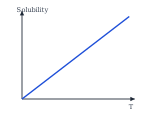
- KCET 2025Set D-41 markMCQQ.Variation of solubility with temperature T for a gas in liquid is shown by the following graphs. The correct representation is: (A)
 (B)
(B) 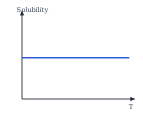 (C)
(C) 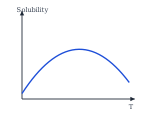 (D)
(D) 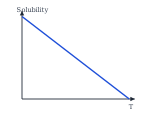
›Reveal solutionSolution
Henry's law makes gas solubility fall as temperature rises — a straight line sloping DOWNWARD, not up, flat, or a hump.
Why solubility decreases with temperature for a gas. Dissolving a gas in a liquid is generally exothermic. As temperature rises, the dissolved gas molecules gain kinetic energy and increasingly escape back into the gas phase, so less gas stays dissolved at equilibrium — the everyday example is a fizzy drink going flat faster when warm. …
- KCET 2025Set D-41 markMCQQ.If N2 gas is bubbled through water at 293 K, how many moles of N2 gas would dissolve in 1 litre of water? Assume that N2 exerts a partial pressure of 0.987 bar. [Given KH for N2 at 293 K is 76.48 K bar] (A) 0.716×10⁻³ (B) 7.16×10⁻⁵ (C) 7.16×10⁻⁴ (D) 7.16×10⁻³
›Reveal solutionSolution
Use Henry's law to get the mole fraction of dissolved N2, then convert that mole fraction to moles using the ≈55.5 mol of water in 1 litre.
Step 1 — Henry's law.
The solubility of a gas in a liquid at a given temperature is proportional to its partial pressure above the liquid:
p=KH⋅x
where x is the mole fraction of the gas in solution and KH is the Henry's-law constant. Rearranged:
x=KHp
Step 2 — Substitute (watch the units on KH).
The constant is given as 76.48 Kbar, i.e. 76.48 kilobar =76.48×10³ bar=76,480 bar (this is the standard NCERT value for N2 at 293 K).
xN2=76,480 bar0.987 bar=1.29×10⁻⁵
A very small number — nitrogen is only sparingly soluble in water, as expected.
Step 3 — Moles of water in 1 litre.
nH2O=18 gmol−11000 g=55.5 mol
Step 4 — Convert mole fraction to moles of N2.
By definition
xN2=nN2+nH2OnN2≈nH2OnN2
The approximation is excellent because nN2⋘nH2O (we are about to find nN2∼10−4 against 55.5). Hence
nN2=xN2×nH2O=(1.29×10⁻⁵)(55.5)
nN2=7.16×10⁻⁴ mol
Step 5 — Check the options. …
- COMEDK 2025Set 2025-E1 markMCQQ.The ratio of N2 and O2 gases in the atmosphere is 4:1. The ratio of the mole fractions of the dissolved gases N2 : O2 in rain water will be approximately ........ (At 293 K, KH for Nitrogen and Oxygen in kbar units are 76.48 and 34.86 respectively.) (A) 3:1 (B) 2:1 (C) 4:1 (D) 1:4
›Reveal solutionSolution
Henry’s law says the mole fraction of a dissolved gas is proportional to its partial pressure times its Henry’s constant. Using the given atmospheric ratio and Henry’s constants, the dissolved N₂:O₂ ratio comes out to about 2:1, so option (B) is correct.
Concept & Intuition
Rainwater is in contact with air, so gases dissolve according to Henry’s law:
xgas=KHpgas
where xgas is the mole fraction in the liquid, pgas is the partial pressure in the gas phase, and KH is Henry’s constant (here given in kbar). The atmospheric ratio N₂:O₂ is 4:1 by volume, which means the partial pressures are in the same ratio (since total pressure ≈ 1 atm, but we only need the ratio). The dissolved ratio is not simply 4:1 because O₂ dissolves more readily (lower KH). We must compute the ratio of p/KH for each gas.
Step-by-step
- Set up partial pressures In dry air, N₂ and O₂ are in volume ratio 4:1. Since partial pressure is proportional to mole fraction in the gas,
pN2:pO2=4:1
Let pO2=P, then pN2=4P.
- Apply Henry’s law for each gas Henry’s law:
xN2=KH,N2pN2,xO2=KH,O2pO2
Given KH,N2=76.48 kbar and KH,O2=34.86 kbar.
- Find the ratio of dissolved mole fractions
xO2xN2=pO2/KH,O2pN2/KH,N2=pO2pN2⋅KH,N2KH,O2
Substitute the partial pressure ratio 4/1:
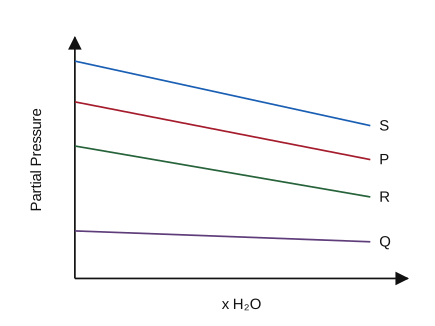
- COMEDK 2024Set 2024-E1 markMCQQ.Study the graph between partial pressure and mole fraction of some gases and arrange the gases P, Q, R and S dissolved in H2O, in the decreasing order of their KH values. (A) S > P > R > Q (B) R > Q > P > S (C) P > R > S > Q (D) Q > R > P > S
›Reveal solutionSolution
Henry's constant equals the slope/intercept of the partial-pressure line; the steepest line (S) has the highest KH and the flattest (Q) the lowest, giving S>P>R>Q.
Henry's law: p=KH⋅xgas. On a partial-pressure vs mole-fraction plot the line for a gas has slope KH; the higher its pressure-axis position/steepness, the larger KH.
From the graph the lines, ranked by steepness / pressure-axis intercept (highest→lowest), are: …
- COMEDK 2024Set 2024-M1 markMCQQ.KH for O2 at 293 K is 34.86 kbar. What should be the partial pressure of O2 gas so that it has a solubility of 0.08 g/L in water at 293 K ? (Density of solution =1 g/ml) (A) 156.8 × 10⁻⁵ bar (B) 15680 bar (C) 156.8 bar (D) 1.569 bar
›Reveal solutionSolution
Convert the solubility to a mole fraction of O2, then apply Henry's law p=KHx to get p≈1.569bar.
Moles in 1 L of solution (≈ 1 L water, density 1g/mL):
nO2=320.08=2.5×10⁻³mol,nwater=181000=55.56mol.
Mole fraction of O2 (its own amount is negligible in the denominator):
x=55.562.5×10−3=4.5×10⁻⁵. …
- KCET 2023Set D-21 markMCQQ.A 30% solution of hydrogen peroxide is (A) '30 volume' hydrogen peroxide (B) '10 volume' hydrogen peroxide (C) '50 volume' hydrogen peroxide (D) '100 volume' hydrogen peroxide
›Reveal solutionSolution
Convert the 30% strength into moles of H2O2 per 100 mL, use 2H2O2→2H2O+O2 to get the oxygen volume at STP, and express it per mL of solution — that number is the "volume strength".
1. What "volume strength" means
A hydrogen-peroxide solution labelled 'x volume' liberates x mL of O2 at STP from 1 mL of the solution on complete decomposition. So the whole problem is: how much O2 does 1 mL of a 30% solution give?
2. Decomposition stoichiometry
2H2O2⟶2H2O+O2
2 mol H2O2 (i.e. 2×34=68 g) give 1 mol O2 = 22.4 L at STP.
3. Take 100 mL of the solution
30% strength ⇒ 30 g of H2O2 in 100 mL of solution.
n(H2O2)=3430=0.882 mol
n(O2)=20.882=0.441 mol
V(O2)=0.441×22.4=9.88 L=9882 mL (at STP)
4. Per mL of solution …
- COMEDK 2023Set 2023-E1 markMCQQ.Choose the incorrect statement: (A) Higher the KH value for a gas at a given pressure, higher is its solubility in that solvent. (B) KH value for a gas present in a given solvent depends on the nature of solute and solvent. (C) KH value is temperature dependent. (D) KH value changes with change in the partial pressure of the gas.
›Reveal solutionSolution
Statement (A) is incorrect: a higher Henry's constant KH means LOWER solubility, not higher.
Henry's law: p=KH⋅x, where x is the mole fraction of dissolved gas. Rearranging, x=p/KH, so for a fixed partial pressure, a larger KH gives a smaller x (lower solubility).
Evaluating:
- (A) "Higher KH ⇒ higher solubility" — INCORRECT; it is the reverse (higher KH ⇒ lower solubility). This is the classic wrong statement being tested.
- (B) KH depends on the nature of gas and solvent — correct.
- (C) KH is temperature dependent (it increases with temperature) — correct. …
- COMEDK 2023Set 2023-M1 markMCQQ.Which of the following is incorrect regarding Henry's law? (A) Gas reacts with solvent chemically. (B) Pressure and concentrations are not too high. (C) Temperature is not too low. (D) Gas does not change its molecular state in solution i.e., neither dissociates nor associates.
›Reveal solutionSolution
Henry's law holds only when the dissolved gas physically dissolves without chemical reaction, at moderate pressure/concentration and not-too-low temperature, and without changing its molecular state (no dissociation/association). The statement that the gas reacts with solvent chemically violates the law, so it is the incorrect one.
Henry's law (p=KH⋅x) applies under the following conditions:
- Pressure and concentration are not too high — (B) is a valid condition.
- Temperature is not too low — (C) is a valid condition.
- The gas does not change its molecular state in solution, i.e. it neither dissociates nor associates — (D) is a valid condition. …
- KCET 2022Set B-31 markMCQQ.Which property of CO2 makes it biologically and geo-chemically important? (A) Its low solubility in water (B) Its high compressibility (C) Its acidic nature (D) Its colourless and odourless nature
›Reveal solutionSolution
The textbook-intended property is CO2's low solubility in water, not its acidic character on its own — that low solubility is exactly what makes the bicarbonate buffer system (blood pH regulation, ocean carbon cycling) possible.
Why not the other options. CO2 IS colourless/odourless and does have some compressibility, but neither of those properties explains its biological/geochemical significance. "Acidic nature" (forming carbonic acid) is real, but it's a consequence of how CO2 behaves in water, not the root property being tested here. …
- KCET 2022Set B-31 markMCQQ.Solubility of a gas in a liquid increases with (A) increase of P and decrease of T (B) decrease of P and decrease of T (C) increase of P and increase of T (D) decrease of P and increase of T
›Reveal solutionSolution
Henry's law makes gas solubility rise with pressure, and because dissolution of a gas is exothermic, Le Chatelier's principle makes it rise as temperature falls.
Step 1 — The pressure dependence: Henry's law.
p=KH⋅x
where p is the partial pressure of the gas above the solution, x its mole fraction in solution, and KH the Henry's-law constant. Rearranged:
x=KHp
So solubility x is directly proportional to pressure. Physically: higher pressure means more gas molecules striking the liquid surface per second, so more of them get captured until a new equilibrium is reached.
⇒ Increase P ⇒ increase solubility.
(Everyday proof: a soda bottle is sealed under high CO2 pressure; the instant you open it and the pressure drops, dissolved CO2 fizzes out.)
Step 2 — The temperature dependence: Le Chatelier.
Dissolution of a gas in a liquid is an exothermic process, because the gas molecules lose their kinetic freedom and are stabilised by solvent interactions:
Gas+Solvent⇌Solution+Heat(ΔH<0) …
- COMEDK 2022Set 20221 markMCQQ.Which of the following does not affect solubility of a gas in liquid? (A) Nature of gas and liquid (B) Pressure (C) Concentration (D) Temperature
›Reveal solutionSolution
'Concentration' is not an independent variable here - the concentration of the dissolved gas IS the solubility (the quantity being measured), not a factor that determines it. So concentration does not affect the solubility of a gas in a liquid.
Concept: Solubility of a gas in a liquid.
The factors that govern how much gas dissolves in a liquid are:
- Nature of the gas and of the solvent (like dissolves like; CO2 is far more soluble in water than O2 because it reacts/interacts with water).
- Pressure of the gas above the liquid - Henry's law, p = K_H * x, so solubility rises with partial pressure. …
- KCET 2021Set B-21 markMCQQ.Henry’s law constant for the solubility of N2 gas in water at 298 K is 1.0×10⁵ atm. The mole fraction of N2 in air is 0.8. The number of moles of N2 from air dissolved in 10 moles of water at 298 K and 5 atm pressure is (A) 4.0×10⁻⁴ (B) 4.0×10⁻⁵ (C) 5.0×10⁻⁴ (D) 4.0×10⁻⁶
›Reveal solutionSolution
Get the partial pressure of N2 from Dalton's law, convert it to a mole fraction with Henry's law, then convert that mole fraction into moles dissolved in 10 mol of water.
Step 1 — Partial pressure of N2 (Dalton's law).
Henry's law uses the partial pressure of the gas, not the total pressure:
pN2=yN2×Ptotal=0.8×5=4 atm.
Step 2 — Henry's law.
pN2=KHxN2⟹xN2=KHpN2=1.0×1054=4×10⁻⁵.
The large KH tells us N2 is only sparingly soluble — the tiny mole fraction is expected.
Step 3 — Convert mole fraction to moles.
xN2=nN2+nH2OnN2≈nH2OnN2(since nN2⋘nH2O) …
🎓Unlock everything free for 14 days
- ✓Full step-by-step solutions
- ✓Concept-first explanations
- ✓Methods, shortcuts & mistakes
- ✓PYQ mapping + timed mock tests
Full access for 14 days. No credit card required.