Q.Consider the experiment of tossing a coin. If the coin shows head, toss it again but if it shows tail, then throw a die. Find the conditional probability of the event that 'the die shows a number greater than 4' given that 'there is at least one tail'.
🔒You're viewing a preview — the full solution, concept, methods & PYQ mapping are locked.
🔒 Start your 14-day free trial to unlock the full solution →Concept understanding — Conditional Probability
Conditional Probability
Roll a die and ask "what is the chance of an even number?" — that is 3/6. But suppose someone tells you the result is greater than 3. Now you are no longer looking at all six faces, only at {4,5,6}, and two of those (4 and 6) are even, so the probability becomes 2/3. That change — from the probability of A to the probability of A given that B has already occurred — is conditional probability.
The Idea: Shrink the Sample Space
Conditioning on B throws away every outcome where B is false and treats B as the new "whole world." You measure A only against what is still possible.
Think of filtering a table of data: unconditional probability uses every row; conditional probability keeps only the rows where the condition is true.
The Definition
For events A and B with P(B)>0,
P(A∣B)=P(B)P(A∩B).
We divide by P(B) to rescale so that B itself has probability 1; the surviving part of A is the overlap A∩B. Checking the die: P(A∩B)=P({4,6})=62 and P(B)=63, so P(A∣B)=3/62/6=32, matching the intuition.
Rearranging gives the multiplication rule P(A∩B)=P(A∣B)P(B), which is usually the easier way to compute a joint probability when a problem says "given that."
Two Cautions
- P(A∣B) and P(B∣A) are generally not equal; swapping them is the classic mistake. They are linked by Bayes' theorem, P(A∣B)=P(B)P(B∣A)P(A). …
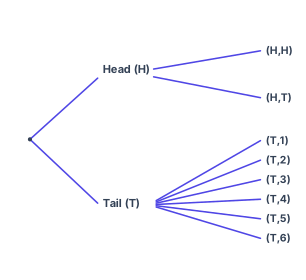
Idea: The outcomes here are NOT equally likely, so weight each by its true probability before using P(A∣B)=P(B)P(A∩B).
Outcomes and their probabilities:
- Head first, then coin: HH, HT, each 21⋅21=41.
- Tail first, then die: T1,…,T6, each 21⋅61=121.
Events:
- A = die shows >4 = {T5,T6}, so P(A)=121+121=61.
- B = at least one tail = everything except HH, so P(B)=1−41=43. …
Because the branch outcomes are not equally likely (HT has probability 41 while each T-die outcome has 121), the conditional probability that the die shows more than 4, given at least one tail, is 92.
Why the outcomes are not equally likely
The experiment branches on the first toss:
- If the coin shows head, we toss the coin again, giving HH or HT.
- If it shows tail, we throw a die, giving T1, T2, T3, T4, T5, T6.
The first toss is fair, so P(H)=P(T)=21. On the head branch the second toss is fair, so
P(HH)=P(HT)=21⋅21=41.
On the tail branch the die is fair, so each of the six outcomes has
P(Ti)=21⋅61=121.
These probabilities sum to 2⋅41+6⋅121=21+21=1, as they should. The eight outcomes are therefore NOT equally likely, so we must use probabilities, not raw counts.
Defining the events
- A: the die shows a number greater than 4, i.e. 5 or 6. A die is thrown only after a tail, so A={T5,T6}.
- B: there is at least one tail. Every outcome has a tail except HH, so B={HT,T1,T2,T3,T4,T5,T6}.
Computing the probabilities
P(B): easiest via the complement. The only "no tail" outcome is HH with probability 41, so …
Method: Conditional probability when outcomes are NOT equally likely
Use this for branching experiments (a coin decides whether you toss again or throw a die) where the final outcomes carry different probabilities. Counting outcomes fails here — you must weight by probability.
Steps
Step 1: Build the tree and attach a probability to each leaf.
Multiply along each branch. A "head then head/tail" leaf has probability 21⋅21=41, while a "tail then die face" leaf has 21⋅61=121. Confirm all leaf probabilities sum to 1.
Step 2: Add probabilities (not counts) for each event. …
Common Mistakes
Mistake 1: Treating all eight leaves as equally likely.
Why it's wrong: a "head then head/tail" leaf has probability 41, but each "tail then die" leaf has only 121; equal weighting wrongly gives 72. Correct approach: weight each leaf by its branch product before adding, giving 92.
Mistake 2: Counting outcomes instead of adding probabilities. …
Showing the 12 most recent of 45 on this concept.
- COMEDK 2023Set 2023-E1 markMCQQ.A die is thrown twice and the sum of numbers appearing is observed to be 8 . What is the conditional probability that the number 5 has appeared atleast once? (A) 365 (B) 52 (C) 181 (D) 31
›Reveal solutionSolution
Given the sum is 8, the sample space is the 5 ordered pairs summing to 8; two of them include a 5, giving probability 52.
The ordered outcomes with sum 8 are
(2,6),(3,5),(4,4),(5,3),(6,2)(5 outcomes). …
- KCET 2021Set A-11 markMCQQ.Two dice are thrown. If it is known that the sum of numbers on the dice was less than 6 the probability of getting a sum as 3 is (A) 181 (B) 185 (C) 51 (D) 52
›Reveal solutionSolution
We use conditional probability: reduce the sample space to only those outcomes where the sum is less than 6, then find the fraction of those that give a sum of exactly 3. The answer is 51.
The key idea here is conditional probability — the probability of one event given that another event has already occurred. When we say "if it is known that the sum was less than 6", we are no longer considering all 36 possible outcomes of throwing two dice. Instead, we restrict ourselves to only those outcomes that satisfy the condition, and then ask: within this smaller set, what fraction gives a sum of 3?
Let’s work it out step by step.
-
List all possible outcomes when two dice are thrown.
Each die shows a number from 1 to 6. The total number of ordered pairs (a,b) is 6×6=36.
-
Identify the condition: sum less than 6.
The possible sums are 2, 3, 4, and 5 (since sum = 1 is impossible with two dice). Let’s list all ordered pairs that give each sum:
- Sum = 2: (1,1) → 1 outcome
- Sum = 3: (1,2),(2,1) → 2 outcomes
- Sum = 4: (1,3),(2,2),(3,1) → 3 outcomes
- Sum = 5: (1,4),(2,3),(3,2),(4,1) → 4 outcomes
Total outcomes with sum < 6: 1+2+3+4=10.
Watch outA common mistake is to forget that (1,2) and (2,1) are different outcomes. Dice are distinct, so order matters. Always count ordered pairs unless the problem explicitly says "identical dice" (which is rare in such problems).
-
Identify the event of interest: sum = 3. …
-
- COMEDK 2024Set 2024-E1 markMCQQ.A coin is tossed until a head appears or until the coin has been tossed three times. Given that 'head' does not appear on the first toss, what is the probability that the coin is tossed thrice? (A) 21 (B) 83 (C) 81 (D) 41
›Reveal solutionSolution
Given the first toss is a tail, the coin is tossed a third time only if the second toss is also a tail — probability 21.
The coin stops the moment a head appears, or after three tosses. We are told the first toss is a tail (no head on toss 1).
Now the second toss decides:
- Head on toss 2 ⇒ stop after 2 tosses.
- Tail on toss 2 ⇒ a third toss is made. …
- KCET 2018Set A-11 markMCQQ.In a simultaneous throw of a pair of dice, the probability of getting a total more than 7 is (A) 127 (B) 365 (C) 125 (D) 367
›Reveal solutionSolution
Count the ordered outcomes whose sum exceeds 7 out of the 36 equally likely outcomes of a pair of dice.
Step 1 — The sample space.
Each die shows one of 6 faces, and the two dice are independent, so
n(S)=6×6=36
All 36 ordered pairs (a,b) are equally likely, so classical probability applies:
P(E)=n(S)n(E)
Step 2 — Count the favourable outcomes (sum >7, i.e. sum =8,9,10,11,12).
Sum Ordered pairs Count 8 (2,6),(3,5),(4,4),(5,3),(6,2) 5 9 (3,6),(4,5),(5,4),(6,3) 4 10 (4,6),(5,5),(6,4) 3 11 (5,6),(6,5) 2 12 (6,6) 1 n(E)=5+4+3+2+1=15
Step 3 — Probability.
P(sum>7)=3615=125 …
- COMEDK 2026Set 2026-M1 markMCQQ.Samhita faces a three-headed dragon. She wins a "Tactical medal" if she manages to defeat exactly one of the three heads. The battle proceeds head-by-head under the following conditions: The probability of defeating the first head is 31. After a win: if she defeats a head, the probability of defeating the next head is 32. After a loss: if she fails to defeat a head, the probability of defeating the next head is 41. What is the probability that Samhita earns the "Tactical medal"? (A) 7223 (B) 365 (C) 7217 (D) 7219
›Reveal solutionSolution
Summing the three disjoint "exactly one win" paths gives 121+181+81=7219 — option (D).
Set up the conditional probabilities. Let Wi mean "defeats head i" and Li mean "fails":
- P(W1)=31, so P(L1)=32.
- After a win: next-head win probability =32, so next-head loss probability =31.
- After a loss: next-head win probability =41, so next-head loss probability =43.
Earning the medal means exactly one of the three heads is defeated. The three disjoint sequences are W1L2L3, L1W2L3, and L1L2W3.
Path 1 — W1L2L3 (win, then loss after a win, then loss after a loss):
P=31⋅31⋅43=363=121
Path 2 — L1W2L3 (loss, then win after a loss, then loss after a win): …
- COMEDK 2025Set 2025-A1 markMCQQ.A bag contains (n+1) coins. It is known that one of these coins has a head on both sides, whereas the other coins are fair. One of these coins is selected at random and tossed. If the probability that the toss results in heads is 127, then the value of n is : (A) 5 (B) 3 (C) 2 (D) 4
›Reveal solutionSolution
The key idea is to treat the coin selection as a two‑case partition (two‑headed coin vs. fair coins) and apply the law of total probability. Solving the resulting equation gives n=5, so the correct option is (A).
Concept and intuition
We have a mixed bag: one trick coin that always lands heads, and n fair coins that land heads with probability 21. When we pick a coin at random and toss it, the overall chance of heads is a weighted average of the two cases. The weight for the trick coin is n+11 (since there are n+1 coins total), and for any fair coin it’s n+1n. The problem gives that overall probability as 127, so we set up an equation and solve for n.
Step‑by‑step solution
- Define the events Let T be the event that the two‑headed coin is selected, and F the event that a fair coin is selected. Since selection is random,
P(T)=n+11,P(F)=n+1n.
- Conditional probabilities for heads If the trick coin is chosen, heads is certain:
P(heads∣T)=1.
If a fair coin is chosen, the chance of heads is 21:
P(heads∣F)=21.
- Apply the law of total probability The overall probability of heads is
P(heads)=P(T)⋅P(heads∣T)+P(F)⋅P(heads∣F).
Substituting the values:
P(heads)=n+11⋅1+n+1n⋅21.
- Simplify the expression
P(heads)=n+11+2(n+1)n=2(n+1)2+n.
- Set equal to the given probability The problem states this equals 127:
- COMEDK 2026Set 2026-A1 markMCQQ.Vishnu has two jars of marbles, Jar A and Jar B. Jar A contains 3 yellow marbles and 2 green marbles. Jar B contains 4 yellow marbles and 3 green marbles. Vishnu flips a fair coin. If it lands heads, he picks two marbles at random without replacement from Jar A. If it lands tails, he picks two marbles at random with replacement from Jar B. Given that Vishnu picked one yellow and one green marble, what is the probability that they came from Jar B? (A) 4121 (B) 8949 (C) 8940 (D) 4120
›Reveal solutionSolution
P(E∣A)=53 (without replacement), P(E∣B)=4924 (with replacement); Bayes gives P(B∣E)=8940 — option (C).
Likelihoods of drawing one yellow and one green (E).
Jar A (3 yellow, 2 green; two draws without replacement):
P(E∣A)=(25)(13)(12)=106=53.
Jar B (4 yellow, 3 green; two draws with replacement):
P(E∣B)=2⋅74⋅73=4924.
Bayes' theorem with P(A)=P(B)=21 (the 21 cancels): …
- COMEDK 2025Set 2025-M1 markMCQQ.Three fair dice are thrown. What is the probability of getting a total of 15 given that they exhibit three different numbers that are in arithmetic progression? (A) 81 (B) 61 (C) 41 (D) 21
›Reveal solutionSolution
The problem asks for the conditional probability that three dice sum to 15, given that the three numbers shown are distinct and form an arithmetic progression. By listing all such triples and counting those summing to 15, the probability is found to be 1/2.
Concept and intuition
We need P(sum=15∣distinct AP). The condition restricts the outcomes to only those triples (a,b,c) with a<b<c (since dice are fair, order matters but we can treat ordered rolls; however the condition “three different numbers” and “arithmetic progression” is symmetric). The key is to enumerate all possible ordered triples of distinct numbers from {1,2,3,4,5,6} that are in arithmetic progression, then count how many of those sum to 15. Because the dice are fair, each ordered triple is equally likely, so the conditional probability is just the ratio of favorable ordered triples to total ordered triples satisfying the condition.
Step-by-step reasoning
- Characterize arithmetic progressions of three distinct numbers from 1 to 6. Three numbers x,y,z (with x<y<z) are in AP iff 2y=x+z. Since they are distinct and from 1 to 6, the possible triples (unordered) are:
(1,2,3), (1,3,5), (2,3,4), (2,4,6), (3,4,5), (4,5,6).
Check: For (1,2,3): 2⋅2=1+3; (1,3,5): 2⋅3=1+5; etc. That’s all.
-
Count ordered triples satisfying the condition.
For each unordered triple, the three numbers are distinct, so they can appear in any order on the three dice. That gives 3!=6 permutations per triple.
Total ordered triples satisfying the condition = 6×6=36.
-
Identify which of these triples sum to 15.
Compute sums of the unordered triples:
(1,2,3)(1,3,5)(2,3,4)(2,4,6)(3,4,5)(4,5,6)→6,→9,→9,→12,→12,→15. …
- KCET 2019Set A-11 markMCQQ.A man speaks truth 2 out of 3 times. He picks one of the natural numbers in the set S={1,2,3,4,5,6,7} and reports that it is even. The probability that it is actually even is (A) 52 (B) 51 (C) 101 (D) 53
›Reveal solutionSolution
By Bayes' theorem the probability is 53 — option (D).
The set S={1,2,3,4,5,6,7} has 3 even numbers (2,4,6) and 4 odd numbers, and one number is picked at random.
Let E = "the number is even" and R = "the man reports it as even."
Priors.
P(E)=73,P(Ec)=74.
Likelihoods. He tells the truth with probability 32 and lies with probability 31.
- If the number really is even, a truthful report says "even": P(R∣E)=32.
- If the number is odd, only a lie reports "even": P(R∣Ec)=31.
Bayes' theorem. …
- COMEDK 2023Set 2023-E1 markMCQQ.Bag A contains 3 white and 2 red balls. Bag B contains only 1 white ball. A fair coin is tossed. If head appears then 1 ball is drawn at random from bag A and put into bag B. However if tail appears then 2 balls are drawn at random from bag A and put into bag B. Now one ball is drawn at random from bag B. Given that the drawn ball from B is white, the probability that head appeared on the coin is (A) 3023 (B) 2312 (C) 2311 (D) 3019
›Reveal solutionSolution
Computing P(white drawn∣H)=54 and P(white∣T)=1511, Bayes' theorem gives P(H∣white)=2312.
Head (transfer 1 ball from A(3W,2R) to B(1W), then draw from B's 2 balls):
P(white)=53(1)+52(21)=53+51=54.
Tail (transfer 2 balls from A to B(1W), then draw from B's 3 balls):
P(WW)=103⇒P(white)=1,P(WR)=106⇒32,P(RR)=101⇒31. …
- COMEDK 2021Set 2021-B1 markMCQQ.At a certain university 4% of male students are over 6 feet tall and 1% of female students are over 6 feet tall. The total student population is divided in the ratio 3 : 2, in favor of female students. If a student is selected at random from amongst all those over 6 feet tall, what is the probability that the student is a female? (A) 1/3 (B) 2/5 (C) 3/11 (D) 3/5
›Reveal solutionSolution
Bayes' theorem gives P(female∣>6ft)=0.0220.006=113.
Population split 3:2 in favour of females ⇒ P(F)=53=0.6, P(M)=52=0.4.
Tall fractions: P(T∣F)=0.01, P(T∣M)=0.04.
By Bayes' theorem: …
- COMEDK 2024Set 2024-M1 markMCQQ.A and B each have a calculator which can generate a single digit random number from the set {1,2,3,4,5,6,7,8}. They can generate a random number on their calculator. Given that the sum of the two numbers is 12 , then the probability that the two numbers are equal is (A) 645 (B) 51 (C) 161 (D) 81
›Reveal solutionSolution
We are asked for the conditional probability that two numbers are equal given their sum is 12.
The only equal pair summing to 12 is (6,6), and there are 5 total pairs summing to 12.
So the probability is 51, which corresponds to option (B).
Concept and intuition
This is a classic conditional probability problem: we are not interested in all possible outcomes, only those where the sum is exactly 12. The phrase “given that the sum is 12” means we restrict our universe to those pairs. Then we count how many of those restricted outcomes have the two numbers equal. The trap is to forget to restrict the denominator — many students mistakenly use the total number of all possible pairs (64) instead of only the favorable-sum pairs.
Step-by-step solution
-
Identify the sample space
Each of A and B picks a digit from {1,2,…,8}.
Total possible ordered pairs (a,b): 8×8=64.
-
List all pairs with sum 12
We need a+b=12, with 1≤a,b≤8.
Possible values for a:
- If a=4, then b=8
- If a=5, then b=7
- If a=6, then b=6
- If a=7, then b=5
- If a=8, then b=4
So the pairs are:
(4,8), (5,7), (6,6), (7,5), (8,4)
That’s 5 ordered pairs.
- Count the favorable outcomes “The two numbers are equal” means a=b. …
-
🎓Unlock everything free for 14 days
- ✓Full step-by-step solutions
- ✓Concept-first explanations
- ✓Methods, shortcuts & mistakes
- ✓PYQ mapping + timed mock tests
Full access for 14 days. No credit card required.