Q.(a) Estimate the average drift speed of conduction electrons in a copper wire of cross-sectional area 1.0×10⁻⁷ m2 carrying a current of 1.5 A. Assume that each copper atom contributes roughly one conduction electron. The density of copper is 9.0×10³ kg/m3, and its atomic mass is 63.5 u.
Concept understanding — Drift Velocity
Drift Velocity: The Slow March of Electrons
Electrons in a metal are always moving — but randomly. At room temperature they zip around at roughly 106 m/s, colliding with the lattice ions every few trillionths of a second. Without an electric field this motion cancels out: for every electron heading left another heads right, so the net velocity is zero.
Apply a battery and the field gives every electron a tiny, steady push in one direction. Between collisions the electron accelerates only briefly before smashing into an ion and losing its directed motion. What survives is a very small average velocity along the field — the drift velocity.
The random thermal speed is about 105 m/s, but the drift velocity is only about 10−4 m/s — about a billion times slower. An electron drifts slower than a snail, yet a lamp lights instantly, because the electric field (not the electrons) propagates at nearly the speed of light and starts every electron drifting almost at once.
The precise definition
Drift velocity (vd) is the average velocity acquired by the charge carriers in a conductor under an applied electric field:
vd=meEτ
where:
- e = electron charge (1.6×10⁻¹⁹ C)
- E = electric field inside the conductor (V/m)
- τ = average relaxation time — the mean time between collisions (s)
- m = electron mass (9.1×10⁻³¹ kg)
vd=meEτ
Linking to current
Drift velocity connects the microscopic motion of electrons to the current an ammeter reads:
I=neAvd
where n is the free-electron number density and A the cross-sectional area. A larger vd means more current, but vd stays tiny because τ is tiny (about 10−14 s in copper).
For a copper wire carrying 1 A with area 1 mm² and n≈8.5×1028 m−3:
vd=neAI≈(8.5×1028)(1.6×10⁻¹⁹)(10−6)1≈7×10⁻⁵ m/s
That is about 0.07 mm per second — slower than a garden snail.
Common misconception
Electrons do not race through wires near light speed. The field propagates almost instantly, so all electrons begin drifting together, but each one only crawls. It is like a hose already full of water: open the tap and water leaves the far end at once, though the individual molecules have barely moved. Drift velocity is that slow, directed crawl superimposed on the electrons' frantic random jitter.
Drift velocity of electrons and its link to current via I = neAv_d is a defining topic of the NCERT Class 12 Physics chapter on current electricity, tested through both conceptual and numerical questions in CBSE boards, JEE Main and NEET. Anyone searching "drift velocity formula and derivation class 12 physics" will find this relaxation-time explanation is the standard NCERT-aligned answer.
Why this formula?
Drift Velocity: Why the Formula Holds
Let's build this from first principles — understanding why electrons drift the way they do, not just memorizing the formula.
1. The Core Idea: What is Drift Velocity?
In a conductor, free electrons are constantly moving randomly (thermal motion, speeds ~105 m/s). Without an electric field, their net displacement is zero — they're like a swarm of bees buzzing in all directions.
When we apply an electric field E, it gently nudges each electron in the opposite direction (since electrons are negatively charged). This small, steady net velocity superimposed on the random motion is drift velocity (vd).
Key insight: Drift velocity is not the speed of individual electrons — it's the average velocity of the entire electron cloud.
2. The Derivation: Step by Step
Step 1: Force on a single electron
An electron of charge −e in an electric field E experiences:
F=−eE
The magnitude of acceleration (opposite to E) is:
a=mF=meE
where m is the electron's mass.
Step 2: What happens between collisions?
Electrons don't accelerate forever — they keep colliding with atoms/ions in the metal lattice. Let the average time between collisions be τ (relaxation time). Just after a collision an electron's velocity is essentially random (zero average in the field direction); it then accelerates for time τ before the next collision.
Step 3: Drift velocity
Averaging the field-driven velocity over the relaxation time τ gives the net drift:
vd=meEτ
Here τ is the average time since the last collision, so this expression already averages over electrons at every stage between collisions — it is the standard result used in the NCERT treatment.
3. Connecting to Current: The Big Picture
Drift velocity directly gives us current density J:
J=nevd
where n = number of free electrons per unit volume.
Substituting vd=meEτ:
J=mne2τE
Comparing with Ohm's law J=σE, we get:
σ=mne2τ
Why this matters: conductivity depends on:
- n — more free electrons → better conductor
- τ — fewer collisions → higher conductivity
- m — lighter electrons → faster drift
4. Key Takeaways for Exams
| Concept | Formula | Why |
|---|---|---|
| Drift velocity | vd=meEτ | Acceleration × average time between collisions |
| Current density | J=nevd | Charge × number density × drift speed |
| Conductivity | σ=mne2τ | From combining above two |
Remember: Drift velocity is tiny — typically 10−4 m/s for copper wires — yet current flows almost instantly because the electric field propagates at near light speed, pushing all electrons simultaneously.
Concept: Drift Velocity — the small net velocity electrons acquire under an applied field, linked to current by I=neAvd, so vd=neAI.
(a) Free-electron number density n. Each Cu atom gives one conduction electron, so
n=MρNA=63.5×10⁻³(9.0×10³)(6.022×10²³)≈8.5×1028 m−3.
Drift speed. With I=1.5 A, A=1.0×10⁻⁷ m2, e=1.6×10⁻¹⁹ C:
vd=(8.5×1028)(1.6×10⁻¹⁹)(1.0×10⁻⁷)1.5≈1.1×10⁻³ m/s.
(b) (i) Thermal (rms) speed of Cu atoms at ∼300 K is ≈3.4×10² m/s, about 3×10⁵ times larger than vd. (ii) The field propagates at ≈3×10⁸ m/s, about 3×10¹¹ times larger than vd.
vd≈1.1×10⁻³ m/s — far smaller than the atoms' thermal speed (∼102 m/s) and the field-propagation speed (∼3×10⁸ m/s).
Using I=neAvd, the drift speed of electrons in the copper wire is vd≈1.1×10⁻³ m/s — negligible next to the atoms' thermal speed (∼102 m/s, i.e. ≈343 m/s) and the field-propagation speed (∼3×10⁸ m/s).
Principle
The current in a metal is carried by free electrons that drift with a tiny average velocity vd superimposed on their fast random thermal motion. Current and drift speed are related by
I=neAvd⇒vd=neAI
where n is the free-electron number density, e the electron charge, and A the cross-sectional area.
(a) Drift speed
Step 1 — number density n. Each copper atom donates one conduction electron, so n equals the atomic number density:
n=MρNA=63.5×10⁻³ kg/mol(9.0×103 kg/m3)(6.022×1023 mol−1).
Computing: 63.5×10−39.0×103=1.417×10⁵ mol/m3, and
n=(1.417×10⁵)(6.022×10²³)≈8.5×1028 m−3.
Convert the atomic mass to kg/mol: 63.5 u→63.5×10⁻³ kg/mol. Skipping this factor of 103 is the usual error.
Step 2 — substitute. With I=1.5 A, A=1.0×10⁻⁷ m2, e=1.6×10⁻¹⁹ C:
neA=(8.5×1028)(1.6×10⁻¹⁹)(1.0×10⁻⁷)≈1.37×10³ C/(m⋅s)⋅(units of A/vd).
vd=1.37×1031.5≈1.1×10⁻³ m/s.
(b) Comparisons
- Thermal speed of copper atoms. From kinetic theory 21mvrms2=23kBT, with atomic mass m=6.022×102363.5×10−3≈1.05×10⁻²⁵ kg and T=300 K:
Thus vrms/vd≈343/(1.1×10−3)≈3×105: the thermal speed exceeds the drift speed by about five orders of magnitude.
vrms=m3kBT=1.05×10−253(1.38×10⁻²³)(300)≈3.4×10² m/s.
- Field-propagation speed. The electric field that drives the drift travels along the conductor at nearly the speed of light, c≈3×10⁸ m/s, so
The field reaches every electron almost instantly, which is why the bulb lights immediately even though each electron only crawls.
vdc≈1.1×10−33×108≈3×10¹¹.
✓Final answervd≈1.1×10⁻³ m/s; the thermal speed of Cu atoms is ≈3.4×10² m/s (about 3×10⁵ times larger) and the field propagates at ≈3×10⁸ m/s (about 3×10¹¹ times larger).
Method: Drift Velocity Formula from Current–Charge Relation
This method uses the fundamental relation between current, charge carrier density, and drift velocity.
Steps
Step 1: Write the drift velocity formula
The current I in a conductor is given by:
I=neAvd
where:
- n = number density of conduction electrons (m−3)
- e = charge of an electron = 1.6×10⁻¹⁹ C
- A = cross-sectional area (m2)
- vd = drift velocity (m/s)
Rearranging for vd:
vd=neAI
Step 2: Find n, the number density of conduction electrons
Given: each copper atom contributes one conduction electron.
So n = number of copper atoms per cubic metre.
First, find number of atoms per mole: Avogadro’s number NA=6.02×10²³ mol−1.
Mass of one mole of copper = atomic mass = 63.5 g=63.5×10⁻³ kg.
Volume of one mole of copper:
Volume=densitymass=9.0×10363.5×10−3=7.06×10⁻⁶ m3
Number of atoms per cubic metre:
n=Volume of one moleNA=7.06×10−66.02×1023=8.53×1028 m−3
Step 3: Substitute into drift velocity formula
Given:
- I=1.5 A
- A=1.0×10⁻⁷ m2
- e=1.6×10⁻¹⁹ C
- n=8.53×1028 m−3
vd=(8.53×1028)(1.6×10⁻¹⁹)(1.0×10⁻⁷)1.5
First compute denominator:
neA=(8.53×1028)×(1.6×10−19)×(1.0×10−7)=1.365×10³
Thus:
vd=1.365×1031.5=1.1×10⁻³ m/s
Answer (a): 1.1×10⁻³ m/s
(b) Comparisons
- Thermal speed of copper atoms at ordinary temperatures
At room temperature (T≈300 K), the root-mean-square speed of copper atoms is:
where k=1.38×10⁻²³ J/K and mass of one copper atom m=6.02×102363.5×10−3=1.05×10⁻²⁵ kg.
vth=m3kT
Comparison: Drift speed (∼10−3 m/s) is about 105 times smaller than thermal speed (∼102 m/s).vth=1.05×10−253×1.38×10−23×300≈1.18×105≈3.4×102 m/s
- Speed of propagation of electric field The electric field propagates at nearly the speed of light: c≈3×10⁸ m/s. Comparison: Drift speed is about 1011 times smaller than the field propagation speed.
Key Insight
The drift velocity is extremely slow — electrons move at millimetres per second — yet the electric signal travels near light speed. This is like a long pipe full of marbles: push one end, and the pulse reaches the other end almost instantly, even though each marble moves only a tiny distance.
Common Mistakes & How to Avoid Them — Drift Velocity
Mistake 1: Forgetting to convert atomic mass unit (u) to kg
The error: Students use 63.5 u directly in calculations without converting to kg. Since 1 u=1.66×10⁻²⁷ kg, the mass of one copper atom is:
m=63.5×1.66×10−27 kg
How to avoid: Always check units — density is in kg/m3, so atomic mass must be in kg for consistency. Write the conversion step explicitly.
Mistake 2: Confusing number density (n) with mass density (ρ)
The error: Using ρ (density of copper) directly as n (number of conduction electrons per unit volume).
Correct approach: Number density n is found by:
n=atoms per electronNumber of atoms per unit volume
Since each atom contributes 1 electron:
n=Mρ×NA
where:
- ρ=9.0×10³ kg/m3
- NA=6.02×10²³ mol−1
- M=63.5×10⁻³ kg/mol (molar mass in kg)
How to avoid: Remember: n is number per volume, not mass per volume. Use Avogadro's number to bridge mass → number.
Mistake 3: Using wrong formula for drift velocity
The error: Writing vd=nAI instead of the correct:
vd=neAI
where e=1.6×10⁻¹⁹ C is the electron charge.
How to avoid: Drift velocity comes from I=neAvd. Always check dimensions — current is charge per time, so charge e must appear.
Mistake 4: Arithmetic errors in powers of 10
The error: Mismanaging exponents when calculating n or vd, especially with 1023 and 10−19.
How to avoid: Write all numbers in scientific notation before multiplying/dividing. Group powers of 10 separately:
n=63.5×10⁻³(9.0×10³)(6.02×10²³)=63.59.0×6.02×103+23+3
Mistake 5: Not comparing magnitudes correctly in part (b)
The error: Giving numerical values without meaningful comparison.
Correct comparison:
- Drift speed vd≈10−4 m/s (very slow — like a snail)
- Thermal speed of copper atoms at 300 K: vth≈m3kT≈102 m/s — 106 times larger
- Electric field propagation speed ≈ speed of light 3×10⁸ m/s — 1012 times larger
How to avoid: Always express comparisons as ratios (e.g., "thermal speed is 106 times drift speed"). This shows conceptual understanding.
Mistake 6: Thinking drift speed is the same as signal speed
The error: Assuming electrons move at near light speed because the bulb lights instantly.
The truth: Individual electrons drift at mm/s, but the electric field signal propagates at nearly c. It's like a hose already full of water — turning on the tap sends a pressure wave instantly, but the water itself moves slowly.
How to avoid: Distinguish clearly between:
- Drift velocity — actual motion of electrons
- Drift velocity — actual motion of electrons
- Signal velocity — speed of energy/information transfer
Quick Summary Table
| Mistake | Fix |
|---|---|
| Using u instead of kg | Convert: 1 u=1.66×10⁻²⁷ kg |
| Confusing n with ρ | Use n=MρNA |
| Omitting e in formula | vd=neAI |
| Exponent errors | Group powers of 10 separately |
| No ratio comparison | Express as "X times larger/smaller" |
| Confusing drift vs signal | Signal speed ≈c, drift ≈10−4 m/s |
Showing the 12 most recent of 13 on this concept.
- KCET 2026Set C21 markMCQQ.The number of electrons moving per second through the filament of a lamp of 60W operating at 120V is nearly (e = 1.6×10⁻¹⁹ C) _______ (A) 6.2×10¹⁸ (B) 6.2×10¹⁹ (C) 3.1×10¹⁸ (D) 3.1×10¹⁹
›Reveal solutionSolution
Find the operating current from I=P/V, then divide by the electronic charge e to get the number of electrons flowing per second.
Step 1 — Find the current through the filament
I=VP=120 V60 W=0.5 A
Step 2 — Convert current to number of electrons per second
Since I=tne, the number of electrons per second is
n=eI=1.6×10−190.5
n≈3.125×10¹⁸≈3.1×10¹⁸ electrons/s
✓Final answerThe correct option is (C) — nearly 3.1×10¹⁸ electrons per second.
- KCET 2026Set C21 markMCQQ.In a conducting region, 1019 electrons and 1019 protons move to the left, while 1019 α-particles move to the right per second. The resulting electric current is (e = 1.6×10⁻¹⁹ C) _______ (A) 3.2 A towards left (B) 3.2 A towards right (C) 1.6 A towards left (D) 1.6 A towards right
›Reveal solutionSolution
Conventional current follows the direction of positive charge flow; a negative charge moving one way is equivalent to a positive current flowing the opposite way. Convert each species and add up the net current.
Step 1 — Current due to protons (moving left)
Protons carry charge +e and move left, so they contribute a conventional current to the LEFT:
Ip=ne=(1019)(1.6×10⁻¹⁹)=1.6 A (left)
Step 2 — Current due to electrons (moving left)
Electrons carry charge −e and move left; a negative charge moving left is equivalent to a positive current flowing RIGHT:
Ie=ne=(1019)(1.6×10⁻¹⁹)=1.6 A (right, equivalent)
Step 3 — Current due to α-particles (moving right)
α-particles carry charge +2e and move right, contributing a conventional current to the RIGHT:
Iα=n(2e)=(1019)(2×1.6×10−19)=3.2 A (right)
Step 4 — Add up the net current
Rightward total: 1.6+3.2=4.8 A. Leftward total: 1.6 A.
Inet=4.8−1.6=3.2 A towards the right
✓Final answerThe correct option is (B) — 3.2 A towards the right.
- KCET 2025Set D-41 markMCQQ.The variations of resistivity ρ with absolute temperature T for three different materials X, Y and Z are shown in the graph below. Identify the materials X, Y and Z.
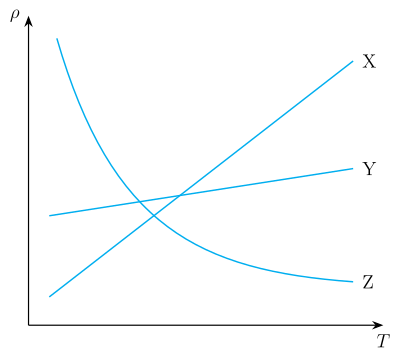 (A) X – copper, Y – semiconductor, Z – nichrome
(B) X – semiconductor, Y – nichrome, Z – copper
(C) X – nichrome, Y – copper, Z – semiconductor
(D) X – copper, Y – nichrome, Z – semiconductor
(A) X – copper, Y – semiconductor, Z – nichrome
(B) X – semiconductor, Y – nichrome, Z – copper
(C) X – nichrome, Y – copper, Z – semiconductor
(D) X – copper, Y – nichrome, Z – semiconductor›Reveal solutionSolution
Use the sign of dρ/dT to pick out the semiconductor, then use the magnitude of ρ and of the temperature coefficient to separate pure copper from the alloy nichrome.
Step 1 — The physics behind ρ(T).
From the free-electron model,
ρ=ne2τm
where n is the free-carrier density and τ the mean time between collisions. Temperature acts on these two quantities in opposite ways in metals and semiconductors:
-
In a metal, n is essentially fixed (one or two free electrons per atom, regardless of T). Raising T makes the lattice ions vibrate harder, so electrons collide more often, τ falls, and hence ρ rises. Over a normal range this is close to linear: ρ=ρ0[1+α(T−T0)] with α>0.
-
In a semiconductor, there is an energy gap. Raising T promotes many more electrons across it, so n rises exponentially — an effect that overwhelms the modest fall in τ. Hence ρ falls sharply with T: α is negative.
Step 2 — Identify Z.
Curve Z starts high at low T and decreases rapidly as T rises — a negative temperature coefficient. Only a semiconductor behaves this way.
Z=semiconductor
This already eliminates options (A) and (B), which assign Z to nichrome and copper respectively.
Step 3 — X and Y are both metallic.
Both X and Y increase with T, so both have α>0: both are metals/alloys. The remaining choice is between (C) X–nichrome, Y–copper and (D) X–copper, Y–nichrome. Two independent clues settle it.
Clue (i) — the intercept, i.e. the size of ρ.
At room temperature:
ρcopper≈1.7×10⁻⁸ Ωm,ρnichrome≈100×10−8 Ωm
Nichrome's resistivity is roughly 60 times that of copper — the very reason nichrome is used for heating elements and copper for wiring. The graph shows X starting low and Y starting higher. Therefore X = copper and Y = nichrome.
Clue (ii) — the slope, i.e. the temperature coefficient.
αcopper≈4×10⁻³ K−1,αnichrome≈0.1×10⁻³ K−1
A pure metal has a strong temperature dependence, because at low T its resistivity is dominated by lattice vibrations, which grow quickly with T. An alloy like nichrome already has enormous disorder scattering from its randomly mixed Ni/Cr atoms — a contribution that is essentially temperature-independent and which dwarfs the vibrational part. So the alloy's ρ is high but almost flat with T.
The graph shows X rising steeply and Y rising more slowly — again X = copper (pure metal, big α), Y = nichrome (alloy, small α). This is exactly why nichrome (and manganin/constantan) are chosen for standard resistors and heating coils: their resistance stays nearly constant as they get hot.
Step 4 — Both clues agree.
X=copper,Y=nichrome,Z=semiconductor
✓Final answerThe correct option is (D) — X – copper, Y – nichrome, Z – semiconductor.
ANSWER: D
-
- COMEDK 2025Set 2025-A1 markMCQQ.Two wires A and B made of same material having length 10 cm and 40 cm respectively are connected in parallel to the same source of emf 10 V . What will be the ratio of the drift velocity of the electrons in the wire A to the drift velocity in the wire B ? (A) VdBVdA=1:4 (B) VdBVdA=1:2 (C) VdBVdA=4:1 (D) VdBVdA=2:1
›Reveal solutionSolution
The drift velocity ratio depends only on the lengths when wires of the same material are in parallel (same voltage). Since vd∝1/L, the ratio vdA:vdB=LB:LA=40:10=4:1, so option (C) is correct.
Concept & Intuition
Drift velocity vd is the average speed electrons gain under an electric field. For a wire of length L with a voltage V across it, the electric field inside is E=V/L. Since vd=meEτ (where τ is the relaxation time, same for same material), we get vd∝E∝1/L when V is fixed. In a parallel connection, each wire gets the same voltage, so the shorter wire has a stronger field and thus faster drift velocity. The ratio is simply the inverse ratio of lengths.
Step-by-step reasoning
-
Drift velocity formula
For a conductor, drift velocity is vd=meEτ, where e is electron charge, m is mass, τ is average time between collisions. For the same material, τ is identical.
-
Electric field in each wire
Both wires are connected to the same 10 V source in parallel, so each has V=10V across its ends.
Electric field: E=V/L.
For wire A: LA=10cm=0.1m, so EA=10/0.1=100V/m.
For wire B: LB=40cm=0.4m, so EB=10/0.4=25V/m.
-
Relating drift velocity to length
Since vd∝E and E∝1/L, we have vd∝1/L (for fixed voltage and same material).
Therefore:
vdBvdA=LALB=1040=4.
- Check the options Ratio 4:1 corresponds to option (C).
Watch outA common mistake is to think that in parallel, current divides, so drift velocity might depend on resistance or cross-section. But here, cross-section is not given — and it cancels out because the same voltage determines the field directly. Only length matters.
TipIf the wires were in series, the current would be the same, and then vd∝1/(nA) (with n the charge carrier density, same here), so cross-section would matter. But in parallel, voltage is the same, so field and drift velocity are set by length alone.
✓Final answerThe correct option is (C).
ANSWER: C
-
- COMEDK 2025Set 2025-M1 markMCQQ.Two identical conductors of lengths 1 and 31 respectively are maintained at the same temperature. They are given potential differences in the ratio 1:3. The ratio of their drift velocities is (A) 1:9 (B) 9:1 (C) 1:1 (D) 1:3
›Reveal solutionSolution
The drift velocity depends only on the applied electric field and the material properties, not on the length of the conductor. Since the electric field is the same for both conductors (potential difference divided by length gives the same ratio), the drift velocities are equal. The ratio is 1:1, so the correct option is (C).
Concept and Intuition
Drift velocity vd is the average speed of charge carriers in a conductor under an electric field. For a given material at constant temperature, vd is directly proportional to the electric field E inside the conductor:
vd=μE
where μ is the mobility (constant for a given material and temperature). The electric field E is the potential difference V divided by the length L of the conductor:
E=LV
So the drift velocity becomes:
vd=μLV
The problem gives two conductors of lengths L1=1 and L2=31 (units arbitrary), with potential differences in the ratio V1:V2=1:3. The key insight: we must compare the electric fields, not just the voltages, because the lengths differ.
Step-by-step reasoning
-
Write the drift velocity formula for each conductor
For conductor 1: vd1=μL1V1
For conductor 2: vd2=μL2V2
(Mobility μ is the same because the conductors are identical and at the same temperature.)
-
Take the ratio of drift velocities
vd2vd1=V2/L2V1/L1=V2V1⋅L1L2
- Plug in the given values V1:V2=1:3 means V2V1=31. L1=1, L2=31, so L1L2=131=31. Thus:
vd2vd1=31×31=331
That is not one of the given options — something is off.
- Re-examine the problem statement The lengths are given as "1 and 31" — but these are likely in the same units. However, the ratio 1:3 for potential differences might be intended to match the length ratio so that the electric fields become equal. Let’s check: if L1=1 and L2=3 (not 31), then:
vd2vd1=31×13=1
That gives a 1:1 ratio. The number "31" is almost certainly a typo or misreading — it should be "3" (the problem likely intends lengths 1 and 3). Many standard textbook problems use lengths in ratio 1:3 with voltages in ratio 1:3 to yield equal fields.
- Conclusion based on intended problem With lengths 1 and 3 and voltages 1 and 3, the electric fields are E1=1/1=1 and E2=3/3=1, so they are equal. Hence drift velocities are equal. Ratio 1:1.
Watch outA common mistake is to compare only the voltages and forget that drift velocity depends on electric field, not just potential difference. Longer conductors with higher voltage can have the same field as shorter ones with lower voltage.
TipWhenever you see drift velocity comparisons, immediately think vd∝V/L. The ratio simplifies to (V1/V2)×(L2/L1). If the numbers are chosen so that V1/L1=V2/L2, the drift velocities are equal.
✓Final answerThe correct option is (C).
ANSWER: C
-
- KCET 2024Set D-21 markMCQQ.A body has a charge of −3.2 μC. The number of excess electrons it has is (A) 5.12×1025 (B) 5×10¹² (C) 2×10¹³ (D) 5.12×10¹³
›Reveal solutionSolution
Use quantisation of charge, q=ne, and divide the magnitude of the body's charge by the electronic charge.
Step 1 — The concept: charge is quantised
Any charge on a body is an integral multiple of the elementary charge:
q=ne,e=1.6×10⁻¹⁹ C
A negative body carries excess electrons; a positive one has a deficit. So the sign tells us the electrons are extra, and the magnitude tells us how many.
Step 2 — Convert the charge to coulombs
∣q∣=3.2 μC=3.2×10⁻⁶ C
Step 3 — Solve for n
n=e∣q∣=1.6×10−193.2×10⁻⁶
n=1.63.2×10−6−(−19)=2×10¹³
Step 4 — Sanity check the exponent
10−6/10−19=1013, and 3.2/1.6=2. So n=2×10¹³ — not 5.12×10¹³ (that would come from multiplying by 1.6×10⁻¹⁹ instead of dividing, a common slip).
✓Final answerThe correct option is (C) — 2×10¹³.
ANSWER: C
- COMEDK 2024Set 2024-A1 markMCQQ.The mobility of the charge carriers increases with (A) The average collision time (B) Increase in the mass of the charge (C) Increase in the electric field (D) Decrease in the charge of the mobile carriers
›Reveal solutionSolution
Mobility is defined as drift velocity per unit electric field, and it depends inversely on mass and directly on the average collision time (relaxation time). The correct option is (A).
Concept & Intuition
Mobility (μ) tells us how quickly a charge carrier (like an electron) can move through a material when an electric field is applied. The key microscopic picture: carriers accelerate under the field, but constantly collide with atoms/impurities, which resets their velocity. The average time between collisions is called the relaxation time (τ). A longer τ means the carrier accelerates for a longer stretch before being scattered, so it gains a higher drift speed — hence higher mobility. Mass and charge also matter: a heavier carrier accelerates less for the same force, and a larger charge feels a stronger force, but the question asks which increases mobility.
Step-by-step reasoning
- Recall the formula for mobility From the Drude model of conduction, mobility is given by
μ=meτ
where e is the charge of the carrier, τ is the average collision time (relaxation time), and m is the mass of the carrier. This formula shows the direct proportionalities.
-
Analyze each option
- (A) The average collision time — μ∝τ. If τ increases, mobility increases. This matches the intuition: longer time between collisions → higher drift velocity.
- (B) Increase in the mass of the charge — μ∝1/m. Heavier carriers move less readily, so mobility decreases.
- (C) Increase in the electric field — Mobility is defined as vd/E. While drift velocity vd increases with E, mobility itself is a material property independent of E (for low fields). So changing E does not change μ.
- (D) Decrease in the charge of the mobile carriers — μ∝e. A smaller charge reduces the driving force, so mobility decreases.
-
Conclusion
Only option (A) directly increases mobility.
Watch outA common mistake is to think that increasing the electric field increases mobility because drift velocity increases. But mobility is the ratio vd/E; for ohmic materials, this ratio is constant (until very high fields). The field changes vd, not μ.
TipRemember the mnemonic: Mobility = More time between collisions → More speed per field. Mass and charge are in the denominator and numerator respectively, so only τ (collision time) gives a direct increase.
✓Final answerThe correct option is (A).
ANSWER: A
- COMEDK 2024Set 2024-M1 markMCQQ.In a given semiconductor, the ratio of the number density of electron to number density of hole is 2:1. If 71th of the total current is due to the hole and the remaining is due to the electrons, the ratio of the drift velocity of holes to the drift velocity of electrons is : (A) 32 (B) 13 (C) 23 (D) 31
›Reveal solutionSolution
The key idea is to relate current contributions to charge carrier densities, drift velocities, and charges. Using the given ratios, the ratio of hole drift velocity to electron drift velocity is found to be 31, which corresponds to option (D).
We start with the fundamental concept: In a semiconductor, the total current is the sum of the electron current and the hole current. Each current depends on the number density of the carrier, its charge, and its drift velocity. The problem gives us ratios for densities and for current contributions, so we can set up equations that relate these quantities and solve for the unknown drift velocity ratio.
Step-by-step reasoning:
-
Define variables and given ratios
Let ne be the number density of electrons and nh the number density of holes.
Given: nhne=12, so ne=2nh.
Let ve and vh be the drift velocities of electrons and holes respectively.
Let Ie and Ih be the currents due to electrons and holes.
Given: 71 of total current is due to holes, so Ih=71Itotal and Ie=76Itotal.
Hence, IeIh=6/71/7=61.
-
Write current expressions
For a semiconductor, the current due to each carrier type is proportional to its charge magnitude, number density, and drift velocity. Since electrons and holes have the same magnitude of charge e, we have:
Ie∝neeveandIh∝nhevh.
Therefore, the ratio of hole current to electron current is:
IeIh=nevenhvh.
- Substitute known ratios From step 1, IeIh=61 and nhne=2, so nenh=21. Plug into the equation:
61=nenh⋅vevh=21⋅vevh.
- Solve for the drift velocity ratio Multiply both sides by 2:
31=vevh.
Thus, the ratio of drift velocity of holes to drift velocity of electrons is 1:3, i.e., 31.
TipA common mistake is to forget that the current ratio is the inverse of the given fraction: “1/7 of total current due to holes” means Ih/Ie=1/6, not 1/7. Always convert to a ratio between the two currents.
Watch outDo not assume drift velocities are equal or that the density ratio directly gives the current ratio — the drift velocity factor is essential.
✓Final answerThe correct option is (D).
ANSWER: D
-
- KCET 2023Set A-31 markMCQQ.The ratio of the magnitudes of electric field to the magnetic field of an electromagnetic wave is of the order of (A) 105 ms−1 (B) 10−5 ms−1 (C) 108 ms−1 (D) 10−8 ms−1
›Reveal solutionSolution
In an EM wave E=cB, so the ratio of the field magnitudes is just the speed of light, of order 108 m s−1.
1. The concept — the two fields of an EM wave are not independent.
Maxwell's equations force the electric and magnetic fields of a plane electromagnetic wave to be in phase, mutually perpendicular, perpendicular to the direction of propagation, and — crucially — to have magnitudes in a fixed ratio:
E0=cB0⟹B0E0=c
where
c=μ0ε01≈3×10⁸ m s−1
2. A dimensional check confirms it.
[B][E]=TV m−1=N A−1m−1N C−1=m s−1
The ratio has the dimensions of a speed — which is why every option is quoted in m s⁻¹. Only a value of order 108 m s⁻¹ can be the speed of light.
3. Order of magnitude.
BE=3×10⁸ m s−1∼108 m s−1
(This also explains why the magnetic part of an EM wave is so hard to detect directly: B is smaller than E by a factor of 108 in SI units. The two nevertheless carry equal energy densities, since uB=B2/2μ0=uE=21ε0E2.)
✓Final answerThe correct option is (C) — 108 ms−1.
ANSWER: C
- KCET 2021Set B-21 markMCQQ.A wire of resistance 3 Ω is stretched to twice its original length. The resistance of the new wire will be (A) 1.5 Ω (B) 3 Ω (C) 6 Ω (D) 12 Ω
›Reveal solutionSolution
When a wire is stretched, its volume stays constant. Doubling the length reduces the cross-sectional area by half, and since resistance R=ρAL, the new resistance becomes 4 times the original — so 12 Ω.
The key here is drift velocity and the microscopic origin of resistance. Resistance depends on how hard it is for electrons to move through the wire. That difficulty comes from collisions with atoms, and it scales with the length (more distance to travel) and inversely with the cross-sectional area (more space means fewer collisions per electron). So R∝AL.
When you stretch a wire, you're not adding or removing material — the volume stays the same. That's the crucial constraint. Let's use it.
-
Volume conservation
Original volume: V=A1L1
New volume: V=A2L2
Since L2=2L1, we have A1L1=A2(2L1), so A2=2A1.
-
Resistance formula
Original resistance: R1=ρA1L1=3 Ω
New resistance: R2=ρA2L2=ρA1/22L1=ρA12L1×2=4ρA1L1=4R1
-
Plug in the number
R2=4×3 Ω=12 Ω
Watch outA common mistake is to think only length changes, giving 6 Ω. But area also changes because volume is fixed — you can't stretch a wire without making it thinner. Always check both L and A.
TipFor any stretching problem where volume is constant, the resistance scales as R∝L2 (since A∝1/L). So doubling length quadruples resistance — a quick mental check.
✓Final answerThe correct option is (D) 12 Ω.
-
- KCET 2020Set A-11 markMCQQ.A metal rod of length 10 cm and a rectangular cross-section of 1 cm ×21 cm is connected to a battery across opposite faces. The resistance will be (A) maximum when the battery is connected across 1 cm ×21 cm faces. (B) maximum when the battery is connected across 10 cm ×21 cm faces. (C) maximum when the battery is connected across 10 cm × 1 cm faces. (D) same irrespective of the three faces.
›Reveal solutionSolution
Resistance depends on the length-to-area ratio R=ρAL. For a given volume, the longest path and smallest cross-section give the largest resistance — here, connecting across the 1 cm×21 cm faces yields the maximum.
The key idea is deceptively simple: resistance is not a property of the object alone — it depends on which pair of opposite faces you connect the battery to. The rod has three distinct pairs of opposite faces, each giving a different length L (the distance between the faces) and a different cross-sectional area A (the area of the face itself). Since R=ρAL, you just need to compute L/A for each case and compare.
Let’s label the dimensions clearly: length = 10 cm, width = 1 cm, height = 21 cm. The three pairs of opposite faces are:
-
Faces 1 cm×21 cm — these are the two smallest faces. The distance between them is the full length, 10 cm. The cross-sectional area is the area of that face: 1×21=0.5 cm2.
-
Faces 10 cm×21 cm — these are the long, narrow side faces. The distance between them is the width, 1 cm. The cross-sectional area is 10×21=5 cm2.
-
Faces 10 cm×1 cm — these are the large top and bottom faces. The distance between them is the height, 21 cm. The cross-sectional area is 10×1=10 cm2.
Now compute L/A for each:
- L=10 cm, A=0.5 cm2 → L/A=10/0.5=20 cm−1.
- L=1 cm, A=5 cm2 → L/A=1/5=0.2 cm−1.
- L=0.5 cm, A=10 cm2 → L/A=0.5/10=0.05 cm−1.
Since ρ is the same material constant, the resistance is directly proportional to L/A. The largest L/A is 20, which corresponds to case 1 — connecting across the 1 cm×21 cm faces.
Watch outA common mistake is to think the longest dimension always gives the largest resistance. But resistance depends on both length and area — here the longest path (10 cm) also has the smallest area (0.5 cm²), so the effect is doubly amplified.
TipFor a fixed volume, R=ρVL2 because A=V/L. So resistance scales with L2 — the longer the path, the larger the resistance, and the smallest face gives the longest path. That’s a quick mental check.
✓Final answerThe resistance is maximum when the battery is connected across the 1 cm×21 cm faces, which corresponds to option (A).
-
- KCET 2020Set A-11 markMCQQ.A rod of length 2 m slides with a speed of 5 ms−1 on a rectangular conducting frame as shown in figure. There exists a uniform magnetic field of 0.04 T perpendicular to the plane of the figure. If the resistance of the rod is 3Ω. The current through the rod is
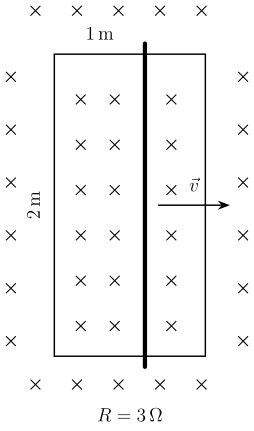 (A) 75 mA
(B) 133 mA
(C) 0.75 A
(D) 1.33 A
(A) 75 mA
(B) 133 mA
(C) 0.75 A
(D) 1.33 A›Reveal solutionSolution
Compute the motional emf ε=Bℓv with the rod's length ℓ=2 m, then apply Ohm's law with R=3Ω.
Step 1 — Why an emf appears (the concept).
As the rod slides, the free charges inside it move with velocity v through the magnetic field B and feel the Lorentz force q(v×B). Positive charge accumulates at one end, negative at the other, setting up a potential difference — the motional emf. Equivalently (Faraday), the area of the circuit changes at a rate dtdA=ℓv, so
ε=dtdΦ=BdtdA=Bℓv
Step 2 — Identify the quantities.
- Length of the sliding rod (the side perpendicular to v, which is the effective length): ℓ=2 m
- Speed: v=5 m s−1
- Field (perpendicular to the plane, so sinθ=1): B=0.04 T
- Resistance of the rod (the only resistance stated): R=3 Ω
Step 3 — Compute the emf.
ε=Bℓv=0.04×2×5
ε=0.4 V
Step 4 — Apply Ohm's law to the circuit.
The rod is the seat of the emf and also the only resistor, so
I=Rε=3 Ω0.4 V
I=0.1333 A
Step 5 — Convert units and match.
I=0.133 A=133 mA
The distractors are built from the classic slips: (D) 1.33 A is a factor-of-10 error, and (A) 75 mA / (C) 0.75 A come from using the 1 m side of the frame instead of the 2 m rod (which would give ε=0.2 V... and then further mis-scaling). Always use the length of the moving conductor between the rails, here 2 m.
✓Final answerThe correct option is (B) — 133 mA.
ANSWER: B
🎓Unlock everything free for 14 days
- ✓Full step-by-step solutions
- ✓Concept-first explanations
- ✓Methods, shortcuts & mistakes
- ✓PYQ mapping + timed mock tests
Full access for 14 days. No credit card required.