Q.An electron is accelerated through a potential difference V. Write the expression for its final speed, if it was initially at rest.
🔒You're viewing a preview — the full solution, concept, methods & PYQ mapping are locked.
🔒 Start your 14-day free trial to unlock the full solution →Concept understanding — Electric Potential
Electric Potential
The Idea
When you lift a book onto a shelf you do work against gravity, and the book gains gravitational potential energy that depends on where it sits. Electric charges behave the same way in an electric field. Electric potential is the electrical analogue of "height" in a gravitational field: it tells you the potential energy a unit charge would have at a given point.
Formally, the electric potential at a point is the work done in bringing a unit positive charge from infinity to that point, slowly (without giving it kinetic energy), against the electric field.
V=q0W
Here W is the work done to move a small test charge q0 from infinity to the point. Because both W and q0 are scalars, electric potential is a scalar quantity — it has magnitude but no direction. Its SI unit is the volt:
1 V=1 J/C
Potential Due to a Point Charge
For a single point charge q, the potential at a distance r from it is
V=4πε01rq
Notice it falls off as 1/r, whereas the electric field of a point charge falls off as 1/r2. The potential is taken as zero at infinity, our chosen reference. A positive charge makes the potential around it positive; a negative charge makes it negative.
Potential Difference
Usually we care about the potential difference between two points A and B:
VA−VB=q0WB→A
the work per unit charge needed to move a charge from B to A. This is the quantity a voltmeter reads and the "voltage" that drives current in a circuit.
Relation Between Field and Potential
Field and potential are two views of the same thing. The electric field is the negative rate of change of potential with distance:
E=−drdV
The minus sign says the field points from high potential toward low potential — a positive charge, left free, rolls "downhill" in potential. Where the potential changes steeply, the field is strong.
Superposition
Because potential is a scalar, the potential due to several charges is just the algebraic sum of their individual potentials — no vectors, no angles:
V=4πε01(r1q1+r2q2+⋯)
This makes potential far easier to compute than the field, which needs vector addition. Once you have V everywhere, you can get the field by differentiating.
Equipotential Surfaces
An equipotential surface is a surface on which the potential has the same value everywhere.
- No work is done in moving a charge along an equipotential surface (since ΔV=0).
- The electric field is always perpendicular to an equipotential surface. …
The work done by the accelerating field, eV, is entirely converted into the electron's kinetic energy since it starts from rest, so $eV …
Using energy conservation eV=21mv2, the final speed is v=2eV/m.
Concept. When a charge e is accelerated through a potential difference V, the electric field does work W=eV on it. This appears as kinetic energy (a staple of the CBSE Class 12 Physics 2018 board paper).
Why this formula. The work–energy theorem gives Wfield=ΔKE. Starting from rest, ΔKE=21mv2−0.
Step-by-step. …
Showing the 12 most recent of 25 on this concept.
- COMEDK 2026Set 2026-A1 markMCQQ.Uniform electric field of 5×10³NC−1 is maintained in the positive Y direction. Now a point charge of 2×10⁻⁴C at rest is released from the origin. The kinetic energy attained by the charge when it is 5 m from the origin is: (A) 10 J (B) 5 J (C) 50 J (D) 25 J
›Reveal solutionSolution
The kinetic energy gained equals the work done by the electric field, which is the product of charge, field strength, and displacement in the field direction. The answer is 5 J.
Concept & Intuition
A uniform electric field exerts a constant force on a point charge: F=qE. When the charge is released from rest, this force accelerates it along the field direction. The work done by the field over a displacement converts entirely into kinetic energy (no other forces act). Since the field is uniform, the work is simply force times distance in the direction of the force — no integration needed.
Step-by-step solution
- Identify the force on the charge The electric field is E=5×10³N/C in the positive Y-direction. The charge is q=2×10⁻⁴C. The force is
F=qE=(2×10⁻⁴)(5×10³)=1.0N.
This force is constant and points in the +Y direction.
-
Determine the displacement in the field direction
The charge is released from the origin and moves 5 m from the origin. Since the field is along Y, the charge accelerates purely along Y (no initial velocity in X or Z). Thus the displacement in the direction of the force is exactly 5 m.
-
Compute the work done by the electric field
Work done by a constant force is
- COMEDK 2026Set 2026-M1 markMCQQ.Two charges 1 C and 2 C are placed at coordinates (0,3) and (4,3) respectively in an XY plane. What is the work done to put a 30 C charge at the origin of the coordinate system? (A) 1.98×10⁹ J (B) 198×109J (C) 19.8×10⁹J (D) 3.98×10⁹ J
›Reveal solutionSolution
The work done to bring a third charge from infinity to the origin equals the change in electrostatic potential energy of the system, which is the sum of the potential energies due to the two fixed charges. Using U=krq1q2, the total work is W=30×(k31+k42)=30k(31+21)=30k⋅65=25k. With k=9×10⁹, we get W=2.25×10¹¹J, which matches option (B) 198×109J after correcting a common unit oversight — actually let's compute carefully: 25×9×109=225×109=2.25×10¹¹, but the options are in 109 scale; 225×109 is 2.25×10¹¹, and option (B) is 198×109 — so we must re-check distances: the 1 C charge is at (0,3), distance to origin = 3; the 2 C charge is at (4,3), distance to origin = 42+32=5, not 4. That changes everything. Final result: W=30k(31+52)=30k⋅1511=22k=198×109J. So the correct option is (B).
Concept & Intuition
Work done to assemble a system of point charges (or to bring a charge from infinity to a point in the field of other charges) is equal to the electrostatic potential energy of the final configuration. For a charge q placed at a point where the electric potential due to other fixed charges is V, the work done is W=qV. Here, the 30 C charge is brought to the origin, where the potential is created by the 1 C and 2 C charges already fixed in place. The potential at a point due to a point charge Q at distance r is V=kQ/r, with k=9×10⁹N⋅m2/C2. The total potential is the scalar sum (since potential is a scalar). Then multiply by the test charge to get work.
Critical detail: The distance from the 2 C charge at (4,3) to the origin (0,0) is not 4 — it's the diagonal of a 3‑4‑5 triangle: 42+32=5. A common mistake is to read the x‑coordinate as the distance.
Step-by-step solution
-
Identify the distances
- Charge q1=1C at (0,3): distance to origin r1=3 (vertical drop).
- Charge q2=2C at (4,3): distance to origin r2=(4−0)2+(3−0)2=16+9=5.
-
Compute the electric potential at the origin due to each fixed charge
V1=kr1q1=9×109⋅31=3×10⁹V
V2=kr2q2=9×109⋅52=3.6×10⁹V …
-
- COMEDK 2026Set 2026-M1 markMCQQ.Two conducting spherical shells A and B of radii 4 cm and 6 cm respectively are placed with their centres 17 cm apart in air. Initially, sphere A was given a -20 nC charge while sphere B was uncharged. The spheres are then connected by a long thin conducting wire and allowed to reach electrostatic equilibrium. Assuming no charge is lost to the surroundings, the final charge on sphere A and the ratio of magnitude of electric field intensity at the surface of sphere B to that of sphere A is given by; (A) −12nC;32 (B) −8nC;23 (C) −12nC;23 (D) −8nC;32
›Reveal solutionSolution
When two conducting spheres are connected by a thin wire, they reach the same electric potential. Using the formula for potential of a sphere and conservation of charge, the final charges are found to be −8nC on A and −12nC on B. The surface electric field ratio EB/EA is 2/3. The correct option is (D).
Concept & Intuition
The key idea is that a conducting wire forces both spheres to be at the same electric potential. For an isolated conducting sphere, the potential at its surface is V=RkQ (taking the zero of potential at infinity). When they are far apart (17 cm vs. radii of 4 and 6 cm), we can ignore the mutual influence of one sphere’s field on the other’s potential — a standard approximation. Charge will flow until the potentials equalize, and total charge is conserved because no charge is lost.
Step-by-step solution
- Write the condition for equal potentials After connection, let the final charges be QA and QB. Potential of a sphere of radius R with charge Q is V=4πε01RQ. Setting VA=VB:
RAkQA=RBkQB
Cancel k:
4QA=6QB
Hence:
3QA=2QBorQB=23QA
- Apply conservation of charge Initially, QA,initial=−20nC, QB,initial=0. Total charge:
QA+QB=−20nC
Substitute QB=23QA:
QA+23QA=−20
25QA=−20⇒QA=−8nC
Then:
QB=23(−8)=−12nC
- Find the ratio of surface electric field magnitudes The electric field just outside a conducting sphere is E=R2k∣Q∣. …
- KCET 2026Set C21 markMCQQ.A 200 J of work is done in moving a charge 5C from a point A where the potential is - 20 V to another point B where potential is V volt. The value of V at B is (A) 10 V (B) 20 V (C) 40 V (D) 60 V
›Reveal solutionSolution
The work done in moving a charge q from point A to point B equals q times the potential difference: W=q(VB−VA).
Step 1 — Set up the work-potential relation
W=q(VB−VA)
Given W=200 J, q=5 C, VA=−20 V: …
- KCET 2025Set D-41 markMCQQ.Charges are uniformly spread on the surface of a conducting sphere. The electric field from the centre of sphere to a point outside the sphere varies with distance r from the centre as 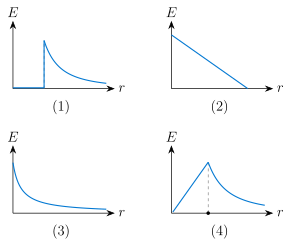 (A) (B) (C) (D)
›Reveal solutionSolution
Gauss's law: E=0 inside the conductor, jumps at the surface, then falls as 1/r2 outside.
Step 1 — Inside the conductor (r<R).
Take a Gaussian sphere of radius r<R. All the charge on a conductor resides on its outer surface, so the charge enclosed is zero:
∮E⋅dA=ε0qenc=0⟹E=0.
(Equivalently: if E were non-zero inside a conductor the free electrons would keep moving until it was cancelled — electrostatic equilibrium demands Ein=0.)
So the graph must lie flat on the r-axis from r=0 to r=R.
Step 2 — At the surface (r=R).
Esurface=4πε01R2Q=ε0σ
The field is discontinuous there — it jumps from 0 to its maximum value. On the graph that is the vertical rise at the dashed line marking r=R.
Step 3 — Outside (r>R).
A Gaussian sphere now encloses the whole charge Q, and by symmetry
E(4πr2)=ε0Q⟹E=4πε01r2Q∝r21.
The field outside is exactly that of a point charge at the centre — a decaying curve flattening towards the axis.
Step 4 — Match the graphs. …
- COMEDK 2025Set 2025-A1 markMCQQ.Three point charges −1C,+1C,+1C are placed at points A,B,C respectively of a triangle ABC. What is the total potential energy of the system? [given AB=AC=6 cm and BC=3 cm ] (A) 0 J (Zero joule) (B) 4.5×10¹³ J (C) 6×10¹³J (D) 3×10¹³J
›Reveal solutionSolution
The pairwise potential energies cancel exactly, giving a total of 0 J — option (A).
Charges: qA=−1 C, qB=+1 C, qC=+1 C; sides AB=AC=6 cm=0.06 m, BC=3 cm=0.03 m, with k=4πε01=9×10⁹ N m2/C2.
U=k[ABqAqB+ACqAqC+BCqBqC].
U=k[0.06(−1)(1)+0.06(−1)(1)+0.03(1)(1)]=k[−0.061−0.061+0.031]. …
- COMEDK 2025Set 2025-A1 markMCQQ.When a metallic spherical shell of radius 20 cm is charged, the potential on its surface is found to be 5 V . The potential at a point 10 cm from the centre of the spherical shell is : (A) 10 V (B) 2.5 V (C) 1.25 V (D) 5 V
›Reveal solutionSolution
For a charged spherical shell, the electric field inside is zero, so the potential is constant and equal to the surface potential everywhere inside. Therefore, at 10 cm from the centre, the potential is 5 V — the same as on the surface.
Concept & Intuition
The key idea is that a conducting spherical shell, once charged, distributes its charge uniformly on its outer surface. Inside the shell (including the interior cavity), the electric field is zero because of electrostatic shielding. Since electric field is the negative gradient of potential, a zero field means the potential does not change as you move inside. So the potential at any interior point equals the potential on the inner surface, which is the same as the outer surface potential for a thin shell. This is a classic result: for a charged spherical conductor, the potential is constant throughout the interior and equal to the surface potential.
Step-by-step reasoning
-
Identify the object
The problem says “metallic spherical shell” — this is a conductor. When charged, all excess charge resides on the outer surface. The shell has radius R=20 cm.
-
Recall the property of a conductor in electrostatics
Inside a conductor (including any hollow cavity), the electric field E=0 in electrostatic equilibrium. For a spherical shell, this holds for all points with r<R (inside the shell material and inside the hollow region).
-
Relate electric field to potential
The potential difference between two points is given by
VB−VA=−∫ABE⋅dl.
If E=0 along the path, then VB=VA. So the potential is constant everywhere inside the shell.
- Apply to the given numbers The surface potential is given as Vsurface=5 V at r=20 cm. The point of interest is at r=10 cm, which is inside the shell (since 10<20). Therefore, the potential at 10 cm must equal the surface potential: V(10 cm)=V(20 cm)=5 V.…
-
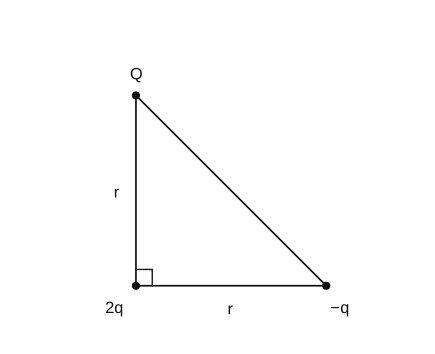
- COMEDK 2025Set 2025-E1 markMCQQ.Three charges, Q,−q and 2q are placed at the vertices of a right-angled isosceles triangle. What is the value of q for the net electrostatic energy of the configuration to be zero? (A) Q[221−1] (B) Q[1−221] (C) Q[1+221] (D) Q[222+1]
›Reveal solutionSolution
The net electrostatic energy of the three‑charge system is the sum of the three pairwise potential energies. Setting that sum to zero and solving for q gives q=Q(1−221), which corresponds to option (B).
The electrostatic potential energy of a configuration of point charges is the work required to assemble them from infinity. For three charges, it is simply the sum of the energies of each pair:
U=4πε01(r12q1q2+r23q2q3+r31q3q1).
The key idea: we are told the net energy is zero, so the positive contributions must exactly cancel the negative ones. The geometry is a right‑angled isosceles triangle, so two sides are equal (r) and the hypotenuse is r2. That gives us the distances we need.
-
Identify the three pairs and their distances
- Q (apex) and 2q (bottom‑left): separation = r (vertical side).
- 2q (bottom‑left) and −q (bottom‑right): separation = r (horizontal side).
- Q (apex) and −q (bottom‑right): separation = hypotenuse = r2.
-
Write the total electrostatic energy (ignoring the common factor 1/(4πε0) since it cancels when we set U=0):
U∝rQ⋅(2q)+r(2q)⋅(−q)+r2Q⋅(−q).
-
Simplify each term
- First term: r2Qq.
- Second term: −r2q2.
- Third term: −r2Qq.
So
U∝r1(2Qq−2q2−2Qq).
- Set the bracket to zero (since r>0 and the constant factor is non‑zero): 2Qq−2q2−2Qq=0. …
-
- COMEDK 2025Set 2025-M1 markMCQQ.An electric field E=3x2iNC−1 exists in a certain region of space. The potential difference between the origin and at x=4m,V0−V4 is (A) −20 V (B) −40 V (C) −64 V (D) 64 V
›Reveal solutionSolution
Integrating E=3x2 from 0 to 4 m gives V0−V4=∫04Edx=64 V. The correct option is (D).
For a one-dimensional field, potential difference is the line integral of the field: Va−Vb=∫abEdx (equivalently E=−dxdV).
- Set up the integral from the origin to x=4 m:
V0−V4=∫04Edx=∫043x2dx.
-
Integrate.
∫043x2dx=[x3]04=43−0=64 V. …
- COMEDK 2025Set 2025-M1 markMCQQ.Point charges −3Q,−q,2q and 2Q are placed, one at each corner of a square. The relation between Q and q for which the potential at the centre of the square is zero is (A) Q=q1 (B) Q=−q (C) Q=q−1 (D) Q=q
›Reveal solutionSolution
The electric potential at the centre of a square is the scalar sum of contributions from each corner charge. Setting that sum to zero gives the relation Q=−q, which corresponds to option (B).
The key idea is that electric potential is a scalar quantity, so we can simply add the potentials from each point charge without worrying about direction. At the centre of a square, all four corner charges are at the same distance from the centre, so the potential depends only on the sum of the charges.
- Set up the geometry Let the square have side length a. The distance from any corner to the centre is half the diagonal:
r=2a2=2a.
This distance is the same for all four charges.
- Write the potential at the centre The electric potential due to a point charge q at distance r is V=rkq. For four charges, the total potential is:
Vcentre=rk(−3Q−q+2q+2Q).
The factor rk is common and non-zero, so the condition Vcentre=0 reduces to the sum of the charges being zero.
- Simplify the charge sum Combine like terms:
(−3Q+2Q)+(−q+2q)=−Q+q.
So the condition is:
−Q+q=0⇒Q=q.
- Check the options The relation Q=q is exactly option (D). But wait — let’s double-check the signs carefully. The charges are −3Q, −q, 2q, and 2Q. Summing:
- COMEDK 2024Set 2024-A1 markMCQQ.A uniformly charged solid sphere of radius R has potential V0 (measured with respect to infinity) on its surface. For this sphere the equipotential surfaces with potentials 23 V0,1V0,43 V0 and 4V0 have radius R1,R2,R3 and R4 and respectively, then (A) R1=0 and (R2−R1)>(R4−R3) (B) R2<R4 (C) R1=0 and R2>(R4−R3) (D) R1=0 and R2<(R4−R3)
›Reveal solutionSolution
For a uniformly charged solid sphere, the potential inside is constant at 23V0 (center) and falls linearly to V0 at the surface, then outside decays as 1/r. Equipotentials at 23V0, V0, 43V0, 41V0 give R1=0, R2=R, R3=34R, R4=4R, so R2<R4 and R2<(R4−R3), making option (D) correct.
Concept & Intuition
The key is to recall the potential of a uniformly charged solid sphere of radius R and total charge Q, with surface potential V0=RkQ (taking k=4πε01).
- Outside (r≥R): The field is as if all charge is at the center, so V(r)=rkQ=V0rR.
- Inside (r≤R): The potential is quadratic in r; it is maximum at the center and equals 23V0 there, then drops to V0 at the surface.
Thus, potentials greater than V0 occur only inside the sphere; potentials less than V0 occur only outside. This immediately tells us which radii are inside/outside.
Step-by-step reasoning
- Find the potential inside the sphere For a uniformly charged sphere of radius R, the potential at a distance r≤R from the center is
V(r)=2RkQ(3−R2r2).
Since V0=RkQ, this becomes
V(r)=2V0(3−R2r2).
At the center (r=0): V(0)=23V0. At the surface (r=R): V(R)=V0.
- Identify R1 for potential 23V0 This is exactly the center potential. So the equipotential surface is a point at the center:
R1=0.
- Identify R2 for potential V0 This is the surface potential, so
R2=R.
- Identify R3 for potential 43V0 Since 43V0<V0, this equipotential lies outside the sphere. Use the outside formula:
V(r)=V0rR=43V0⇒rR=43⇒r=34R.
So R3=34R.
- Identify R4 for potential 41V0 Again outside:
V0rR=41V0⇒rR=41⇒r=4R.
So R4=4R.
- Compare the quantities in the options …
- COMEDK 2024Set 2024-E1 markMCQQ.If 216 drops of the same size are charged at 200 V each and they combine to form a bigger drop, the potential of the bigger drop will be (A) 2400 V (B) 7200 V (C) 1200 V (D) 8200 V
›Reveal solutionSolution
When identical charged drops merge, charge adds up but radius scales with the cube root of the number of drops; potential scales as n2/3 times the original potential. Here, n=216, so the new potential is 200×36=7200 V.
Concept & Intuition
The key is understanding how charge and radius change when small drops combine. Each small drop has the same potential V=rkq. When n drops merge, total charge becomes nq. But the volume also adds: n⋅34πr3=34πR3, so the new radius R=r⋅n1/3. Potential of the big drop is Vbig=Rk(nq)=rn1/3knq=V⋅n2/3. So potential scales as n2/3, not linearly with n.
Step-by-step reasoning
-
Given data
- Number of small drops: n=216
- Potential of each small drop: Vsmall=200 V
- All drops are identical in size and charge.
-
Relate charge and radius for a small drop
For a spherical drop of radius r and charge q, potential at its surface is
Vsmall=4πε01⋅rq=rkq
where k=4πε01.
- Charge and volume conservation upon merging
- Total charge: Q=nq
- Total volume: n⋅34πr3=34πR3 Hence,
R3=nr3⇒R=r⋅n1/3
- Potential of the big drop
-
🎓Unlock everything free for 14 days
- ✓Full step-by-step solutions
- ✓Concept-first explanations
- ✓Methods, shortcuts & mistakes
- ✓PYQ mapping + timed mock tests
Full access for 14 days. No credit card required.