Q.(a) A 900 pF capacitor is charged by 100 V battery [Fig. 2.31(a)]. How much electrostatic energy is stored by the capacitor?
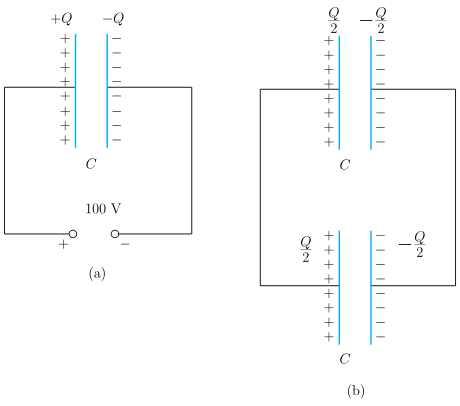
🔒You're viewing a preview — the full solution, concept, methods & PYQ mapping are locked.
🔒 Start your 14-day free trial to unlock the full solution →Concept understanding — Capacitor Energy Storage
Capacitor Energy Storage
The Intuition
Charging a capacitor is like piling sand onto a growing heap. The first grain of charge lands on an empty plate easily. But every later bit of positive charge must be pushed onto a plate that is already positive, and it resists. So more and more work is needed as the plate fills up. All of that work does not disappear — it is stored in the capacitor as electrostatic potential energy, ready to be released later.
Building the Formula
Suppose at some instant during charging the capacitor already holds charge q, so the voltage across it at that moment is v=q/C. Moving one more small charge dq onto the plate costs work:
dW=vdq=Cqdq
Adding up (integrating) all these small contributions as the charge builds from 0 to a final value Q gives the total work done:
W=∫0QCqdq=C1⋅2Q2=2CQ2
This work is exactly the energy U stored in the charged capacitor.
Three Equivalent Forms
Using Q=CV, the same stored energy can be written three ways — pick whichever matches the quantities you know:
U=2CQ2=21QV=21CV2
- Use 2CQ2 when the charge is fixed (capacitor disconnected from the source).
- Use 21CV2 when the voltage is fixed (capacitor stays connected to a battery).
The factor of 21 is essential. A common error is writing U=QV. That would only be true if the full voltage V acted while all the charge moved — but the voltage climbs steadily from 0 to V as the plates fill, so the effective average voltage is V/2, giving U=21QV.
Where the Energy Lives — Energy Density
The energy is stored in the electric field occupying the space between the plates, not on the plates themselves. For a parallel-plate capacitor this leads to a general result: energy stored per unit volume of field is
u=21ε0E2
where E is the field strength. Wherever an electric field exists, energy is stored there, with density proportional to E2.
A Quick Example
A 10 μF capacitor is charged to 100 V. The stored energy is:
U=21CV2=21×(10×10−6)×(100)2=0.05 J
That 0.05 J can be released almost instantly — which is exactly how a camera flash works: charge slowly, discharge fast. …
Concept: Capacitor Energy Storage — U=21CV2=Q2/2C; connecting a charged capacitor to an identical uncharged one conserves total charge but not total energy.
(a) C=900 pF=9×10⁻¹⁰ F, V=100 V:
Ui=21CV2=21(9×10⁻¹⁰)(100)2=4.5×10⁻⁶ J.
(b) Disconnected, the charge Q=CV=9×10⁻⁸ C is fixed. Connected to an identical uncharged 900 pF capacitor (now in parallel, Ceq=1.8×10⁻⁹ F), it splits equally, 4.5×10⁻⁸ C each: …
Energy stored in a charged capacitor is U=21CV2=Q2/2C. Charging 900 pF to 100 V stores Ui=4.5 μJ (part a). Once disconnected from the battery and connected to an identical uncharged 900 pF capacitor, the fixed total charge splits equally between the two (now-parallel) capacitors, and the system's total stored energy drops to exactly half, Uf=2.25 μJ (part b) — the rest is dissipated as heat/spark during the redistribution.
Part (a): energy stored while connected to the battery
C=900 pF=9×10⁻¹⁰ F,V=100 V.
Using U=21CV2:
Ui=21(9×10⁻¹⁰)(100)2=21(9×10⁻¹⁰)(104)=4.5×10⁻⁶ J=4.5 μJ.
The charge on the capacitor at this point is Q=CV=(9×10⁻¹⁰)(100)=9×10⁻⁸ C — this is the charge carried over into part (b).
Part (b): disconnect, then connect to an identical uncharged capacitor
Once the battery is removed, the charge Q=9×10⁻⁸ C on the first capacitor is fixed (nothing left to add or remove charge). Connecting it to a second, identical, uncharged 900 pF capacitor puts the two in parallel, and since there is no external source, the total charge Q must simply redistribute between them.
By symmetry (identical capacitors), the charge splits equally:
Q1=Q2=2Q=4.5×10⁻⁸ C.
The combined (parallel) capacitance is Ceq=C+C=1.8×10⁻⁹ F, and the total stored energy afterward is …
Method: Capacitor Energy Storage — Whether the Capacitor Stays Connected to the Source or Is Isolated
This method applies to any problem comparing a capacitor's stored energy before and after some change (adding a dielectric, connecting to another capacitor, disconnecting from the battery) — the correct formula to use depends on what is held fixed during the change.
Steps
Step 1: Decide what is held constant — voltage or charge
If the capacitor stays connected to a battery throughout, the voltage across it is fixed by the battery; use U=21CV2. If the capacitor is disconnected from every source before the change happens, its charge is fixed (nothing can add or remove charge); use U=2CQ2.
Step 2: Compute the initial energy with the appropriate formula
Use whichever of U=21CV2, U=21QV, or U=Q2/2C matches the quantities actually given at that stage.
Step 3: For a "disconnect, then connect to another capacitor" scenario, apply charge conservation first …
- COMEDK 2026Set 2026-A1 markMCQQ.A capacitor of capacitance 8μ F is fully charged by connecting it to a source of 200 V . It is then disconnected from the supply and connected to an uncharged capacitor of capacitance 4μ F. The electrostatic energy lost in this sharing is: (A) 21.34×10⁻²J (B) 5.33×10⁻²J (C) 3.53×10⁻³J (D) 10.67×10⁻²J
›Reveal solutionSolution
The energy lost when a charged capacitor shares charge with an uncharged one equals the difference between the initial stored energy and the final stored energy. The result is 5.33×10⁻²J, which corresponds to option (B).
The key idea here is that energy is not conserved when two capacitors are connected directly — charge is conserved, but some energy is inevitably lost as heat in the connecting wires (or radiated as electromagnetic waves). The problem asks for that lost energy, which is simply the difference between the initial energy (stored in the first capacitor alone) and the final energy (stored in both capacitors after they reach the same voltage).
1. Find the initial charge and energy
The first capacitor is fully charged to 200 V.
Charge stored:
Q0=C1V=(8×10⁻⁶F)(200V)=1.6×10⁻³C
Initial energy:
Ei=21C1V2=21(8×10⁻⁶)(200)2=21(8×10⁻⁶)(40000)=0.16J
2. After connecting to the uncharged capacitor
The two capacitors are now in parallel (same voltage after connection). Total capacitance:
Ceq=C1+C2=8μF+4μF=12μF=12×10−6F
Charge is conserved (no battery connected):
Qtotal=Q0=1.6×10⁻³C
Final common voltage:
Vf=CeqQtotal=12×10−61.6×10−3=121600=133.33V
3. Final energy stored
Ef=21CeqVf2=21(12×10−6)(3400)2
Since 133.33=3400:
- KCET 2026Set C21 markMCQQ.A parallel plate capacitor has a uniform electric field 'E' in the space between the plates. If the distance between the plates is 'd' and area of each plate is 'A', the energy stored in the capacitor is (A) 21ϵ0E2 (B) ϵ0EAd (C) 21ϵ0E2Ad (D) ϵ0E2Ad
›Reveal solutionSolution
The energy stored in a capacitor's field equals the energy density u=21ϵ0E2 multiplied by the volume of the field region between the plates.
Step 1 — Energy density of the electric field
For a uniform electric field E, the energy stored per unit volume is
u=21ϵ0E2(J/m3)
Step 2 — Multiply by the volume between the plates …
- COMEDK 2025Set 2025-M1 markMCQQ.An ideal inductor is connected across a capacitor. Oscillations of energy K are set up in the circuit. The capacitor plates are slowly drawn apart such that the frequency of oscillations is quadrupled. The work done in the process is (A) 15K (B) 13K (C) zero (D) 2K
›Reveal solutionSolution
Quadrupling the LC circuit's frequency means the capacitance drops to 1/16 of its original value. Treating the charge amplitude as fixed while the plates are drawn apart (the standard approach for this problem), the stored energy rises from K to 16K, so the work done is 15K — option (A).
Concept and Intuition
An ideal LC circuit oscillates at ω=1/LC. Pulling the capacitor's plates apart lowers C, which raises ω. Since the inductor is ideal and no current flows through the external agent doing the pulling, the charge on the capacitor cannot change abruptly — so as the plates separate, the amplitude of the charge oscillation stays fixed at its established value Q0, while the stored energy E=Q02/(2C) changes purely because C changes. The work done by the external agent equals the resulting change in the circuit's total energy.
Step-by-step reasoning
- Relate frequency and capacitance. ω=LC1⇒ωiωf=CfCi=4⇒Cf=16Ci …
- COMEDK 2023Set 2023-M1 markMCQQ.If C be the capacitance and V be the electric potential, then the dimensional formula of CV2 is (A) [ML2 T−2 A0] (B) [MLT−2 A−1] (C) [M0LT−2 A0] (D) [ML−3TA]
›Reveal solutionSolution
The energy stored in a capacitor is 21CV2, so CV2 has the dimensions of energy, [ML2T−2] (with A0).
The electrostatic energy stored in a capacitor is
U=21CV2,
so CV2=2U carries the dimensions of energy: …
- KCET 2022Set B-31 markMCQQ.If voltage across a bulb rated 220V, 100 W drops by 2.5 % of its rated value, the percentage of the rated value by which the power would decrease is (A) 5% (B) 10% (C) 20% (D) 2.5%
›Reveal solutionSolution
Power varies as the square of the voltage, so a small fractional change in V produces twice that fractional change in P.
Step 1 — The relation between P and V.
The bulb's resistance is fixed by its rating:
R=PV2=100(220)2=484 Ω.
With R constant, the power dissipated at any applied voltage is
P=RV2⟹P∝V2.
Step 2 — Convert a proportionality into a percentage rule (error/differential analysis).
Take logarithms and differentiate:
lnP=2lnV−lnR⟹PdP=2VdV.
In percentage terms, for small changes,
PΔP×100%=2(VΔV×100%)
This is the standard rule: the percentage error/change in a quantity is multiplied by its exponent.
Step 3 — Substitute.
VΔV=−2.5%⟹PΔP=2×(−2.5%)=−5%.
The power decreases by 5 % of its rated value.
Step 4 — Exact check (no approximation). …
- KCET 2021Set B-21 markMCQQ.In figure, charge on the capacitor is plotted against potential difference across the capacitor. The capacitance and energy stored in the capacitor are respectively. (A) 12 μF, 1200 μJ (B) 12 μF, 600 μJ (C) 24 μF, 600 μJ (D) 24 μF, 1200 μJ
›Reveal solutionSolution
The slope of the Q–V graph gives the capacitance, and the area under the graph gives the energy stored. Reading the graph's marked point, C=12 μF and U=600 μJ, so the correct option is (B).
The relationship between charge Q on a capacitor and the potential difference V across it is Q=CV, where C is the capacitance — a straight line through the origin when Q is plotted against V, whose slope is C. The energy stored in a capacitor is U=21CV2=21QV, which is also the area under the Q–V graph (since U=∫VdQ and the graph is linear). So both quantities can be read directly from the graph's marked point.
- Find the capacitance from the slope. The graph's marked point is at V=10 V, Q=120 μC.
C=ΔVΔQ=10 V120 μC=12 μF.
- Find the energy stored. For a linear Q–V graph through the origin, the energy stored up to that point is the area of the triangle under the line: …
- KCET 2018Set A-11 markMCQQ.Two capacitors of 3μF and 6μF are connected in series and a potential difference of 900V is applied across the combination. They are then disconnected and reconnected in parallel. The potential difference across the combination is (A) Zero (B) 100V (C) 200V (D) 400V
›Reveal solutionSolution
Find the common series charge, then redistribute that total charge over the parallel combination: V=Qtotal/Cparallel.
Step 1 — Series combination: same charge on each capacitor.
Capacitors in series carry equal charge (the inner plates form an isolated conductor). The equivalent capacitance is
Cs1=31+61=62+1=21⇒Cs=2 μF.
Step 2 — Charge stored.
Q=CsV=(2 μF)(900 V)=1800 μC.
So the 3μF capacitor holds 1800 μC and the 6μF capacitor holds 1800 μC.
Step 3 — Disconnect and reconnect in parallel.
The capacitors keep their charges when disconnected. Reconnecting them in parallel (positive plate to positive plate — the standard reading of "reconnected in parallel") means the charges simply add on the common node:
Qtotal=1800+1800=3600 μC.
The parallel capacitance is …
🎓Unlock everything free for 14 days
- ✓Full step-by-step solutions
- ✓Concept-first explanations
- ✓Methods, shortcuts & mistakes
- ✓PYQ mapping + timed mock tests
Full access for 14 days. No credit card required.