Physics · Ch 9 — Ray Optics and Optical Instruments
Sign Convention
Sign Convention
Why a Sign Convention is Needed
To derive a single formula that works for all cases of reflection by spherical mirrors and refraction by spherical lenses, we must first agree on how to measure distances and heights. Without a standard rule, the same formula would give different answers for different setups. The Cartesian sign convention provides this standard.
The Cartesian Sign Convention
All distances are measured from a fixed reference point:
- For mirrors: the reference point is the pole (the centre of the mirror's surface).
- For lenses: the reference point is the optical centre (the centre of the lens).
Rules for Distances
- Direction of incident light: The direction in which light initially travels before hitting the mirror or lens is taken as the positive direction.
- Distances along the principal axis:
- Distances measured in the same direction as the incident light are positive.
- Distances measured in the opposite direction to the incident light are negative.
Rules for Heights (Perpendicular to the Principal Axis)
The principal axis is taken as the -axis.
- Heights measured upwards (perpendicular to the principal axis, i.e., along the positive -axis) are positive.
- Heights measured downwards (along the negative -axis) are negative.
Why This Convention is Powerful …
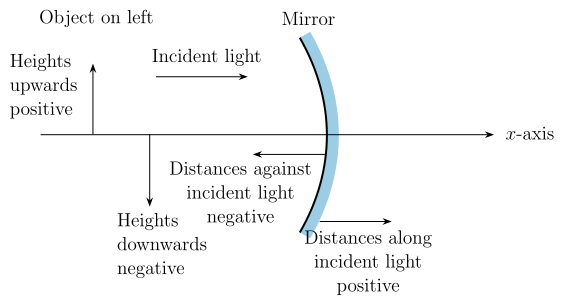
Drawn by us to help you understand the concept clearly, and verified to make sure it's accurate. For exams, practice from your textbook's own diagram.
What the Figure Shows
The figure is a coordinate diagram overlaid on a concave mirror. The mirror's pole (the central point of its reflecting surface) is placed at the origin of an – Cartesian plane. The mirror's principal axis lies along the -axis. The mirror itself is drawn as an arc that opens to the left — meaning its reflecting surface faces the incoming light.
- The direction points to the right, which is the same direction as the incident light (light travels from left to right toward the mirror).
- The direction points to the left, opposite to the incident light.
- The direction is upward, perpendicular to the principal axis; is downward.
A coordinate cross is drawn at the pole , marking the origin. Annotations on the figure state:
- Distances measured in the direction of incident light (to the right) are positive.
- Distances measured against the direction of incident light (to the left) are negative.
- All distances are measured from the pole .
- Heights measured upward () are positive; heights measured downward () are negative.
Physical Idea Taught
This figure establishes the Cartesian sign convention, a consistent rule for assigning signs to distances in ray optics. Without a uniform sign convention, the same formula would need different versions for concave vs. convex mirrors or converging vs. diverging lenses. By fixing the incident light direction as positive and the pole as the origin, one single formula can describe all spherical mirrors (and similarly one for lenses). The key insight: the sign of a distance tells you whether the point lies on the same side as the incoming light (positive) or opposite to it (negative).
Key Formula Developed Using This Convention
For spherical mirrors, the mirror formula is:
where:
- = focal length (distance from pole to focus)
- = object distance (distance from pole to object)
- = image distance (distance from pole to image)
All three are measured from the pole along the principal axis. Using the Cartesian sign convention:
- For a concave mirror, is negative (focus lies to the left of the pole, against incident light).
- is negative for real objects (placed to the left of the mirror, against incident light). …