Q.A small candle, 2.5 cm in size is placed at 27 cm in front of a concave mirror of radius of curvature 36 cm. At what distance from the mirror should a screen be placed in order to obtain a sharp image? Describe the nature and size of the image. If the candle is moved closer to the mirror, how would the screen have to be moved?
Concept understanding — Spherical Mirror Equation
The Spherical Mirror Equation: From Intuition to Formula
Imagine you're standing in front of a concave mirror — the kind that makes your face look bigger when you're close, but flips everything upside down when you step far back. That change isn't magic; it's geometry. The spherical mirror equation is the single relationship that predicts exactly where an image will form, and whether it's real or virtual, for any spherical mirror.
The Core Idea
Every point on an object sends out light rays in all directions. A mirror redirects those rays. The mirror equation tells you: given the mirror's curvature and the object's distance, where will those rays meet again (or appear to meet)?
There are only three quantities you need:
- u — object distance (from the mirror's pole)
- v — image distance (from the mirror's pole)
- f — focal length (a property of the mirror's curvature)
The equation is:
v1+u1=f1
The power is in the sign convention, because every distance can point in one of two directions.
The Sign Convention (New Cartesian Sign Convention)
This is where most students slip. The equation works for all spherical mirrors — concave and convex — only if you follow the convention used throughout NCERT and CBSE:
- All distances are measured from the mirror's pole.
- The incident light is taken to travel left to right, so distances measured in that same direction (to the right) are positive, and distances measured against it (to the left) are negative.
- Heights above the principal axis are positive; heights below are negative.
Because a real object is always placed in front of the mirror (to the left, where the incident light originates), its distance u is always negative.
Under this convention, the focal length of a concave mirror is negative (its focus F sits in front of the mirror, on the same side as the object), and the focal length of a convex mirror is positive (its focus lies behind the mirror). This is one of the most frequently tested facts in CBSE board exams.
A very common mistake is writing f as positive for a concave mirror because "it converges light." Convergence tells you the type of mirror, not the sign — the sign comes purely from where the focus physically sits relative to the pole, under the convention above.
Where Does the Formula Come From?
For a concave mirror, parallel rays from a distant object converge at the focus, a point at (signed) distance f from the mirror. The derivation uses similar triangles from a ray diagram.
›Proof
Consider an object of height ho in front of a concave mirror. Draw the ray parallel to the axis: it reflects through the focus F. Draw the ray through the centre of curvature C: it strikes the mirror normally and reflects straight back on itself. These two reflected rays cross to form the image, of height hi.
From similar triangles formed by the ray through C:
hiho=R−vu−R
where R=2f is the radius of curvature (with the same sign convention as f).
From similar triangles formed by the ray through F:
hiho=fu−f
Equating the two ratios and simplifying (using R=2f) gives:
v1+u1=f1
What the Equation Tells You
Rearranging for v:
v=u−fuf
Because u is negative for a real object, and v takes the sign the geometry dictates:
- v negative → the image forms in front of the mirror → real image (can be projected on a screen).
- v positive → the image forms behind the mirror → virtual image.
For a concave mirror (f negative), using the magnitude of the object distance ∣u∣ measured from the pole:
- ∣u∣>2∣f∣ → real, inverted, diminished image between f and 2f
- ∣u∣=2∣f∣ → real, inverted, same-size image at 2f
- ∣f∣<∣u∣<2∣f∣ → real, inverted, magnified image beyond 2f
- ∣u∣=∣f∣ → image at infinity
- ∣u∣<∣f∣ → virtual, erect, magnified image behind the mirror (the "shaving mirror" case)
For a convex mirror (f positive), any real object gives a virtual, erect, diminished image behind the mirror — the familiar "rear-view mirror" case.
The Magnification Link
m=hohi=−uv
A negative m means the image is inverted relative to the object; a positive m means it is erect.
A Worked Example
A concave mirror has focal length of magnitude 20 cm, so f=−20 cm. An object is placed 30 cm in front, so u=−30 cm.
v1=f1−u1=−201−−301=−201+301=60−3+2=−601
v=−60 cm
v is negative, so the image is real, 60 cm in front of the mirror. Magnification: m=−v/u=−(−60)/(−30)=−2 — the image is twice the object's size and inverted, matching the ∣f∣<∣u∣<2∣f∣ case above.
The Big Picture
The spherical mirror equation is one instance of a pattern that recurs across optics: the lens formula, the refraction-at-a-spherical-surface formula, and even more advanced optical-system equations share the same reciprocal-distance structure. Master the mirror equation together with its sign convention, and the rest of ray optics — telescopes, microscopes, your own eye — follows the same logic.
The spherical mirror equation, 1/v + 1/u = 1/f, together with the Cartesian sign convention, is one of the most heavily tested formulas in the NCERT Class 12 Physics chapter on ray optics, appearing in nearly every CBSE board paper and in JEE Main/NEET. Searches for "mirror formula sign convention numericals class 12 physics" will find this concave-versus-convex-mirror derivation matches the NCERT textbook precisely.
Why this formula?
Spherical Mirror Equation: Why the Formula Holds
The spherical mirror equation — also called the mirror formula — relates the object distance (u), image distance (v), and focal length (f) of a spherical mirror. Let's build the reasoning step by step.
1. The Key Formula
For a spherical mirror (concave or convex):
f1=u1+v1
Where:
- f = focal length (positive for concave, negative for convex)
- u = object distance from pole (always negative by sign convention)
- v = image distance from pole (sign depends on image location)
2. Why This Formula Holds — The Derivation
Step 1: Start with a ray diagram
Consider a concave mirror with:
- Pole P
- Centre of curvature C (radius R)
- Focus F (midpoint of PC, so f=R/2)
Take an object placed beyond C. Draw two rays from the object's tip:
- A ray parallel to the principal axis → reflects through F
- A ray through C → reflects back along itself
These rays meet at the image point.
Step 2: Use similar triangles
Let the object height be ho and image height be hi.
From the geometry of the ray through C:
- Triangle formed by object, C, and axis is similar to triangle formed by image, C, and axis.
This gives:
hiho=R−vu−R
(Here u and v are distances from P, with sign conventions applied later.)
Step 3: Use the parallel ray
From the ray parallel to the axis:
- Triangle formed by object, F, and axis is similar to triangle formed by image, F, and axis.
This gives:
hiho=fu−f
Step 4: Equate the two ratios
Since both ratios equal ho/hi:
R−vu−R=fu−f
Step 5: Substitute R=2f
For a spherical mirror, the focal length is half the radius of curvature:
R=2f
Substitute:
2f−vu−2f=fu−f
Step 6: Cross-multiply and simplify
Cross-multiply:
f(u−2f)=(u−f)(2f−v)
Expand:
fu−2f2=2fu−uv−2f2+fv
Cancel −2f2 on both sides:
fu=2fu−uv+fv
Bring all terms to one side:
0=fu−uv+fv
Rearrange:
uv=fu+fv
Step 7: Divide by uvf
Divide both sides by uvf:
f1=v1+u1
This is the mirror formula.
3. Why the Sign Convention Matters
The derivation above used distances as positive magnitudes. In actual problem-solving, we use the Cartesian sign convention:
- Distances measured against incident light are negative
- Distances measured along incident light are positive
For a concave mirror:
- u is negative (object in front)
- f is negative (focus in front)
- v is negative for real images (in front)
The formula f1=u1+v1 remains valid with these signed values.
4. Key Insight — Why It's Not Just a Formula
The mirror equation is not an arbitrary rule. It emerges from:
- Geometry (similar triangles from ray paths)
- Physics (law of reflection: angle of incidence = angle of reflection)
- Approximation (paraxial rays — rays close to the axis, so sinθ≈θ)
For rays far from the axis (marginal rays), spherical mirrors show spherical aberration — the formula breaks down.
5. Quick Summary
| Step | What we did |
|---|---|
| Drew two special rays | Parallel ray → through F; Ray through C → reflects back |
| Used similar triangles | Two pairs of similar triangles from geometry |
| Equated height ratios | ho/hi from both pairs |
| Substituted R=2f | Key relation for spherical mirrors |
| Simplified algebra | Cross-multiplied, cancelled, rearranged |
| Divided by uvf | Got f1=u1+v1 |
Bottom line: The mirror formula is a direct consequence of the law of reflection applied to a spherical surface, under the paraxial approximation. It's geometry + physics, not magic.
Concept: Reflection by a spherical mirror — use the mirror formula and magnification relation.
Step 1 — Find focal length.
For a concave mirror, f=2R=236=18 cm.
Object distance u=−27 cm (sign convention: object in front).
Step 2 — Apply mirror formula.
v1+u1=f1
v1+−271=−181
v1=−181+271=54−3+2=−541
Thus v=−54 cm. The negative sign means the image is real and on the same side as the object.
Step 3 — Magnification and image size.
m=−uv=−−27−54=−2
Image height hi=m×ho=−2×2.5=−5 cm.
Negative m means inverted; ∣m∣>1 means enlarged.
Step 4 — Effect of moving candle closer.
If the candle is moved closer (i.e., ∣u∣ decreases), v becomes more negative (image moves farther behind the mirror). Since the image is real, the screen must be moved away from the mirror to keep the image sharp.
The screen should be placed at 54 cm in front of the mirror; the image is real, inverted, and 5 cm tall. Moving the candle closer requires moving the screen farther away.
Using the mirror formula f1=u1+v1 with f=−18 cm (concave mirror) and u=−27 cm, we find v=−54 cm. The screen must be placed 54 cm in front of the mirror. The image is real, inverted, and 5.0 cm tall. Moving the candle closer requires moving the screen away from the mirror until the object reaches the focal point.
1. Understanding the physics: Why the mirror formula works
A concave mirror converges light. When an object is placed beyond the centre of curvature (C), the image forms between C and F — real and inverted. When the object is between F and the pole, the image is virtual and erect. The mirror formula ties object distance u, image distance v, and focal length f:
f1=u1+v1
Sign convention (Cartesian): distances measured from the pole. For a concave mirror, f is negative, u is negative (object in front), and v is negative for a real image (in front of the mirror).
2. Step-by-step solution
Step 1: Find the focal length.
Radius of curvature R=36 cm. For any spherical mirror, f=R/2.
f=236=18 cm
Since it's concave, f=−18 cm.
Step 2: Write the object distance.
Object is placed 27 cm in front of the mirror.
u=−27 cm
Step 3: Apply the mirror formula.
v1=f1−u1=−181−−271=−181+271
Find a common denominator (LCM = 54):
−543+542=−541
Thus:
v=−54 cm
A common mistake is forgetting the negative signs. If you plug u=27 and f=18 without signs, you get v=54 cm — but that would be for a convex mirror. Always apply the sign convention.
Step 4: Interpret v.
The negative sign means the image is formed in front of the mirror — real and inverted. The screen must be placed 54 cm from the mirror on the same side as the object.
Step 5: Find the magnification and image size.
Magnification m=−uv:
m=−(−27)(−54)=−2754=−2
The negative sign indicates inversion. Image height hi=m×ho:
hi=(−2)×2.5 cm=−5.0 cm
The magnitude 5.0 cm tells the size; the negative sign confirms inversion.
Magnification ∣m∣>1 means the image is enlarged. Here ∣m∣=2, so the image is twice the object size.
Step 6: Describe the image.
- Real (can be projected on a screen)
- Inverted (upside down)
- Magnified (5.0 cm tall)
- Formed 54 cm in front of the mirror
Step 7: What happens when the candle is moved closer?
If the object moves toward the mirror (i.e., ∣u∣ decreases), the image distance v changes. Let's examine two cases:
- Object beyond C (∣u∣>36 cm): Image between C and F, real and smaller.
- Object between C and F (18<∣u∣<36): Image beyond C, real and enlarged.
- Object at F (∣u∣=18 cm): Image at infinity — no sharp image on any screen.
- Object between F and pole (∣u∣<18 cm): Image virtual, behind the mirror — cannot be caught on a screen.
In our problem, the candle is at 27 cm (between C and F). Moving it closer to the mirror means ∣u∣ decreases from 27 toward 18 cm. From the mirror formula:
v1=f1−u1
As ∣u∣ decreases, ∣u∣1 increases, so v1 becomes more negative — meaning ∣v∣ increases. The screen must be moved farther away from the mirror.
When the candle reaches 18 cm (the focal point), v→∞ — no image on any screen. Beyond that, the image becomes virtual and the screen is useless.
For a concave mirror, as the object moves from infinity toward the focus, the real image moves from the focus toward infinity. The screen must be moved away from the mirror to keep the image sharp — until the object reaches the focus, after which no real image forms.
The screen must be placed 54 cm in front of the concave mirror to obtain a sharp, real, inverted image of size 5.0 cm. If the candle is moved closer to the mirror, the screen must be moved farther away until the candle reaches the focal point, beyond which no real image is formed.
Method: Mirror Formula and Magnification Approach
This problem uses the Mirror Formula combined with Magnification relations — the standard method for all spherical mirror image-location problems in ray optics.
Step 1: Identify given data and sign convention
Sign convention: Cartesian sign convention (all distances measured from pole, direction of incident light is positive).
- Object size, ho=+2.5 cm
- Object distance, u=−27 cm (negative: object is in front of mirror)
- Radius of curvature, R=−36 cm (negative for concave mirror)
Step 2: Find focal length
For a spherical mirror:
f=2R
f=2−36=−18 cm
Step 3: Apply mirror formula to find image distance
Mirror formula:
v1+u1=f1
Substitute u=−27 cm, f=−18 cm:
v1+−271=−181
v1−271=−181
v1=−181+271
Take LCM (54):
v1=54−3+2=−541
v=−54 cm
Screen should be placed 54 cm in front of the mirror.
Step 4: Find magnification and image size
Magnification:
m=−uv=−(−27)(−54)=−2754=−2
Image size:
hi=m×ho=(−2)×(2.5)=−5 cm
Step 5: Describe the nature of the image
- Real (since v is negative, image is in front of mirror)
- Inverted (since m is negative)
- Magnified (since ∣m∣>1)
- Size: 5 cm (inverted)
Step 6: Effect of moving candle closer
If the candle is moved closer to the mirror (i.e., ∣u∣ decreases):
- For a concave mirror, as object moves from beyond C toward F, the image moves farther away from the mirror (beyond C).
- The screen must be moved away from the mirror to capture the sharp image.
Rule: For a concave mirror, object moving toward mirror → image moves away from mirror (until object reaches focus, after which image becomes virtual).
Final Answer Summary
| Quantity | Value |
|---|---|
| Screen distance | 54 cm in front of mirror |
| Image nature | Real, inverted, magnified |
| Image size | 5 cm |
| If candle moves closer | Move screen away from mirror |
Here are the common mistakes students make with this exact problem, and how to avoid each one.
1. Confusing Radius of Curvature (R) with Focal Length (f)
The Mistake:
Students plug R=36 cm directly into the mirror formula as f.
Why it’s wrong:
For a spherical mirror, the focal length is half the radius of curvature:
f=2R
How to avoid:
Always write the relation first:
f=2R=236=18 cm
Then use f=−18 cm (concave mirror → negative focal length as per Cartesian sign convention).
2. Forgetting the Sign Convention (Cartesian)
The Mistake:
Using u=27 cm as positive, or treating f as positive.
Why it’s wrong:
In the Cartesian sign convention:
- Distances measured against the incident light direction are negative.
- For a concave mirror, both u and f are negative.
How to avoid:
Always draw a quick ray diagram and label directions. Then:
u=−27 cm,f=−18 cm
3. Using the Lens Formula Instead of the Mirror Formula
The Mistake:
Writing f1=v1−u1 (lens formula) instead of the mirror formula.
Why it’s wrong:
The mirror formula is:
f1=v1+u1
How to avoid:
Memorise separately:
- Mirror: f1=v1+u1
- Lens: f1=v1−u1
Write the correct one before substituting.
4. Sign Error When Solving for v
The Mistake:
After substituting u=−27 and f=−18, students get the algebra wrong and end up with v positive when it should be negative (or vice versa).
How to avoid:
Do the algebra step-by-step:
v1=f1−u1=−181−−271=−181+271
Find LCM = 54:
v1=54−3+2=−541
Thus:
v=−54 cm
Check: Negative v means the image is in front of the mirror (real image), which matches the problem’s requirement for a screen.
5. Misinterpreting Magnification Sign
The Mistake:
Using m=uv without signs, or forgetting that m negative means inverted image.
How to avoid:
Use the signed formula:
m=−uv=−(−27)(−54)=−2754=−2
- Negative m → image is inverted.
- ∣m∣=2 → image is magnified (twice the object size).
6. Calculating Image Size Incorrectly
The Mistake:
Using hi=m×ho but forgetting the sign of m or ho.
How to avoid:
Object size ho=+2.5 cm (always positive). Then:
hi=m×ho=(−2)×(2.5)=−5.0 cm
- ∣hi∣=5.0 cm → size.
- Negative sign → image is inverted relative to object.
7. Describing the Image Incorrectly
The Mistake:
Saying “real, inverted, diminished” when it’s actually magnified.
How to avoid:
Check ∣m∣:
- ∣m∣>1 → magnified
- ∣m∣<1 → diminished
- ∣m∣=1 → same size
Here ∣m∣=2, so the image is real, inverted, and magnified.
8. Answering the “Move the Screen” Part Wrong
The Mistake:
Saying “move the screen away” when the candle is moved closer, without checking the new u.
How to avoid:
If the candle is moved closer (say u becomes less negative, e.g., −20 cm), recalculate v:
v1=−181−−201=−181+201=180−10+9=−1801
So v=−180 cm — farther from the mirror.
Key rule: For a concave mirror, as the object moves from infinity toward the focus, the image moves away from the mirror (from focus to infinity). So the screen must be moved farther from the mirror.
Quick Summary Checklist
| Step | Common Mistake | Correct Approach |
|---|---|---|
| f | Use R directly | f=R/2=−18 cm |
| Signs | u positive | u=−27 cm |
| Formula | Lens formula | f1=v1+u1 |
| v | Algebra slip | Solve stepwise → v=−54 cm |
| m | Forget sign | m=−v/u=−2 |
| hi | Wrong sign | hi=m×ho=−5.0 cm |
| Nature | Wrong description | Real, inverted, magnified |
| Screen move | Wrong direction | Move away from mirror |
Final Answer for the problem:
- Screen distance: 54 cm in front of the mirror
- Image: real, inverted, 5.0 cm tall
- If candle is moved closer: move screen farther from the mirror
- COMEDK 2026Set 2026-M1 markMCQQ.An object is placed 25 cm in front of a fully silvered concave mirror of focal length 15 cm . A plane mirror is placed 35 cm behind the concave mirror on the side opposite to the object. The final image after reflection first from the concave mirror and then from the plane mirror is formed at: (A) 37.5 cm in front of the plane mirror (B) 72.5 cm behind the concave mirror (C) 107.5 cm behind the concave mirror (D) 37.5 cm in front of the concave mirror
›Reveal solutionSolution
The key idea is to treat the fully silvered concave mirror as a mirror (not a lens) and then use the plane mirror to fold the path. After two reflections, the final image lies 107.5 cm behind the concave mirror, which corresponds to option (C).
Concept & Intuition
A fully silvered concave mirror is just a concave mirror — it reflects light. The plane mirror is placed behind it, so after the first reflection from the concave mirror, the light travels toward the plane mirror, reflects again, and the final image location is found by applying the mirror formula twice, carefully tracking sign conventions. The trick: the plane mirror simply creates a virtual image at the same distance behind it as the object is in front of it. We must keep distances measured from the concave mirror consistent.
Step-by-step solution
- First reflection from the concave mirror
- Object distance from concave mirror: u1=−25 cm (negative because object is in front, per Cartesian sign convention).
- Focal length: f=−15 cm (concave mirror, negative focal length).
- Mirror formula: v11+u11=f1.
v11+−251=−151
v11=−151+251=75−5+3=−752
So $v_1 = -37.5$ cm.- The negative sign means the image is in front of the concave mirror (real image), 37.5 cm from it.
-
Position of this image relative to the plane mirror
- The plane mirror is 35 cm behind the concave mirror. So the distance from the concave mirror to the plane mirror is +35 cm (taking direction from concave toward plane as positive).
- The first image is at −37.5 cm from the concave mirror (i.e., 37.5 cm in front).
- Distance from this image to the plane mirror = 35−(−37.5)=72.5 cm.
- So the image is 72.5 cm in front of the plane mirror.
-
Second reflection from the plane mirror
- For a plane mirror, the image is formed at the same distance behind the mirror as the object is in front.
- Object (first image) is 72.5 cm in front of the plane mirror → second image is 72.5 cm behind the plane mirror.
-
Locate the final image relative to the concave mirror
- The plane mirror is 35 cm behind the concave mirror.
- The final image is 72.5 cm behind the plane mirror → total distance from concave mirror = 35+72.5=107.5 cm behind the concave mirror.
Watch outA common mistake is to forget that the first image is real and in front of the concave mirror, so its distance to the plane mirror is the sum of 35 cm and 37.5 cm, not the difference.
TipDrawing a quick ray diagram helps: the concave mirror forms a real image between itself and the plane mirror; the plane mirror then creates a virtual image further behind.
✓Final answerThe correct option is (C).
ANSWER: C
- First reflection from the concave mirror
- KCET 2026Set C21 markMCQQ.The direction of a ray of light incident on a concave mirror is shown by PQ, while direction in which the ray would travel after reflection is shown by four rays marked as A, B, C and D as shown in the figure. Which of the four rays correctly shows the direction of the reflected ray?
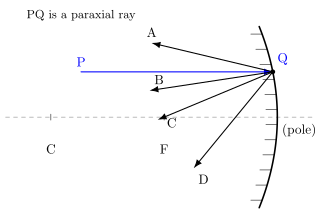 PQ is a paraxial ray.
(A) D
(B) C
(C) B
(D) A
PQ is a paraxial ray.
(A) D
(B) C
(C) B
(D) A›Reveal solutionSolution
A basic property of a concave (converging) mirror: any paraxial ray travelling parallel to the principal axis, after reflection, passes through the mirror's principal focus F.
Step 1 — Recall the reflection rule for a ray parallel to the axis
For a concave mirror, a ray parallel to the principal axis strikes the mirror and is reflected such that the reflected ray passes through the focus F, which lies midway between the pole and the centre of curvature C on the principal axis. This follows directly from the law of reflection applied to the mirror's curved surface at the point of incidence Q.
Step 2 — Identify the correct ray among the four options
Among the four candidate directions A, B, C and D shown emerging from Q, only the ray labelled C is directed so as to pass through F on the principal axis, consistent with this rule; the other three rays do not pass through F.
✓Final answerThe correct option is (B) — ray C, since it is the one that passes through the focus F after reflection.
- KCET 2025Set D-41 markMCQQ.A ray of light passes from vacuum into a medium of refractive index n. If the angle of incidence is twice the angle of refraction, then the angle of incidence in terms of refractive index is (A) sin−1(2n) (B) 2cos−1(2n) (C) 2sin−1(2n) (D) cos−1(2n)
›Reveal solutionSolution
Put i=2r into Snell's law, expand sin2r with the double-angle identity, cancel sinr, and solve for r.
Step 1 — Write Snell's law for the vacuum → medium refraction.
Light goes from vacuum (n1=1) into a medium of refractive index n:
n1sini=n2sinr⟹sini=nsinr
Step 2 — Impose the given condition.
We are told the angle of incidence is twice the angle of refraction:
i=2r
Substituting:
sin(2r)=nsinr
Step 3 — Use the double-angle identity.
sin2r=2sinrcosr
so
2sinrcosr=nsinr
Step 4 — Cancel sinr.
Since the ray actually refracts, r=0, so sinr=0 and we may divide both sides by it:
2cosr=n⟹cosr=2n
r=cos−1(2n)
Step 5 — Return to the angle of incidence.
The question asks for i, not r:
i=2r=2cos−1(2n)
Step 6 — Sanity check with a number.
Take n=3. Then cosr=3/2⇒r=30∘, so i=60∘. Check in Snell's law: sin60∘=0.866 and nsinr=3×0.5=0.866. ✓ Consistent, and indeed i=2r.
Option (D) forgets the factor of 2 (it gives r, not i); options (A) and (C) wrongly use sin−1 instead of cos−1.
✓Final answerThe correct option is (B) — 2cos−1(2n).
ANSWER: B
- KCET 2025Set D-41 markMCQQ.A convex lens has power P. It is cut into two halves along its principal axis. Further one piece (out of two halves) is cut into two halves perpendicular to the principal axis as shown in figure. Choose the incorrect option for the reported lens pieces (A) Power of L2 is 2P (B) Power of L3 is 2P (C) Power of L1 is P (D) Power of L1 is 2P
›Reveal solutionSolution
A cut along the principal axis does not change the power (L1=P); a cut perpendicular to it halves the power (L2=L3=P/2), so the incorrect statement is the one claiming L1 has power P/2.
Step 1 — The lens-maker's formula is the concept.
f1=(μ−1)(R11−R21),P=f1
The power depends only on the refractive index and the two radii of curvature — not on the aperture (the size/height of the lens).
Step 2 — Cut ALONG the principal axis.
This cut is made in a plane containing the principal axis, so each half still has both curved surfaces with the same R1 and R2; only the aperture is halved. Therefore
Phalf=(μ−1)(R11−R21)=P
The piece L1 (the half that is not cut again) has power P. (Only its light-gathering area, and hence image brightness, is halved.)
Step 3 — Cut PERPENDICULAR to the principal axis.
The second half is now sliced through the middle perpendicular to the axis. Each resulting piece is plano-convex: one surface keeps its curvature, the other becomes flat (R→∞).
For the original biconvex lens with R1=+R, R2=−R:
f1=(μ−1)(R1+R1)=R2(μ−1)⇒P=R2(μ−1)
For each plano-convex piece:
f′1=(μ−1)(R1−∞1)=R(μ−1)⇒P′=R(μ−1)=2P
So L2 and L3 each have power 2P.
Step 4 — Test the four statements.
- (A) Power of L2 is P/2 — correct
- (B) Power of L3 is P/2 — correct
- (C) Power of L1 is P — correct
- (D) Power of L1 is P/2 — INCORRECT
The question asks for the incorrect option.
✓Final answerThe correct option is (D) — Power of L1 is 2P.
ANSWER: D
- COMEDK 2025Set 2025-M1 markMCQQ.A convex lens forms a real image of an object with magnification m1. The lens is moved towards the object to obtain another real image of magnification m2. The image distance is increased by x. The focal length of the lens is (A) (m1m2)x (B) (m2m1)x (C) m2−m1x (D) x(m2−m1)
›Reveal solutionSolution
The key is to relate the change in image distance to the two magnifications using the lens formula. The focal length turns out to be f=m2−m1x, so the correct option is (C).
Concept and intuition
When a convex lens forms a real image, both object distance u and image distance v are positive (using the real-is-positive sign convention). The magnification for a real image is m=v/u. If we move the lens toward the object, u decreases, so v must increase to keep the lens equation 1/f=1/u+1/v satisfied. The problem tells us that the image distance increases by x, and gives two magnifications m1 and m2. The trick is to express u and v in terms of m and f, then use the change in v to solve for f.
Step-by-step solution
- Relate magnification to object and image distances For a real image formed by a convex lens,
m=uv.
So we can write v=mu.
- Use the lens formula The lens equation is
f1=u1+v1.
Substitute v=mu:
f1=u1+mu1=u1(1+m1)=mum+1.
Hence
u=mm+1f.
Then the image distance is
v=mu=m⋅mm+1f=(m+1)f.
- Apply to the two positions For the first position:
v1=(m1+1)f.
For the second position (after moving the lens toward the object):
v2=(m2+1)f.
- Use the given change in image distance The image distance increases by x, so
v2−v1=x.
Substituting:
(m2+1)f−(m1+1)f=x,
which simplifies to
(m2−m1)f=x.
- Solve for focal length
f=m2−m1x.
TipNotice that m2>m1 because moving the lens toward the object increases magnification for a real image, so m2−m1 is positive — the formula gives a positive focal length, as expected.
✓Final answerThe correct option is (C).
ANSWER: C
- COMEDK 2024Set 2024-M1 markMCQQ.When a particular wave length of light is used the focal length of a convex mirror is found to be 10 cm. If the wave length of the incident light is doubled keeping the area of the mirror constant, the focal length of the mirror will be: (A) 5 cm (B) 20 cm (C) 15 cm (D) 10 cm
›Reveal solutionSolution
The focal length of a convex mirror depends only on its geometry (radius of curvature), not on the wavelength of light. Therefore, changing the wavelength does not change the focal length. The answer is 10 cm.
Concept and Intuition
The key idea here is to recall what determines the focal length of a mirror. For any spherical mirror — concave or convex — the focal length f is given by f=2R, where R is the radius of curvature of the mirror. This radius is a purely geometric property: it is the radius of the sphere from which the mirror’s surface is cut. It does not depend on the color, wavelength, or frequency of the light used.
A common confusion arises because lenses do have wavelength-dependent focal lengths (chromatic aberration), but mirrors work by reflection, not refraction. Reflection obeys the law of reflection for all wavelengths equally — there is no dispersion. So, no matter what light you shine on a mirror, its focal length stays fixed.
Let’s walk through the reasoning step by step.
- Recall the mirror formula for focal length For any spherical mirror (concave or convex), the focal length is
f=2R
where R is the radius of curvature. This is derived from geometry and the law of reflection, and it contains no term involving wavelength.
-
Identify what changes when wavelength is doubled
The problem states that the wavelength of incident light is doubled, but the mirror’s area (and therefore its shape and radius) is kept constant. Changing the wavelength does not alter the physical shape of the mirror — the mirror remains the same piece of glass with the same silvered surface.
-
Check for any possible effect of wavelength on reflection
In reflection, the angle of incidence equals the angle of reflection for all wavelengths. There is no refraction, no dispersion, and no change in the path of rays due to wavelength. The only way wavelength could affect a mirror is if the mirror were so small that diffraction became significant — but here the mirror’s area is constant and presumably much larger than the wavelength, so diffraction effects are negligible.
-
Conclude that the focal length remains unchanged
Since R is unchanged and the mirror’s behavior is independent of wavelength, the focal length stays exactly the same:
f=10 cm
Watch outA common mistake is to treat the mirror like a lens and assume that doubling the wavelength would change the focal length (as it does for a lens due to dispersion). But mirrors reflect — they do not refract — so no such effect occurs.
TipA quick way to remember: Mirrors have no chromatic aberration. The focal length of a mirror is purely geometric. If you change the light’s color, the image might change in brightness or sharpness due to diffraction, but the focal length itself does not budge.
✓Final answerThe correct option is (D).
ANSWER: D
🎓Unlock everything free for 14 days
- ✓Full step-by-step solutions
- ✓Concept-first explanations
- ✓Methods, shortcuts & mistakes
- ✓PYQ mapping + timed mock tests
Full access for 14 days. No credit card required.