Q.What is a rectifier? Explain the working of p-n junction diode as a fullwave rectifier with circuit and input-output waveforms.
You're viewing a preview — the full solution, concept, methods & PYQ mapping are locked.
Start your 14-day free trial to unlock the full solution →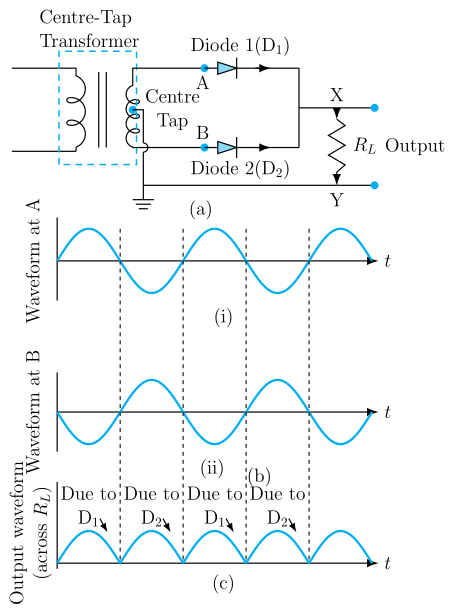
A rectifier converts AC into DC. A full-wave rectifier uses two p-n junction diodes with a centre-tapped transformer; each diode conducts during one half-cycle, so the output is a unidirectional (pulsating DC) current for the full cycle.
Rectifier
A rectifier is a device that converts alternating current (AC) into direct current (DC), by making use of the property that a p-n junction diode conducts appreciably only when it is forward biased.
Full-wave rectifier — construction
It uses two p-n junction diodes and and a centre-tapped transformer. The two ends of the secondary are connected to the diodes, the load resistance is connected between the common point of the diodes and the centre tap of the secondary.
Working
- During the positive half-cycle of the AC input, the upper end of the secondary is positive. Diode is forward biased and conducts, while is reverse biased. Current flows through in a fixed direction.
- During the negative half-cycle, the lower end becomes positive. Now is forward biased and conducts, while is reverse biased. Current again flows through in the same direction. …
Unlock everything free for 14 days
- Full step-by-step solutions
- Concept-first explanations
- Methods, shortcuts & mistakes
- PYQ mapping + timed mock tests
Full access for 14 days. No credit card required.