Q.Consider sunlight incident on a pinhole of width 103 A˚. The image of the pinhole seen on a screen shall be
🔒You're viewing a preview — the full solution, concept, methods & PYQ mapping are locked.
🔒 Start your 14-day free trial to unlock the full solution →Concept understanding — Frequency Invariance
Frequency Invariance
When a light wave crosses from one medium into another — on reflection or on refraction — one property never changes: its frequency. Everything else about the wave (its speed, its wavelength) can change, but the frequency is fixed the moment the wave leaves its source.
Why frequency is set by the source, not the medium
A wave's frequency is the rate at which its source oscillates. Think of shaking one end of a rope: if you shake it 5 times a second, exactly 5 crests leave your hand every second. If that rope changes into a heavier rope partway along, the wave travels slower in the heavier section, but the number of crests arriving per second at the join must still equal 5 — a crest cannot be created or destroyed at the boundary. The same logic applies to light: whatever surface it meets, the boundary condition (continuity of the oscillating electric and magnetic fields) forces the reflected and refracted waves to oscillate at exactly the incident frequency.
A common mistake is to think that because wavelength changes across a boundary, frequency must change too. It's the reverse: frequency is fixed by the source, so when speed changes, wavelength (λ=v/f) adjusts to compensate.
What changes instead: speed and wavelength
In a medium of refractive index n, light slows to v=c/n. Since frequency f is unchanged and v=fλ, the wavelength inside the medium must shrink:
fmedium=fvacuum,v=nc,λmedium=nλvacuum
For reflection, the ray stays in the original medium, so speed, wavelength, and frequency are all unchanged. For refraction, the frequency still matches the incident wave, but speed and wavelength both scale by 1/n.
Does slowing down mean losing energy?
No. The energy of light is carried by its photons, each of energy E=hf — a quantity that depends only on frequency. Since frequency doesn't change on entering a denser medium, the energy per photon is unchanged too; only the wave's speed and wavelength are affected. (The wave's amplitude does adjust at the boundary so that energy is properly split between the reflected and transmitted beams — but frequency, and hence photon energy, is untouched.)
Worked example
Light of λ0=589 nm in air strikes water (n=1.33). The frequency is …
Why this formula?
Frequency Invariance
When light (or any wave) crosses from one medium into another, one property refuses to change: its frequency. Understanding why is the key to Snell's law and to how colour is preserved through glass, water and lenses.
On refraction the frequency f stays the same; the speed v and wavelength λ change together so that v=fλ still holds.
Why Frequency Is Conserved
A wave is driven at the boundary by the incoming oscillation. The electric field of the light wave forces the electrons in the second medium to oscillate, and they can only oscillate at the same rate at which they are driven. If the frequency changed, wave crests would either pile up at or vanish from the interface — the boundary would not stay continuous. So the number of crests arriving per second must equal the number leaving per second:
f1=f2=f
What Does Change
Inside a denser medium light slows to v=c/n. Since f is fixed and v=fλ, the wavelength must shrink in the same proportion:
λmedium=fv=fc/n=nλvacuum …
The pinhole width is a=103 A˚=100 nm, which is smaller than every visible wavelength (400–700 nm). When the aperture is smaller than the wavelength, diffraction is extreme: the light spreads out over very large angles (θ∼λ/a>1) and no sharp geometrical image of the pinhole can form. …
a=103 A˚=100 nm is smaller than the wavelength of visible light, so diffraction is extreme and the screen shows a spread-out, diffuse patch rather than a sharp geometrical image — matching option (b).
1. Size of the pinhole.
a=103 A˚=103×10−10 m=10−7 m=100 nm.
2. Compare with visible wavelengths. Visible light has λ≈400–700 nm. Here a<λ for the whole visible range, i.e. the aperture is sub-wavelength.
3. Diffraction condition. The angular spread of light through an aperture is of order θ∼λ/a. With λ/a>1 for every colour, sinθ is of order 1 — the light bends through very large angles. There is no near-parallel beam that could cast a sharp shadow the size of the hole. …
Method: Comparing Aperture Size to Wavelength to Predict the Diffraction Pattern
Use this whenever a question gives a pinhole/slit width and asks what image forms — always compare the aperture size to the wavelength of light rather than judging shape from the aperture size alone.
Steps
Step 1: Convert the aperture size into the same units as the wavelength
Angstrom values convert to metres or nanometres so they compare directly against the visible range λ≈400–700 nm.
Step 2: Compute the ratio of aperture size to wavelength
λa
Step 3: Classify the regime using this ratio
- a≫λ: diffraction negligible, sharp geometric image forms.
- a a small multiple of λ: moderate diffraction — bright central region, colour separation towards the edges. …
- KCET 2024Set D-21 markMCQQ.An equiconvex lens of radius of curvature 14 cm is made up of two different materials. Left half and right half of vertical portion is made up of material of refractive index 1.5 and 1.2 respectively as shown in the figure. If a point object is placed at a distance of 40 cm, calculate the image distance.
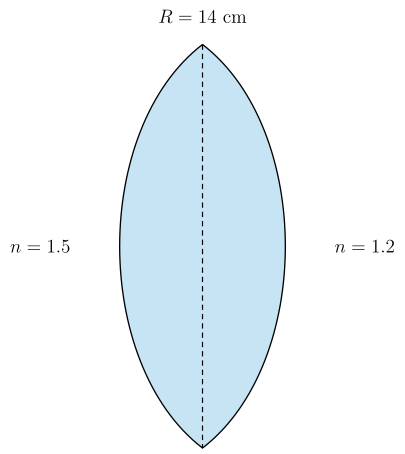 (A) 25 cm
(B) 50 cm
(C) 35 cm
(D) 40 cm
(A) 25 cm
(B) 50 cm
(C) 35 cm
(D) 40 cm›Reveal solutionSolution
Treat the two-material equiconvex lens as two plano-convex lenses in contact, add their powers, then apply the thin-lens equation.
Step 1 — Decode the geometry
The equiconvex lens is cut by a vertical plane through its centre, perpendicular to the principal axis. So:
- The left piece is bounded by the front convex surface (R1=+14 cm) and the flat cut (R2=∞) → a plano-convex lens of n1=1.5.
- The right piece is bounded by the flat cut (R1=∞) and the rear convex surface (R2=−14 cm) → a plano-convex lens of n2=1.2.
They are cemented together, i.e. two thin lenses in contact, sharing the same axis. ("Equiconvex, radius 14 cm" fixes both magnitudes at 14 cm; the sign convention makes the second surface negative because its centre of curvature lies to the left.)
Step 2 — Focal length of each half (lens-maker's formula)
f1=(n−1)(R11−R21)
Left lens (n=1.5, R1=+14, R2=∞):
f11=(1.5−1)(141−0)=140.5=281⟹f1=28 cm
Right lens (n=1.2, R1=∞, R2=−14):
f21=(1.2−1)(0−−141)=140.2=701⟹f2=70 cm
Step 3 — Combine (lenses in contact ⇒ powers add)
For thin lenses in contact, P=P1+P2, i.e. f1=f11+f21: …
- COMEDK 2024Set 2024-A1 markMCQQ.An electromagnetic wave of frequency 3 MHz passes from vacuum into a dielectric medium (μr=1) of relative permittivity 4.0. Then, (A) Wavelength is halved and frequency is doubled (B) Wavelength doubled and frequency remains unchanged (C) Wavelength and frequency are unchanged (D) Wavelength is halved and frequency remains unchanged
›Reveal solutionSolution
When an electromagnetic wave enters a dielectric, its frequency stays constant (source property), but its speed and wavelength decrease by the refractive index factor. Here, n=2, so wavelength is halved; frequency unchanged → option (D).
The key concept is that frequency of an electromagnetic wave is determined by the source and does not change when the wave moves from one medium to another. What changes are the wave’s speed and wavelength, because the medium’s permittivity (and possibly permeability) alters the phase velocity. For a non-magnetic dielectric (μr=1), the refractive index is n=εr. The wave slows down by a factor n, and since v=fλ, the wavelength must shrink by the same factor.
-
Identify the given data
- Frequency in vacuum: f=3 MHz (this will remain the same in the dielectric).
- Relative permittivity: εr=4.0.
- Relative permeability: μr=1 (non-magnetic).
-
Find the refractive index
For a non-magnetic medium, n=μrεr=1×4=2.
This means the speed of the wave in the dielectric is v=nc=2c.
-
Relate speed, frequency, and wavelength
In vacuum: c=fλ0.
In the dielectric: v=fλ.
Since f is unchanged, we have
λ0λ=cv=n1=21.
So the wavelength is halved.
- Check the options
- (A) Wavelength halved, frequency doubled → wrong (frequency doesn’t double). …
-
- COMEDK 2023Set 2023-E1 markMCQQ.What will be change in wave length, if a light of wave length 600 nm travels from air enters a medium of refractive index 1.5 and continues its journey through that medium? (A) 300 nm (B) 200 nm (C) 600 nm (D) 400 nm
›Reveal solutionSolution
So while travelling through the medium the light has a wavelength of 400 nm.
Concept: when light enters a denser medium its FREQUENCY is unchanged (it is set by the source), while its speed drops to v = c/n; hence the wavelength shortens:
lambda_medium = lambda_air / n.
Given lambda_air = 600 nm and n = 1.5: …
- KCET 2021Set B-21 markMCQQ.In refraction, light waves are bent on passing from one medium to second medium because, in the second medium. (A) frequency is different (B) speed is different (C) coefficient of elasticity is different (D) amplitude is smaller.
›Reveal solutionSolution
Refraction is caused by the change in the speed of light in the second medium; frequency is unchanged, so the wavelength must change and the wavefront bends.
1. What stays the same and what changes
When light passes from medium 1 into medium 2:
Quantity Changes? Why Frequency f NO It is set by the oscillating source. The atoms of medium 2 are driven at the frequency of the arriving wave, so they re-radiate at that same frequency. Speed v YES v=c/n — it depends on the optical density (refractive index) of the medium. Wavelength λ YES Forced by v=fλ: if f is fixed and v changes, λ must change. 2. Why a change of speed makes the ray bend
Consider a plane wavefront striking the boundary obliquely. The edge of the wavefront that enters the denser medium first immediately slows down, while the rest of the wavefront is still travelling at the old (faster) speed. In a given time the two ends advance by different distances, so the wavefront swivels — and the ray, being perpendicular to the wavefront, bends.
Huygens' construction turns this straight into Snell's law. In time t, the incident wavefront covers v1t in medium 1 while the refracted one covers v2t in medium 2 across the same interface segment AB:
sini=ABv1t,sinr=ABv2t
⟹sinrsini=v2v1=n1n2=constant(n=c/v)
Notice the speed ratio is the whole content of Snell's law. If v1=v2, then sini=sinr and there is no bending at all — which proves the change in speed is the cause.
3. Rejecting the other options …
- KCET 2018Set A-11 markMCQQ.A candle placed 25 cm from a lens forms an image on a screen placed 75 cm on the other side of the lens. The focal length and type of the lens should be (A) +18.75 cm and convex lens (B) −18.75 cm and concave lens (C) +20.25 cm and convex lens (D) −20.25 cm and concave lens
›Reveal solutionSolution
A real image formed on a screen means the lens is convex (converging). Using the lens formula with u=−25 cm and v=+75 cm gives f=+18.75 cm.
The key here is that the image is formed on a screen. A screen can only capture a real image — one where light rays actually converge at a point. That immediately tells you the lens must be convex (converging), because a concave lens always produces a virtual image that cannot be projected onto a screen.
Now, the lens formula is the standard tool for relating object distance, image distance, and focal length. But the sign convention matters. In the Cartesian sign convention (used in most Indian board exams):
- Distances measured from the optical centre toward the incident light are negative.
- Distances measured opposite to the incident light are positive.
The candle (object) is on one side of the lens, and the screen (image) is on the other side. So the object distance u is negative, and the image distance v is positive.
-
Assign signs correctly
Object distance: u=−25 cm (since object is on the incident side)
Image distance: v=+75 cm (since image is on the opposite side, real)
-
Apply the lens formula
The lens formula is:
f1=v1−u1
Substitute the values:
f1=+751−−251=751+251
- Simplify
f1=751+753=754
Therefore:
f=475=18.75 cm
- Interpret the sign The focal length is positive, which confirms a convex lens. A concave lens would have a negative focal length. …
🎓Unlock everything free for 14 days
- ✓Full step-by-step solutions
- ✓Concept-first explanations
- ✓Methods, shortcuts & mistakes
- ✓PYQ mapping + timed mock tests
Full access for 14 days. No credit card required.