Q.Let us list some of the factors, which could possibly influence the speed of wave propagation:
On which of these factors, if any, does
depend?
🔒You're viewing a preview — the full solution, concept, methods & PYQ mapping are locked.
🔒 Start your 14-day free trial to unlock the full solution →Concept understanding — Refractive Index Calculation
Refractive Index Calculation
The refractive index n of a medium measures how much it slows down and bends light compared to vacuum. This concept collects the standard ways to calculate n from measurable quantities. There is no single formula — you pick the one matching the data you are given.
1. From the speed of light
The defining relation: refractive index is how many times slower light travels in the medium than in vacuum.
n=vc
where c=3×10⁸ m/s is the speed of light in vacuum and v is its speed in the medium. Since v≤c, we always have n≥1.
Example: light travels at 2×10⁸ m/s in glass, so n=(3×10⁸)/(2×108)=1.5.
2. From Snell's law (angles of incidence and refraction)
When light goes from medium 1 into medium 2,
n1sinθ1=n2sinθ2
For light entering a medium from air (n1≈1):
n=sinrsini
Measure the angle of incidence i and angle of refraction r, take the ratio of their sines.
3. From real and apparent depth
An object under water looks shallower than it is. The refractive index of the liquid is
n=apparent depthreal depth
Example: a coin at the bottom of a tank of real depth 12 cm appears to be at 9 cm, so n=12/9=1.33.
4. From wavelength
Because frequency is unchanged across a boundary while wavelength scales as 1/n,
n=λmediumλvacuum
5. Relative refractive index
The refractive index of medium 2 with respect to medium 1 is
n21=n1n2=v2v1=λ2λ1
Note it can be less than 1 (e.g. going from glass to air).
6. From the critical angle
For total internal reflection at a denser-to-rarer boundary with critical angle C,
n=sinC1
(for the denser medium relative to the rarer one).
Refractive index is a ratio, so it has no units. Also remember it depends slightly on the wavelength (colour) of light — this dispersion is why a prism splits white light.
Worked example (combining methods)
A ray enters a glass block from air at i=45∘ and refracts to r=28∘. …
Why this formula?
Refractive Index Calculation
The refractive index n measures how strongly a medium slows and bends light. Calculating it is a routine ray-optics task, and there are two equivalent routes: from speeds and from angles.
n=vc=sinrsini — a speed ratio and an angle ratio that always give the same number.
Route 1 — From Speed
By definition the (absolute) refractive index is the ratio of the speed of light in vacuum to its speed in the medium:
n=vc
A larger n means slower light and a denser medium. Glass with v=2×10⁸ m/s gives n=2×1083×108=1.5.
Route 2 — From Angles (Snell's Law)
For a ray passing from air into a medium, measuring the angle of incidence i and the angle of refraction r (both from the normal) gives:
n=sinrsini …
The speed of light in vacuum is a universal constant that never changes, while its speed inside a material medium is affected only by the wavelength (colour) of the light, not by any of the other listed factors. …
The speed of light in vacuum, c, is a universal constant independent of all five listed factors; the speed of light inside a medium, however, does depend on wavelength (this is the origin of dispersion), but not on the nature/motion of the source, the direction of travel, or the intensity.
Step 1: Speed of light in vacuum
By the postulates underlying the theory of relativity (and confirmed by every experiment to date), the speed of light in vacuum, c=3×10⁸ m s−1, is a fundamental constant of nature. It does not depend on:
- (i) the nature of the source that emits it,
- (ii) the direction in which it travels,
- (iii) the relative motion of the source and/or the observer,
- (iv) its wavelength, or
- (v) its intensity.
c is the same for all observers and all sources, in every direction — none of the five factors affect it.
Step 2: Speed of light in a medium
Inside a material medium, the speed of light is v=c/μ, where μ is the refractive index of the medium. The refractive index of ordinary materials is known to depend on the wavelength of light — this is exactly the phenomenon of dispersion, as already seen for glass in Exercise 10.3(b), where red and violet light travel at slightly different speeds in the same glass prism.
The speed in a medium does not depend on:
- the nature of the source, …
- COMEDK 2026Set 2026-A1 markMCQQ.The ratio of the angle of deviation produced by a thin prism, when it is placed in air to the angle of deviation produced when it is immersed in water of refractive index 34 is: (A) 4:1 (B) 8:9 (C) 9:8 (D) 1:4
›Reveal solutionSolution
The deviation angle of a thin prism depends on the relative refractive index between the prism and the surrounding medium. When immersed in water, the effective refractive index changes, giving a ratio of 9:8 for deviation in air to deviation in water.
The key concept is that the deviation produced by a thin prism is proportional to the difference between the refractive index of the prism material relative to the surrounding medium and 1. For a thin prism with small angle A, the deviation δ is given by δ=(μrelative−1)A. When the prism is in air, the relative index is simply the prism's own refractive index μ. When immersed in a liquid, the relative index becomes μ/μliquid. The ratio of deviations then reduces to a ratio of these relative indices minus one.
- Write the deviation formula for a thin prism in air. Let the refractive index of the prism material be μ (typically around 1.5 for glass). In air, the surrounding refractive index is 1, so the relative refractive index is μ. The deviation is:
δair=(μ−1)A
where A is the prism angle (small).
- Write the deviation formula when the prism is immersed in water. Water has refractive index μw=34. The relative refractive index of the prism with respect to water is μwμ. Hence the deviation in water is:
δwater=(μwμ−1)A
- Find the ratio δair:δwater. The prism angle A cancels out:
δwaterδair=μwμ−1μ−1
Simplify the denominator:
μwμ−1=μwμ−μw
So the ratio becomes:
δwaterδair=μwμ−μwμ−1=μ−μw(μ−1)μw
- Substitute the known value μw=34. We still need μ. For a typical glass prism, μ=23 (a common value used in such problems). Substituting: δwaterδair=23−34(23−1)⋅34 …
- KCET 2026Set C21 markMCQQ.The incorrect statement about refractive index for a pair of media is (A) It depends upon nature of the first medium (B) It depends upon nature of the second medium (C) It depends upon wavelength of light (D) It depends upon angle of incidence
›Reveal solutionSolution
The refractive index of a pair of media is a fixed material property that depends on the nature of both media and the wavelength of light used, but never on the angle of incidence.
Step 1 — Check the true statements
The refractive index n21=v2v1=n1n2 is a ratio that depends on the optical density (nature) of the first medium and the second medium — so statements (A) and (B) are correct.
Refractive index also varies with wavelength (this is the basis of dispersion, e.g. in a prism), so statement (C) is also correct.
Step 2 — Identify the false statement …
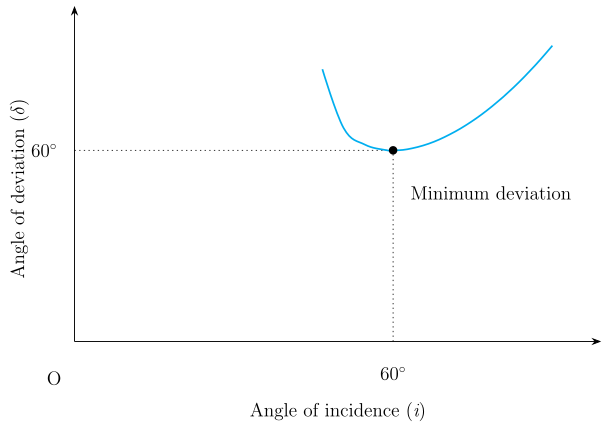
- KCET 2026Set C21 markMCQQ.From the graph of angle of deviation versus angle of incidence for an equilateral prism, the refractive index of material of prism is
 (A) 23
(B) 23
(C) 3
(D) 2
(A) 23
(B) 23
(C) 3
(D) 2›Reveal solutionSolution
At minimum deviation, the refractive index of a prism's material is given by μ=sin(2A)sin(2A+Dm), where A is the prism (apex) angle and Dm is the angle of minimum deviation.
Step 1 — Read off A and Dm from the graph
The prism is equilateral, so its apex angle is A=60°. From the graph, the minimum point of the deviation-versus-incidence curve occurs at a deviation of Dm=60° (at an incidence angle of 60°).
Step 2 — Apply the prism formula …
- COMEDK 2025Set 2025-A1 markMCQQ.What is the velocity of light in vacuum if the velocity of light in a medium of refractive index 1.2 is ' v ' ms−1 ? (A) (1.2v)ms−1 (B) (2.4v)ms−1 (C) (1.2v)ms−1 (D) 3×10⁸ ms−1
›Reveal solutionSolution
The refractive index is the ratio of the speed of light in vacuum to its speed in the medium. Given refractive index 1.2 and speed in medium v, the vacuum speed is 1.2v, so the correct option is (C).
The key idea here is the definition of refractive index. It’s not a mysterious property — it simply tells you how much slower light travels in a material compared to empty space. If the refractive index is 1.2, light in that medium moves at 1/1.2 times the vacuum speed. So to go from the medium speed back to the vacuum speed, you multiply by 1.2.
Let’s walk through it step by step.
- Recall the definition The absolute refractive index n of a medium is given by
n=vc
where c is the speed of light in vacuum and v is the speed of light in the medium. This is the fundamental relationship.
- Plug in the given numbers We are told n=1.2 and the speed in the medium is v (the same symbol, but careful — here v is the speed in the medium, not vacuum). So:
1.2=vc
- Solve for c Multiply both sides by v:
c=1.2v
That’s it — the vacuum speed is simply 1.2 times the medium speed.
- Check the options
- (A) 1.2v would be the speed in the medium if the vacuum speed were v — backwards.
- (B) 2.4v is double the correct factor — no reason for that.
- (C) 1.2v matches exactly. …
- KCET 2024Set D-21 markMCQQ.A galaxy is moving away from the Earth so that a spectral line at 600 nm is observed at 601 nm. Then the speed of the galaxy with respect to the Earth is (A) 500 km s−1 (B) 50 km s−1 (C) 200 km s−1 (D) 20 km s−1
›Reveal solutionSolution
The line shifts to a longer wavelength (redshift), so the galaxy is receding. Using the Doppler formula v=cΔλ/λ0 with Δλ=1 nm and λ0=600 nm gives v=500 km/s — option (A).
Step 1 — Recognise the phenomenon.
When a light source moves away from an observer, the wavelength of light it emits appears stretched (increased) — this is the optical Doppler effect, and an increase in wavelength is called a redshift. Here the spectral line shifts from its rest value λ0=600 nm to an observed value λ=601 nm — a shift toward longer wavelength, consistent with the galaxy moving away from Earth (matching the problem statement).
Step 2 — Find the wavelength shift.
Δλ=λ−λ0=601−600=1 nm
Step 3 — Apply the (non-relativistic) Doppler formula.
For speeds much smaller than c (true here, as the answer itself will confirm), the fractional wavelength shift equals the fractional speed: …
- COMEDK 2024Set 2024-M1 markMCQQ.For a 30∘ prism when a ray of light is incident at an angle 60∘ on one of its faces, the emergent ray passes normal to the other surface. Then the refractive index of the prism is: (A) 3 (B) 23 (C) 1.5 (D) 1.33
›Reveal solutionSolution
For a prism with apex angle 30∘, incidence at 60∘ and emergence normal to the second face, Snell’s law at both faces gives the refractive index as 3, matching option (A).
Concept & Intuition
The problem is a classic prism refraction scenario where the ray emerges perpendicular to the second face. That means the angle of emergence is 0∘ relative to the normal, so the ray inside the prism hits the second face at exactly the critical angle for that interface? No—actually, if it emerges normal, the angle of refraction at the second face is 0∘, so by Snell’s law the angle of incidence inside the prism at that face must also be 0∘. That’s a huge clue: the ray inside the prism travels parallel to the base? Let’s check carefully.
We have a prism with apex angle A=30∘. Light enters at i1=60∘ on the first face. It emerges normal to the second face, meaning the emergent ray makes 0∘ with the normal, so i2=0∘ (angle of incidence inside the prism at the second face). Using geometry of the prism, we can find the angle of refraction r1 at the first face, then apply Snell’s law.
Step-by-step reasoning
- Geometry of the prism In a prism, the sum of the two internal angles of refraction equals the apex angle:
r1+r2=A
Here A=30∘. Since the emergent ray is normal to the second face, the angle of incidence inside the prism at that face is r2=0∘ (because the ray is perpendicular to the surface).
Therefore:
r1+0∘=30∘⇒r1=30∘
- Apply Snell’s law at the first face At the first face, light goes from air (n=1) into the prism (n). The angle of incidence is i1=60∘, and the angle of refraction inside is r1=30∘. Snell’s law gives: 1⋅sin60∘=n⋅sin30∘ …
- COMEDK 2024Set 2024-M1 markMCQQ.A ray of light travelling through a medium of refractive index 45 is incident on a glass of refractive index 23. Find the angle of refraction in the glass, if the angle of incidence at the given medium - glass interface is 30∘. (A) sin−1(21) (B) sin−1(31) (C) sin−1(125) (D) sin−1(56)
›Reveal solutionSolution
Using Snell’s law, the angle of refraction is found from n1sini=n2sinr. Substituting n1=5/4, n2=3/2, i=30∘ gives r=sin−1(5/12), which corresponds to option (C).
The key idea is Snell’s law: when light passes from one medium to another, the ratio of the sines of the angles equals the inverse ratio of the refractive indices. The intuition: light bends toward the normal when entering a denser medium (higher refractive index). Here, glass (1.5) is denser than the first medium (1.25), so the refraction angle will be smaller than the incidence angle. We just need to compute exactly how much smaller.
- Write Snell’s law
n1sini=n2sinr
where n1=45 (incident medium), n2=23 (glass), i=30∘, and r is the unknown angle of refraction.
- Substitute the known values
45⋅sin30∘=23⋅sinr
Since sin30∘=21, this becomes:
45⋅21=23sinr
85=23sinr
- Solve for sinr Multiply both sides by 32:
sinr=85⋅32=2410=125
- Interpret the result …
- COMEDK 2023Set 2023-E1 markMCQQ.When the angle of incidence on one face of an equilateral glass prism is 43th of the angle of prism, the ray of light undergoes minimum deviation. If the velocity of light in vacuum is 'c', then the velocity of light in the glass is: (A) 2c2 (B) 43c (C) 2c (D) 2c
›Reveal solutionSolution
Speed of light in the glass: v = c / n = c / sqrt2.
Concept: prism at minimum deviation - the ray passes symmetrically, so r1 = r2 = A/2, and n = sin i / sin(A/2).
Equilateral prism: A = 60 degrees.
Given i = (3/4) A = (3/4)(60) = 45 degrees.
At minimum deviation, r = A/2 = 30 degrees.
Refractive index: …
- KCET 2022Set B-31 markMCQQ.The fringe width for red colour as compared to that for violet colour is approximately (A) 4 times (B) 8 times (C) 3 times (D) Double
›Reveal solutionSolution
β∝λ in Young's double-slit experiment, and red light has roughly twice the wavelength of violet, so its fringes are about twice as wide.
1. The formula and why it applies
In Young's double-slit experiment, bright fringes occur where the path difference is an integral number of wavelengths. The separation between consecutive bright (or dark) fringes — the fringe width — is
β=dλD
where D = slit-to-screen distance and d = slit separation.
The key structural point: D and d are properties of the apparatus, not of the light. If we simply change the colour of the source in the same set-up, D and d are unchanged, so
β∝λ
2. Wavelengths of the two colours
At the two ends of the visible spectrum:
λviolet≈400 nmλred≈700−800 nm
3. Take the ratio
βvioletβred=λvioletλred≈400700=1.75≈2 …
- COMEDK 2021Set 2021-B1 markMCQQ.A thin prism gives a deviation of 1.5. If its refractive index is 1.5. Then the angle of the prism is (A) 3o (B) 2o (C) 5o (D) 1.5o
›Reveal solutionSolution
A thin prism gives δ=(μ−1)A, so A=δ/(μ−1)=1.5∘/0.5=3∘.
For a thin prism the deviation is
δ=(μ−1)A.
Solving for the prism angle: …
- KCET 2020Set A-11 markMCQQ.The refracting angle of a prism is A and refractive index of material of prism is cot 2A. The angle of minimum deviation is (A) 180°−3A (B) 180°+2A (C) 90°−A (D) 180°−2A
›Reveal solutionSolution
Substitute μ=cot(A/2) into the prism (minimum-deviation) formula and use the co-function identity cosθ=sin(90∘−θ).
Step 1 — The prism formula
At minimum deviation the ray passes symmetrically through the prism, and the refractive index is
μ=sin(2A)sin(2A+δm)
where A is the refracting (apex) angle and δm the angle of minimum deviation.
Step 2 — Substitute the given μ
We are told μ=cot2A. Writing the cotangent as a ratio:
cot2A=sin2Acos2A
So
sin2Asin(2A+δm)=sin2Acos2A
Step 3 — Cancel and use the co-function identity
The common denominator sin2A cancels (it is non-zero for a real prism, 0<A<180∘):
sin(2A+δm)=cos2A=sin(90∘−2A)
Step 4 — Equate the angles and solve …
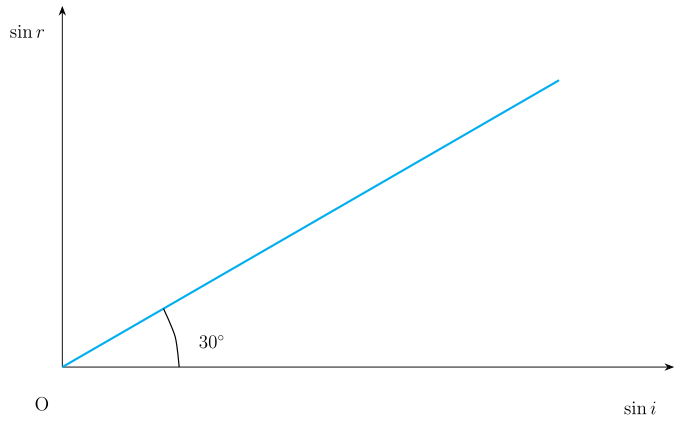
- KCET 2019Set A-11 markMCQQ.A transparent medium shows relation between i and r as shown. If the speed of light in vacuum is c the Brewster angle for the medium is
 (A) 30°
(B) 45°
(C) 60°
(D) 90°
(A) 30°
(B) 45°
(C) 60°
(D) 90°›Reveal solutionSolution
The slope of the sinr vs sini line is 1/n; here slope =tan30∘=1/3, so n=3 and θB=tan−13=60∘.
Step 1 — Extract the refractive index from the graph.
Snell's law for light entering the medium from vacuum:
sini=nsinr⟹sinr=n1sini.
So a plot of sinr (y-axis) against sini (x-axis) is a straight line through the origin with slope n1 — which is exactly what the figure shows.
Step 2 — Read the slope.
The line makes 30∘ with the sini axis, so
slope=tan30∘=31.
Therefore
n1=31⟹n=3≈1.732.
(Sensible: a typical glass has n≈1.5–1.7.)
Step 3 — Brewster's law.
At the Brewster (polarising) angle θB, the reflected ray is completely plane-polarised, and the reflected and refracted rays are perpendicular. That geometric condition (θB+r=90∘) fed into Snell's law gives …
🎓Unlock everything free for 14 days
- ✓Full step-by-step solutions
- ✓Concept-first explanations
- ✓Methods, shortcuts & mistakes
- ✓PYQ mapping + timed mock tests
Full access for 14 days. No credit card required.