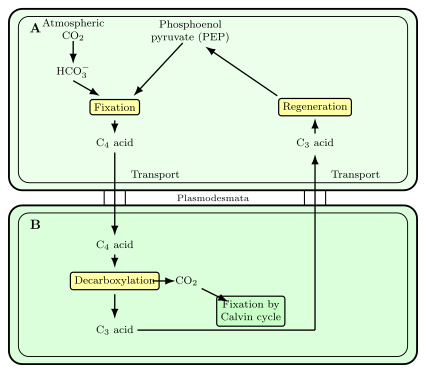
Q.Observe the given figure showing C4 pathway.
[Two connected cells, A and B, are shown in the original paper]
🔒You're viewing a preview — the full solution, concept, methods & PYQ mapping are locked.
🔒 Start your 14-day free trial to unlock the full solution →Concept understanding — C4 Pathway
The Problem C4 Plants Solve
Imagine a plant trying to photosynthesise on a hot, dry day. To stop water from escaping, it closes its stomata. But with stomata closed, CO₂ can't enter easily, and the oxygen produced inside the leaf builds up. The Calvin cycle's key enzyme, RuBisCO, is terrible at telling CO₂ apart from O₂. When O₂ levels are high, RuBisCO grabs oxygen instead of carbon dioxide, starting a wasteful process called photorespiration — it burns up energy and releases already-fixed CO₂. The plant is stuck: open stomata and lose water, or close them and starve the Calvin cycle.
C4 plants evolved a clever workaround. They don't try to make RuBisCO better. Instead, they build a CO₂-concentrating pump that delivers a high dose of CO₂ directly to RuBisCO, even when the leaf's air spaces are low on CO₂. This pump is the Hatch-Slack pathway.
The Two-Cell Strategy
C4 plants separate the initial capture of CO₂ from the Calvin cycle into two different types of cells:
- Mesophyll cells — the outer, sun-exposed layer. Here, CO₂ is caught quickly and converted into a 4-carbon compound (hence "C4").
- Bundle sheath cells — a tightly packed inner layer surrounding the leaf veins. Here, the 4-carbon compound releases its CO₂, creating a high local concentration for the Calvin cycle.
The mesophyll cells act like a trap, and the bundle sheath cells are where the real carbon fixation happens — but only after the trap has concentrated the CO₂.
The Hatch-Slack Pathway Step by Step
Step 1 — Fixation in mesophyll. CO₂ from the air (or from respiration inside the leaf) combines with phosphoenolpyruvate (PEP), a 3-carbon molecule. The enzyme PEP carboxylase catalyses this reaction, producing oxaloacetate (a 4-carbon compound). PEP carboxylase has no affinity for oxygen, so it never wastes time on photorespiration — it just grabs CO₂.
PEP+CO2PEP carboxylaseoxaloacetate
Step 2 — Conversion to a transport form. Oxaloacetate is unstable and is quickly reduced to malate (another 4-carbon compound) using NADPH. In some plants, it is converted to aspartate instead — the principle is the same.
Step 3 — Transport to bundle sheath. Malate moves from the mesophyll cell into the bundle sheath cell through plasmodesmata (tiny channels connecting plant cells).
Step 4 — Decarboxylation. Inside the bundle sheath, malate is broken down. It releases CO₂ and leaves behind pyruvate (a 3-carbon compound). The CO₂ now floods the bundle sheath, raising its concentration many times above what the air could provide.
Step 5 — Calvin cycle runs. RuBisCO in the bundle sheath now sees a high CO₂ / low O₂ environment. It fixes CO₂ into 3-phosphoglycerate (3-PGA) without wasting energy on photorespiration.
Step 6 — Pyruvate returns. The leftover pyruvate goes back to the mesophyll cell, where it is converted back into PEP using ATP. The cycle is ready to catch another CO₂.
Overall: CO2+PEPATP, NADPH3-PGA+PEP
The PEP is regenerated; the net gain is one CO₂ fixed into the Calvin cycle.
Why It Costs More but Works Better …
C4 plants show a distinctive leaf anatomy in which CO2 is first fixed in one cell type, and the resulting 4-carbon acid is then transported into a second, inner cell type, where CO2 is released again for fixation by the Calvin cycle.
…
In C4 plants, CO2 is first fixed in mesophyll cells (cell A) to form a 4-carbon acid using the enzyme PEP carboxylase, and this acid is transported into the bundle sheath cells (cell B), where CO2 is released again for fixation by the Calvin (C3) cycle.
(a) Identifying cells A and B: C4 plants have a special "Kranz anatomy" in their leaves, where the vascular bundles are surrounded by large bundle sheath cells, which are in turn surrounded by mesophyll cells. Atmospheric CO2 first enters the outer mesophyll cells (cell A, as shown by "Atmospheric CO2 entering" and the "Fixation" step producing the C4 acid). The C4 acid formed is then transported through plasmodesmata into the inner bundle sheath cells (cell B, as shown by "Transport," "Fixation by Calvin cycle," and "Decarboxylation" releasing CO2). So A = Mesophyll cell, B = Bundle sheath cell.
…
- CBSE 2026Set ANNUAL1 markMCQQ.In Hatch and Slack pathway the primary acceptor of CO2 is(a) RuBisCO(b) Phosphoenol pyruvate (PEP)(c) RuBP(d) Oxaloacetic acid
›Reveal solutionSolution
In the C4/Hatch-and-Slack pathway, CO2 is first fixed onto PEP (a 3-carbon compound) in mesophyll cells.
The Hatch and Slack (C4) pathway is found in plants adapted to hot, dry, and bright conditions (e.g. maize, sugarcane). Here, atmospheric CO2 is first fixed in the mesophyll cells by combining with the 3-carbon acceptor phosphoenolpyruvate (PEP), catalysed by the enzyme PEP carboxylase (PEPcase), forming the 4-carbon compound oxaloacetic acid (OAA) — hence the name 'C4 pathway'. OAA is converted to malate/aspartate and transported to the bundle sheath cells, where CO2 is released and re-fixed via the Calvin cycle (using RuBisCO and the acceptor RuBP), while a 3-carbon compound (pyruvate) is recycled back to the mesophyll to regenerate PEP.
…
- CBSE 2025Set F1 markMCQQ.In which of the following plants is there phosphoenol pyruvate receptor of CO2?(a) C-3(b) C-4(c) C-6(d) All of these
›Reveal solutionSolution
The PEP acceptor of CO2 is found in C4 plants.
In C4 plants (e.g. maize, sugarcane), CO2 is first fixed in the mesophyll cells by the enzyme PEP carboxylase, which uses phosphoenolpyruvate (PEP, a 3-carbon molecule) as the CO2 acceptor to form the 4-carbon oxaloacetate. In C3 plants the acce …
- CBSE 2025Set botany-hz21 markMCQQ.In C4 pathway the CO2 fixation in mesophyll cells is carried out by the enzyme:(a) Pyruvate dehydrogenase(b) Pyruvate decarboxylase(c) RUBISCO(d) PEP carboxylase
›Reveal solutionSolution
CO2 fixation in the mesophyll cells of C4 plants is carried out by PEP carboxylase, forming the 4-carbon compound oxaloacetic acid (OAA).
C4 plants (e.g., maize, sugarcane) show Kranz anatomy, with two distinct photosynthetic cell types: mesophyll cells and bundle sheath cells. In the mesophyll cells, atmospheric CO2 combines with the 3-carbon acceptor phosphoenolpyruvate (PEP) in a reaction catalysed by the enzyme PEP carboxylase (PEPcase). Because PEP carboxylase has a much higher affinity for CO2 than RuBisCO and does not react with O2, it efficiently fixes CO2 even at low concentrations, producing the 4-carbon compound oxaloacetic acid (OAA), which is subsequently converted to malate/aspartate and transported to the bundle sheath cells. There, the 4-carbon acid is decarboxylated to release CO2, which is then fixed again by RuBisCO in the Calvin cycle (this second, …
- CBSE 2024Set ANNUAL1 markMCQQ.PEP is primary CO₂ acceptor in :(a) C₂ plants(b) C₃ plants(c) C₄ plants(d) Both (B) & (C)
›Reveal solutionSolution
PEP (phosphoenolpyruvate) is the primary CO₂ acceptor of the Hatch and Slack (C4) pathway, present in mesophyll cell chloroplasts.
In C3 plants, CO₂ is directly fixed by the enzyme RuBisCO onto ribulose-1,5-bisphosphate (RuBP) in the Calvin cycle, forming two molecules of 3-phosphoglyceric acid (3-PGA), a 3-carbon compound — hence the name C3 pathway. In C4 plants, CO₂ is first fixed in the mesophyll cells by the enzyme PEP carboxylase (PEPcase) onto phosphoenolpyruvate (PEP), a 3-carbon molecule, forming oxaloacetic acid (OAA), a 4-carbon compound — hence the nam …
- CBSE 2024Set ANNUAL1 markMCQQ.Phosphoenol pyruvate is the primary CO2 acceptor in:(a) C2 plants(b) C3 plants(c) C3 and C4 plants(d) C4 plants
›Reveal solutionSolution
Phosphoenol pyruvate (PEP) is the primary CO2 acceptor of the C4 (Hatch–Slack) pathway found in C4 plants such as maize and sugarcane.
C4 plants have a distinctive leaf anatomy (Kranz anatomy) with two photosynthetic cell types — mesophyll cells and bundle sheath cells. CO2 fixation happens in two stages, spatially separated between these two cell types:
- In the mesophyll cells, atmospheric CO2 (as bicarbonate) combines with the 3-carbon acceptor phosphoenol pyruvate (PEP), catalysed by the enzyme PEP carboxylase, forming the 4-carbon compound oxaloacetic acid (OAA) — hence the name 'C4 pathway'. OAA is then converted to malic acid or aspartic acid.
- This 4-carbon acid is transported into the bundle sheath cells, where it is decarboxylated to release CO2. This CO2 is then fixed a second time by RuBisCO via the ordinary Calvin cycle (C3 pathway, whose acceptor is RuBP), which operates in the bundle sheath. …
- CBSE 2022Set TERM11 markMCQQ.In C4 plants, first stable product of CO2 fixation is(a) OAA(b) RuBP(c) 3PGA(d) Malic acid
›Reveal solutionSolution
The first stable product in C4 photosynthesis is the 4-carbon compound oxaloacetic acid (OAA).
In C4 plants (e.g., maize, sugarcane), CO2 fixation happens in two steps across two cell types. In the mesophyll cells, the enzyme PEP carboxylase (PEPcase) -- which has a much higher affinity for CO2 than RuBisCO and no oxygenase activity -- combines atmospheric CO2 with the 3-carbon acceptor phosphoenolpyruvate (PEP) to directly produce a 4-carbon compound, oxaloacetic acid (OAA). This OAA is the FIRST STABLE PRODUCT of CO2 fixation in the C4 pathway (hence the name 'C4' …
- CBSE 2022Set TERM11 markMCQQ.The primary acceptor of CO2 in C4 plants is(a) RuBP(b) PEP(c) OAA(d) PGA
›Reveal solutionSolution
PEP (phosphoenolpyruvate) is the molecule that first accepts CO2 in the C4 pathway.
In C4 photosynthesis, CO2 fixation begins in the mesophyll cells, where the enzyme PEP carboxylase catalyses the addition of atmospheric CO2 to the 3-carbon compound phosphoenolpyruvate (PEP), producing the 4-carbon compound oxaloacetic acid (OAA). PEP is therefore the primary (first) CO2 acceptor in C4 plants -- distinct from C3 plants, where R …
- CBSE 2022Set TERM11 markMCQQ.In C4 plants sugar is produced in(a) Bundle sheath cells(b) Mesophyll cells(c) Palisade leaf cells(d) Spongy mesophyll
›Reveal solutionSolution
Sugar synthesis (the Calvin cycle) in C4 plants happens in the bundle sheath cells, not the mesophyll.
C4 photosynthesis is split across two cell types arranged in a characteristic 'Kranz anatomy': mesophyll cells fix atmospheric CO2 into a 4-carbon acid (via PEP carboxylase), which is then transported to the surrounding bundle sheath cells. There, the C4 acid is decarboxylated to release CO2 in a concentrated, localised pocket, and this CO2 is fixed again -- this time by RuBisCO -- entering the standard Calvin cycle (C3 cycle) to ultimately produce sugars/starch. The mesophyll cells only perform the initial CO2-tra …
- CBSE 2022Set ANNUAL1 markMCQQ.Which of the following is a C4 plant?(a) Papaya(b) Potato(c) Maize(d) Pea
›Reveal solutionSolution
Maize fixes CO₂ by the C4 pathway → (c).
- C4 plants (maize, sugarcane, sorghum, amaranthus) show Kranz anatomy and the first stable product of CO₂ fixation is the 4-carbon oxaloacetic acid. …
- CBSE 2021Set ANNUAL1 markMCQQ.The primary CO₂ acceptor in C₄ plants is(a) RuBP(b) PEP(c) PGA(d) NADP
›Reveal solutionSolution
PEP (phosphoenolpyruvate) is the CO₂-accepting molecule in C₄ plants; RuBP plays that role only in C₃ plants.
C₄ plants (e.g., maize, sugarcane) fix atmospheric CO₂ in their mesophyll cells using the enzyme PEP carboxylase, which has a very high affinity for CO₂ and no oxygenase activity. It combines CO₂ with the 3-carbon compound phosphoenolpyruvate (PEP) to produce oxaloacetic acid (OAA), a 4-carbon compound — this is why the pathway is called the C₄ pathway. OAA is subsequently converted to malate/aspartate and shuttled into the bundle sheath cells, where CO₂ is released again and fixed a second time by RuBisCO in the standard Calvin cycle.
…
- CBSE 2018Set ANN1 markQ.Choose the correct answer from the bracket. First stable product of carbondioxide fixation in C4 plant is ______ (PGA, OAA, PEP, RUBP)
›Reveal solutionSolution
The first stable product of CO2 fixation in a C4 plant is the 4-carbon acid OAA (oxaloacetic acid).
In C4 plants, CO2 is first fixed in the mesophyll cells. The primary CO2 acceptor is phosphoenolpyruvate (PEP), a 3-carbon compound, and the enzyme PEP carboxylase (PEPcase) catalyses the reaction. The addition of CO2 to PEP produces a 4-carbon organic acid, oxaloacetic acid (OAA). Because the first stable product has four carbon atoms, the pathway is called the C4 pathway. (Among th …
🎓Unlock everything free for 14 days
- ✓Full step-by-step solutions
- ✓Concept-first explanations
- ✓Methods, shortcuts & mistakes
- ✓PYQ mapping + timed mock tests
Full access for 14 days. No credit card required.