Capillary Rise: Why Water Climbs a Straw
Imagine dipping a thin glass straw into a glass of water. You expect the water level inside the straw to match the water level outside. But if the straw is narrow enough, the water actually climbs up the straw, standing higher inside than outside. That's capillary rise. If you try the same straw in a glass of mercury, the opposite happens — the mercury level inside the straw sits lower than outside. That's capillary depression.
Why? The answer lies in two forces you can't see: surface tension and adhesion.
The Intuition: A Sticky, Stretchy Skin
Water molecules are attracted to each other (cohesion), which creates a "skin" at the surface — that's surface tension. But water molecules are also attracted to the glass (adhesion). When the glass is clean, adhesion is stronger than cohesion. So at the point where water meets glass, the water molecules are literally pulled upward along the wall.
In a wide container, this upward pull only affects a tiny rim around the edge. But in a narrow tube, the entire surface is close to the wall. The upward pull from the glass is strong enough to drag the whole water column upward against gravity. The water keeps rising until the weight of the lifted column exactly balances the upward pull from surface tension.
For mercury, adhesion to glass is weak — cohesion dominates. So mercury molecules prefer to stick to each other rather than to the glass, and the surface curves downward at the walls. The net effect is a downward pull, so the mercury column is pushed lower than the outside level.
The Geometry: The Contact Angle
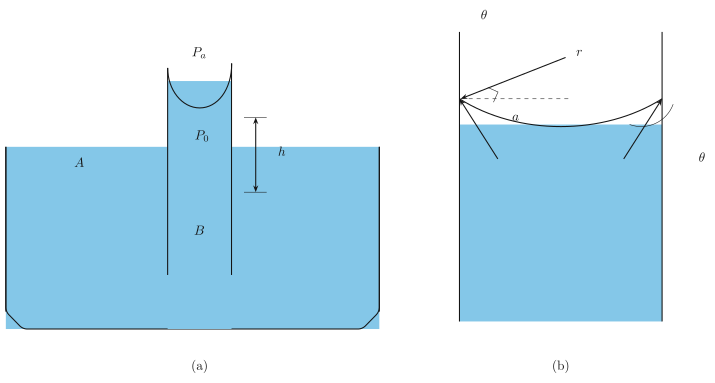
The key to describing this quantitatively is the contact angle θ — the angle the liquid surface makes with the solid wall, measured inside the liquid.
- For water on clean glass, θ≈0∘ (the water spreads completely, "wetting" the surface).
- For mercury on glass, θ≈140∘ (the mercury beads up, barely touching the glass).
The curved liquid surface in the tube is called the meniscus. For a wetting liquid (θ<90∘), the meniscus is concave (curved upward). For a non-wetting liquid (θ>90∘), it's convex (curved downward).
The Precise Statement
Consider a narrow cylindrical tube of radius r dipped into a liquid of density ρ and surface tension T. The liquid makes a contact angle θ with the tube wall. The liquid rises (or falls) to a height h given by:
h=ρgr2Tcosθ
where g is the acceleration due to gravity.
h=ρgr2Tcosθ
Where Does This Formula Come From?
The upward force comes from surface tension acting along the entire inner circumference of the tube. Surface tension T is a force per unit length, so the total upward force is:
Fup=T×(2πr)×cosθ
The cosθ factor picks out the vertical component of that force — only the part that actually lifts the liquid.
The downward force is the weight of the liquid column. The column is approximately a cylinder of height h and radius r, so its volume is πr2h, and its weight is:
Fdown=(πr2h)ρg
At equilibrium, these balance:
T⋅2πr⋅cosθ=πr2hρg
Cancel πr from both sides:
2Tcosθ=rhρg
And solve for h:
h=ρgr2Tcosθ
This formula assumes the meniscus is approximately hemispherical and that the tube is narrow enough that the weight of the meniscus itself is negligible. For very narrow tubes (capillaries), this is an excellent approximation.
What the Formula Tells You …