Q.A body falling under the effect of gravity is said to be in free fall.
You're viewing a preview — the full solution, concept, methods & PYQ mapping are locked.
Start your 14-day free trial to unlock the full solution →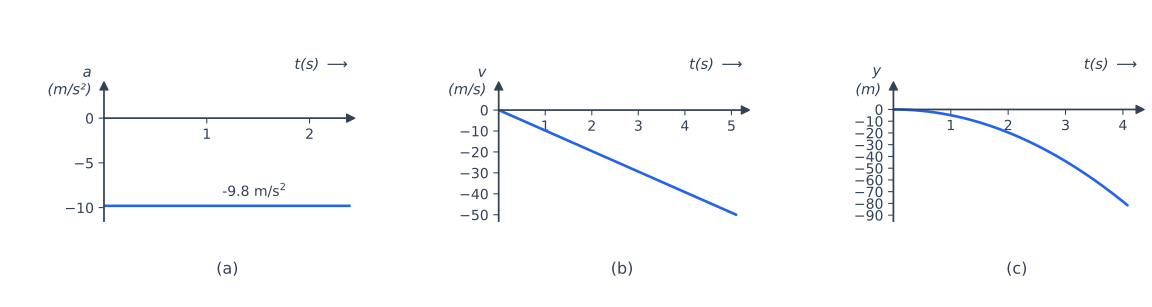
Free fall gives a straight-line v–t graph through the origin (v = gt); uniform acceleration means constant acceleration; among the four graphs, only the straight-line v vs t graph (fig 3) directly shows this constant-slope, uniformly-increasing-velocity behaviour.
a) Velocity–time graph for a freely falling object: taking downward as positive and the object released from rest, v = gt. This is a straight line starting from the origin (v = 0 at t = 0) and rising with a constant slope equal to g — a straight, upward-sloping line through the origin.
b) Uniform acceleration is defined as acceleration that remains constant — the same in both magnitude and direction — at every instant of the motion; equivalently, the velocity changes by equal amounts in every equal interval of time.
c) Checking each graph for uniformly accelerated motion:
- fig(1): position vs time is a curve that rises and then flattens off (compared against a straight reference line) — this shows changing, non-uniform (decreasing) velocity, not uniform acceleration. …
Unlock everything free for 14 days
- Full step-by-step solutions
- Concept-first explanations
- Methods, shortcuts & mistakes
- PYQ mapping + timed mock tests
Full access for 14 days. No credit card required.