Q.v-t curve for an object with uniform acceleration is given below.
Using this graph derive the relation, x = v0 t + (1/2) a t^2 and v^2 = v0^2 + 2 a x.
You're viewing a preview — the full solution, concept, methods & PYQ mapping are locked.
Start your 14-day free trial to unlock the full solution →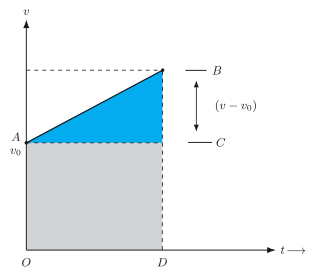
The displacement x equals the area under the v–t line (trapezium OABD). Writing this area two ways — as a trapezium using v = v0+at, and as a rectangle plus a triangle — gives x = v0t + ½at² and, after eliminating t, v² = v0² + 2ax.
From the graph: the velocity rises uniformly (uniform acceleration a) from v0 at t = 0 (point A) to v at time t (point B). D is the foot of the perpendicular from B on the time axis, and C is the point directly below B on the horizontal line through A, so that AC = t and BC = (v − v0), as marked in the figure.
Slope of the line = acceleration
a = slope of AB = BC/AC = (v − v0)/t
⟹ v = v0 + at ... (i)
Derivation of x = v0t + ½at²
The displacement x in time t equals the area under the v–t graph, i.e. the area of the trapezium OABD (with parallel sides OA = v0 and DB = v, and height OD = t):
x = area of trapezium OABD = ½ (OA + DB) × OD = ½ (v0 + v) t
Substitute v = v0 + at from (i):
x = ½ (v0 + v0 + at) t = ½ (2v0 + at) t
x = v0 t + ½ a t² ... (ii)
…
Unlock everything free for 14 days
- Full step-by-step solutions
- Concept-first explanations
- Methods, shortcuts & mistakes
- PYQ mapping + timed mock tests
Full access for 14 days. No credit card required.