Q.Convert
🔒You're viewing a preview — the full solution, concept, methods & PYQ mapping are locked.
🔒 Start your 14-day free trial to unlock the full solution →Concept understanding — Aromatic Synthesis Route
Aromatic Synthesis Route – First Principles
Imagine you are a chef who has been given a plain wooden board and told to carve a specific shape out of it. You can cut away wood, but you cannot add wood back. That is exactly the problem in aromatic synthesis: you start with a simple, cheap aromatic ring (like benzene) and you need to attach specific groups at specific positions. The ring itself is already there — you cannot rearrange its carbon skeleton. So the entire challenge is where to put the next group, and how to get it there.
The "route" is the sequence of reactions you choose. The order matters enormously because the groups already on the ring control where the next group will go. A wrong order can give you the wrong isomer, or force you into a dead end.
The Core Idea: The Ring Directs
Every substituent already on a benzene ring has a directing effect — it tells the next incoming group to go to certain positions. There are two families:
- Ortho/para directors (e.g., –OH, –NH₂, –CH₃, –Cl) — they push the next group to positions 2 and 4 (ortho and para).
- Meta directors (e.g., –NO₂, –CN, –CHO, –SO₃H) — they push the next group to position 3 (meta).
A common mistake is to think you can just "add any group in any order." The ring is not passive — it has a memory of what is already attached. If you ignore directing effects, you will get a mixture of products, often with the wrong isomer as the major one.
The Precise Statement
An aromatic synthesis route is a planned sequence of electrophilic aromatic substitution (EAS) reactions, chosen so that each new substituent is introduced at the correct position relative to the existing ones. The route must account for:
- Directing effects of all current substituents.
- Activation/deactivation — some groups make the ring more reactive (activators), some make it less reactive (deactivators). You cannot do a reaction on a strongly deactivated ring without special conditions.
- Order of introduction — sometimes you must introduce a meta director first, then an ortho/para director, or vice versa, to get the desired final pattern.
A Concrete Example: Making 4-Nitrobenzoic Acid
You want a benzene ring with –COOH at position 1 and –NO₂ at position 4 (para to each other).
–COOH is a meta director. –NO₂ is also a meta director. If you put –COOH first and then nitrate, the –COOH will send the –NO₂ to the meta position (3), not para (4). That gives the wrong isomer.
Correct route:
- Nitrate benzene first → nitrobenzene ( –NO₂ is meta directing).
- Then oxidise the methyl group (if you started with toluene) or use a different method to introduce –COOH. But wait — –NO₂ deactivates the ring strongly. So you cannot easily do Friedel-Crafts acylation on nitrobenzene.
So the actual correct route is different:
- Start with toluene (methylbenzene). The –CH₃ is an ortho/para director and an activator.
- Nitrate toluene → you get a mixture of ortho and para nitrotoluene. Separate the para isomer.
- Oxidise the –CH₃ to –COOH using KMnO₄. The –NO₂ survives this oxidation.
The order here is: introduce the ortho/para director first ( –CH₃ ), then nitrate to get para, then convert the –CH₃ to –COOH. If you had tried to put –COOH first, you would have a meta director that would send –NO₂ to the wrong place.
The General Strategy
When planning a route, ask yourself in order:
- What is the final substitution pattern? (1,2- ; 1,3- ; 1,4- ; etc.)
- Which groups are ortho/para directors and which are meta directors?
- Can I introduce the meta director first, then the ortho/para director? (Often yes, because meta directors deactivate the ring, making further substitution harder — so you want to do the deactivating step last if possible.)
- If I need a 1,3 pattern, I usually put a meta director first, then an ortho/para director. If I need a 1,4 pattern, I usually put an ortho/para director first, then a meta director (because the ortho/para director will send the next group to para, and the meta director will then be at the correct position). …
Why this formula?
Aromatic Synthesis Route: Understanding the Why Behind the Key Principles
In organic chemistry, an aromatic synthesis route refers to a sequence of reactions designed to construct or modify an aromatic ring (typically benzene or its derivatives). The "key formulas" here are not single equations but rather rules and principles that govern reactivity and orientation. Let's break down the reasoning behind the most critical ones.
1. The 4n+2 Hückel Rule — Why Aromaticity Exists
Formula: A planar, cyclic, conjugated molecule is aromatic if it has (4n+2) π electrons, where n=0,1,2,…
Why this holds (the derivation):
- In a cyclic conjugated system, the π electrons occupy molecular orbitals (MOs) that form a ring.
- The energy levels of these MOs are given by the Frost circle (or polygon rule):
- For a regular polygon with N vertices (atoms), inscribe it in a circle with one vertex at the bottom.
- The energy of each MO corresponds to the vertical coordinate of each vertex.
- For benzene (N=6), the MOs split into:
- 1 low-energy bonding orbital
- 2 degenerate bonding orbitals
- 2 degenerate antibonding orbitals
- 1 high-energy antibonding orbital
- Key insight: The 6 π electrons fill the 3 bonding MOs completely. This gives a closed-shell, highly stable configuration — the aromatic stabilization energy (~150 kJ/mol for benzene).
- For N=4 (cyclobutadiene), the MO pattern gives 2 degenerate non-bonding orbitals — filling with 4 electrons creates an open-shell, antiaromatic (unstable) system.
Takeaway: The (4n+2) rule is not arbitrary — it emerges from the symmetry of cyclic π systems and the filling of bonding MOs.
2. Electrophilic Aromatic Substitution (EAS) — The Reactivity Formula
General reaction:
Ar-H+E+catalystAr-E+H+
Why this is the only viable route for aromatic rings:
- Aromatic rings are electron-rich (due to the π cloud) but resistant to addition — addition would break aromaticity.
- Mechanism reasoning:
- The electrophile E+ attacks the ring, forming a σ-complex (arenium ion) — this step is slow (rate-determining).
- The σ-complex is non-aromatic (4 π electrons in the ring) — it is high-energy and unstable.
- To regain aromaticity, the complex loses a proton (H+) — this step is fast and thermodynamically driven.
- Why substitution, not addition: Addition would permanently destroy aromaticity; substitution restores it.
Key formula: The rate law is Rate=k[Ar-H][E+] — first order in both, because the slow step involves both reactants.
3. Orientation Rules — Why Substituents Direct Where the Next Group Goes
Rule:
- Activating groups (e.g., −OH,−NH2,−OCH3) direct to ortho/para positions.
- Deactivating groups (e.g., −NO2,−CN,−CHO) direct to meta positions.
Why this happens (resonance + inductive reasoning):
For ortho/para directors:
- The substituent has a lone pair or π bond that can donate electrons into the ring via resonance.
- Draw the resonance structures of the σ-complex for attack at ortho, meta, and para:
- Ortho attack: The positive charge can be delocalized onto the substituent (e.g., −OH becomes =OH+). This stabilizes the intermediate.
- Para attack: Similar stabilization — charge delocalized to the substituent.
- Meta attack: The positive charge cannot reach the substituent — less stable.
- Result: Ortho/para intermediates are lower in energy → faster reaction.
For meta directors:
- The substituent is electron-withdrawing (by induction or resonance, e.g., −NO2).
- Draw resonance for ortho attack: The positive charge is placed directly on the carbon bearing the withdrawing group — this is highly destabilizing (like putting a + charge next to a + pole).
- For meta attack: The positive charge is never on the carbon with the withdrawing group — relatively more stable.
- Result: Meta attack is the least destabilized → preferred. …
Concept: Aromatic Synthesis via Diazonium Salts — the diazonium group can either be swapped for another substituent at the very same ring position, or deleted (replaced by H), depending on the reagent chosen.
- 3-Methylaniline → 3-Nitrotoluene In 3-methylaniline the −NH2 (C-1) and −CH3 (C-3) are already meta to each other — exactly the relationship the product needs between −NO2 and −CH3. So the amino group only needs to be replaced in place, not removed: diazotise with NaNO2/HCl at 273–278 K, convert the diazonium chloride into the stable diazonium fluoroborate with HBF4, then heat the fluoroborate with aqueous NaNO2 in the presence of copper (Δ). The −N2+ group is replaced directly by −NO2 at the same carbon, giving 3-nitrotoluene.
- Aniline → 1,3,5-Tribromobenzene …
Use diazonium chemistry to swap or delete the amino group without disturbing anything else on the ring. For (i), the amino and methyl groups of 3-methylaniline are already meta to each other — diazotise, form the diazonium fluoroborate with HBF4, then heat with NaNO2/Cu to replace −N2+ directly with −NO2 at the same position, giving 3-nitrotoluene. For (ii), brominate free aniline directly (excess bromine water → 2,4,6-tribromoaniline), then delete the amino group via diazotisation and H3PO2, giving 1,3,5-tribromobenzene.
The Core Concept: The Diazonium Route
The amino group (−NH2) is a powerful ortho/para director and a strong activator. This makes it excellent for placing substituents at specific positions — but it also means aniline cannot be nitrated or mono-brominated cleanly. Diazonium chemistry resolves this: the amino group does its directing work (or simply marks a position), and is then either converted into the substituent needed at that very carbon, or removed entirely.
(i) 3-Methylaniline → 3-Nitrotoluene
In 3-methylaniline, the methyl group sits at C-3 relative to the amino group at C-1 — they are already meta to each other, which is exactly the −NO2/−CH3 relationship the target needs. So the cleanest route is not to nitrate the ring at all: it is to convert the existing amino group directly into a nitro group at the position it already occupies.
1. Diazotise the amine.
Treat 3-methylaniline with NaNO2 and dilute HCl at 273–278 K:
C6H4(CH3)(NH2)+NaNO2+2HCl273–278 KC6H4(CH3)(N2+Cl−)+NaCl+2H2O
2. Convert the diazonium chloride into the fluoroborate.
Treat the diazonium salt with fluoroboric acid; the stable, sparingly soluble diazonium fluoroborate separates:
Ar-N2+Cl−+HBF4→Ar-N2+BF4−+HCl
3. Replace −N2+ with −NO2.
Heat the diazonium fluoroborate with aqueous NaNO2 in the presence of copper — nitrite displaces the diazonium group:
Ar-N2+BF4−+NaNO2Cu, ΔAr-NO2+N2+NaBF4
Because the substitution happens at the same carbon the amino group occupied, the methyl group never moves and the new nitro group inherits the meta relationship. The product is 3-nitrotoluene.
Do not reach for H3PO2 here — that reagent replaces −N2+ with plain −H (deamination) and would simply regenerate toluene, deleting the nitrogen instead of converting it into the −NO2 group the target needs. H3PO2 is the right reagent for part (ii) below, where the amino group must disappear; it is the wrong reagent here.
Diazonium → nitro: Ar-N2+Cl−HBF4Ar-N2+BF4−NaNO2/Cu, ΔAr-NO2 — one of the standard diazonium substitutions, alongside Ar-N2+CuClAr-Cl, Ar-N2+CuBrAr-Br, Ar-N2+KIAr-I and Ar-N2+H3PO2Ar-H.
(ii) Aniline → 1,3,5-Tribromobenzene
The target is a benzene ring with three bromines in a 1,3,5 pattern and no nitrogen. The free amino group is the perfect tool: it activates the ring so strongly that bromine water substitutes all three ortho/para positions almost instantly.
1. Brominate free aniline directly.
Add excess bromine water at room temperature — the reaction is immediate and gives a white precipitate:
C6H5NH2+3Br2H2O2,4,6-Br3C6H2NH2+3HBr …
Aromatic Synthesis Route — Two Clear Methods
(i) 3-Methylaniline → 3-Nitrotoluene
Method: Diazotisation → diazonium fluoroborate (HBF4) → replacement of −N2+ by −NO2 (NaNO2/Cu, Δ)
Why this works:
In 3-methylaniline the amino group (C-1) and the methyl group (C-3) are already meta to each other — the exact geometry the product needs between −NO2 and −CH3. So no new substitution on the ring is required at all: the amino group is converted in place into a nitro group. No nitration step, no protection step, no isomer problem.
Steps:
- Diazotise Treat 3-methylaniline with NaNO2 + dilute HCl at 273–278 K to form the diazonium salt:
C6H4(CH3)(NH2)NaNO2/HCl273–278 KC6H4(CH3)(N2+Cl−)
- Form the diazonium fluoroborate Treat the diazonium chloride with HBF4; the stable fluoroborate separates:
C6H4(CH3)(N2+Cl−)HBF4C6H4(CH3)(N2+BF4−)+HCl
- Replace −N2+ by −NO2 Heat the fluoroborate with aqueous NaNO2 in the presence of copper. Nitrite displaces the diazonium group at the same carbon:
C6H4(CH3)(N2+BF4−)NaNO2/Cu, ΔC6H4(CH3)(NO2)+N2+NaBF4
The methyl group never moves, so the product keeps the meta relationship.
Final product: 3-nitrotoluene
(ii) Aniline → 1,3,5-Tribromobenzene
Method: Direct tribromination → Diazotisation → Reduction (replacement of −N2+ by −H)
Why this works:
The free −NH2 group is strongly activating and ortho/para-directing, so bromine water substitutes all three ortho/para positions of aniline at once — giving 2,4,6-tribromoaniline directly. Deleting the amino group afterwards leaves the three bromines in the 1,3,5 pattern.
Steps:
- Brominate aniline directly Add excess bromine water at room temperature; the reaction is instantaneous:
C6H5NH2+3Br2H2O2,4,6-Br3C6H2NH2+3HBr
Product: 2,4,6-tribromoaniline (white precipitate). No acetylation/protection step is used — protection would moderate the ring and stop bromination at the mono stage.
- Diazotise NaNO2 + dilute HCl at 273–278 K → the diazonium salt. …
These two conversions test whether you can tell when to swap the amino group for another substituent and when to delete it — and when a protecting group helps versus when it ruins the synthesis.
(i) 3-Methylaniline → 3-Nitrotoluene
✗ Common Mistake 1: Direct nitration of 3-methylaniline
Why it's wrong:
The free −NH2 group is a strongly activating ortho/para director, so nitration would go ortho/para to the amino group — not where the target needs it — and the amine itself is prone to oxidation in the nitrating mixture. More fundamentally, no nitration is needed at all: the product's −NO2 belongs at the very carbon the −NH2 already occupies.
✗ Common Mistake 2: The protect–nitrate–deaminate detour
Why it's wrong — check the geometry:
Acetylating to 3-methylacetanilide and then nitrating does not save this route, because −NHCOCH3 is an ortho/para director (the textbook's own bromination of acetanilide gives the para product as the major one — the amide group does not direct meta). Nitration would therefore land ortho/para to the acetamido group at C-1 — e.g. at C-4, which is ortho to the methyl at C-3. After hydrolysis and deamination the nitro group would sit ortho to the methyl group (a 2-nitrotoluene-type product), not meta. The detour is longer and delivers the wrong isomer.
✗ Common Mistake 3: Using H3PO2 on the diazonium salt
Why it's wrong:
H3PO2 replaces −N2+ with plain −H — that deletes the nitrogen entirely and just gives toluene. In this part the nitrogen position must become a nitro group, not vanish.
✓ Correct Route
- Diazotise 3-methylaniline (NaNO2/HCl, 273–278 K).
- Form the diazonium fluoroborate with HBF4.
- Heat with NaNO2/Cu, Δ — the diazonium group is replaced by −NO2 at the same carbon → 3-nitrotoluene. The original meta relationship between −CH3 and the nitrogen position is preserved automatically.
(ii) Aniline → 1,3,5-Tribromobenzene
✗ Common Mistake 1: Acetylating (protecting) the amine before bromination
Why it's wrong:
Protection is the tool for mono-bromination: the acetamido group moderates the ring precisely so that bromination stops at one position (mainly para) — that is why acetanilide, not aniline, is brominated when p-bromoaniline is the target. Here the target needs three bromines, so protection defeats the whole plan. The free amine's full activation is exactly what delivers 2,4,6-tribromoaniline in one step.
✗ Common Mistake 2: Stopping at 2,4,6-tribromoaniline
Why it's wrong:
The target contains no nitrogen. The amino group must still be removed after it has done its directing work.
✗ Common Mistake 3: Using NaNO2/Cu on the diazonium salt
Why it's wrong: …
- KEAM 2026Set eng-2026-04214 marksMCQQ.Which of the following is a commercial method of manufacture of benzaldehyde? (A) Hydrogenation of benzoylchloride with Pd/BaSO4 as catalyst. (B) Oxidation of toluene with chromyl chloride followed by hydrolysis (C) Toluene is treated with Cr2O3 in acetic anhydride followed by hydrolysis (D) Side chain chlorination of toluene followed by hydrolysis. (E) Benzene is treated with CO and HCl in the presence of anhydrous AlCl3.
›Reveal solutionSolution
Industrially benzaldehyde is made by chlorinating the methyl side chain of toluene to C6H5CHCl2 (benzal chloride) and then hydrolysing it — option (D).
Reasoning
Toluene undergoes free-radical (side-chain) chlorination in sunlight/heat to give benzal chloride, C6H5CHCl2. Hydrolysis of this gem-dihalide gives the aldehyde:
C6H5CH3Cl2, hνC6H5CHCl2H2OC6H5CHO
This is the cheap, large-scale commercial process.
- (A) Rosenmund reduction (benzoyl chloride, Pd/BaSO4) is a lab method. …
- KEAM 2026Set eng-2026-04224 marksMCQQ.Match the following: <!-- keam-table-embedded -->
Conversion Reagents / conditions (i) p-nitrotoluene → 2-bromo-4-nitrotoluene |(a) KMnO4/OH− | |(ii) 2-bromo-4-nitrotoluene → 2-bromo-4-aminotoluene |(b) Br2 | |(iii) 2-bromo-4-aminotoluene → the diazonium salt |(c) Sn/HCl | |(iv) the diazonium salt → bromo-methylbenzene |(d) NaNO2/HCl, 273–278 K | |(v) (methyl, bromo)benzene → bromo-benzoic acid |(e) H2O/H3PO2 | (A) (i)-(b), (ii)-(c), (iii)-(e), (iv)-(d), (v)-(a) (B) (i)-(b), (ii)-(c), (iii)-(d), (iv)-(e), (v)-(a) (C) (i)-(e), (ii)-(c), (iii)-(b), (iv)-(d), (v)-(a) (D) (i)-(c), (ii)-(b), (iii)-(e), (iv)-(d), (v)-(a) (E) (i)-(b), (ii)-(c), (iii)-(a), (iv)-(d), (v)-(e)›Reveal solutionSolution
Matching each aromatic conversion to its reagent gives (i)-(b), (ii)-(c), (iii)-(d), (iv)-(e), (v)-(a).
(i) Introducing Br onto the ring uses Br2 → (b). (ii) −NO2→−NH2 reduction uses Sn/HCl → (c). (iii) −NH2→−N2+Cl− diazotisation uses NaNO2/HCl at 273–278 K → (d). (iv) Replacing −N2+ by −H (deamination) …
- KEAM 2025Set eng-2025-04284 marksMCQQ.The products P1, P2, P3 and P4 of the following reactions are:(i) Sodium benzenesulphonate (C6H5SO3Na) NaOH,H+P1(ii) Phenol (C6H5OH) CO2/NaOH/H+P2(iii) Benzene-1,2-diol (catechol) NaOH,CH3ClP3(iv) 2-Hydroxybenzoic acid (salicylic acid) (CH3CO)2O,H+P4 (A) P1 = Phenol, P2 = Salicylaldehyde, P3 = Cyclohexanol, P4 = Phenyl acetate, (B) P1 = Benzene, P2 = Salicylic acid, P3 = Cyclohexanol, P4 = Phenyl acetate, (C) P1 = Phenol, P2 = Salicylic acid, P3 = Anisole, P4 = Aspirin, (D) P1 = Phenol, P2 = Salicylic acid, P3 = Anisole, P4 = Phenyl acetate, (E) P1 = Cyclohexanol, P2 = Salicylic acid, P3 = Phenol, P4 = Aspirin, 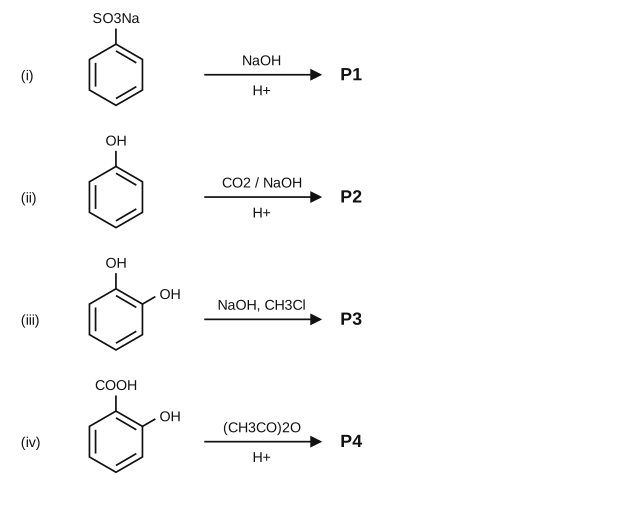
›Reveal solutionSolution
Alkali fusion → phenol; Kolbe-Schmitt → salicylic acid; O-methylation; acetylation → aspirin.
- Sodium benzenesulphonate fused with NaOH then acidified → phenol (P1).
- Phenol + CO2/NaOH then H+ (Kolbe-Schmitt) → salicylic acid (P2).
- O-methylation gives the aryl methyl ether, matched here as anisole (P3). …
- KEAM 2025Set pha-2025-0424F4 marksMCQQ.Which of the following compound is used for the manufacture of phenol in large scale? (A) Chlorobenzene (B) Benzene (C) Aniline (D) Cumene (E) Cyclohexane
›Reveal solutionSolution
The large-scale route to phenol is the cumene process — cumene is oxidised to cumene hydroperoxide, which is cleaved by dilute acid into phenol and acetone.
Process:
- Benzene + propene → cumene (isopropylbenzene).
- Cumene + O2→ cumene hydroperoxide.
- Hydroperoxide H3O+ phenol + acetone. …
- KEAM 2025Set pha-2025-0429F4 marksMCQQ.An aromatic compound (X) of molecular formula, C7H7Cl, on ammonolysis gives Y(Molecular formula, C7H9N). The compound 'Y' reacts with two moles of CH3Cl gives N, N-Dimethylphenylmethanamine. The compounds 'X' and 'Y' are (A) Benzylchloride and Aniline (B) Chlorobenzene and Aniline (C) Benzylchloride and Benzylamine (D) Chlorobenzene and Benzylamine (E) Benzoylchloride and Benzylamine.
›Reveal solutionSolution
The final product N,N-dimethylphenylmethanamine (C6H5CH2N(CH3)2) fixes Y as benzylamine, and its aromatic C7H7Cl precursor is benzyl chloride.
Working backward from the product: N,N-dimethylphenylmethanamine is C6H5CH2N(CH3)2. Removing the two methyl groups (added by the two moles of CH3Cl) leaves C6H5CH2NH2 = benzylamine, formula C7H9N — this is Y.
Benzylamine is obtained by ammonolysis of an alkyl-type halide, so X must give it on treatment with NH3:
C6H5CH2ClNH3C6H5CH2NH2. …
- KEAM 2024Set eng-2024-06074 marksMCQQ.Compound 'X' (C6H6O) reacts with aqueous NaOH to give compound 'Y'. 'Y' reacts with CO2 followed by acidification to give compound 'Z'. The compounds X, Y and Z are respectively (A) benzene, phenol, salicylaldehyde (B) phenol, benzene, benzoic acid (C) phenol, sodium phenoxide, benzophenone (D) benzaldehyde, sodium phenoxide, salicylic acid (E) phenol, sodium phenoxide, salicylic acid
›Reveal solutionSolution
C6H6O is phenol (X). With NaOH it gives sodium phenoxide (Y); Kolbe–Schmitt carboxylation with CO2 followed by acidification gives salicylic acid (Z).
The molecular formula C6H6O corresponds to phenol. Phenol reacts with aqueous NaOH to give sodium phenoxide (Y). In the Kolbe–Schmitt reaction, sodium phenoxide reacts with CO2 under pressure; acidification …
- KEAM 2024Set eng-2024-06084 marksMCQQ.Which of the following statement is correct? (A) Bromination of phenol in CS2 at low temperature give 2,4,6-tribromophenol. (B) Oxidation of phenol with chromic acid gives benzene. (C) Conversion of phenol into tribromophenol by bromine water is a nucleophilic substitution reaction. (D) p-Nitrophenol is steam volatile due to intermolecular hydrogen bonding. (E) The intermediate in Riemer-Tiemann reaction is substituted benzal chloride.
›Reveal solutionSolution
The Reimer–Tiemann intermediate is a substituted benzal chloride (o-hydroxybenzal chloride) that hydrolyses to salicylaldehyde, so statement (E) is correct.
Evaluating each statement:
- (A) In CS2 at low temperature phenol gives mainly monobromination (p-bromophenol); 2,4,6-tribromophenol needs bromine water — false.
- (B) Oxidation of phenol with chromic acid gives benzoquinone, not benzene — false.
- (C) Bromination of phenol is an electrophilic aromatic substitution, not nucleophilic — false. …
- KEAM 2022Set eng-2022-P1-A14 marksMCQQ.Which of the following aryl chlorides on warming with water forms the corresponding phenol? (A) 4-Methylchlorobenzene (B) 4-Nitrochlorobenzene (C) 2, 4, 6-Trinitrochlorobenzene (D) 2-Nitrochlorobenzene (E) 2, 4-Dinitrochlorobenzene
›Reveal solutionSolution
2,4,6-Trinitrochlorobenzene (picryl chloride) hydrolyses to the phenol on warming with water.
Concept and Intuition
Aryl halides are normally inert to nucleophilic substitution, but strongly electron-withdrawing nitro groups ortho/para to the halogen stabilise the Meisenheimer intermediate, greatly accelerating nucleophilic aromatic substitution. Three nitro groups make hydrolysis facile.
Step-by-Step Solution
- Water is a weak nucleophile; plain chlorobenzene needs very harsh conditions.
- Nitro groups at the 2,4,6 positions withdraw electrons and stabilise the negative-charge intermediate.
- With three such groups, warm water alone displaces chloride to give 2,4,6-trinitrophenol (picric acid). …
- KEAM 2021Set eng-2021-P1-A14 marksMCQQ.Isopropylbenzene (cumene) is oxidized in the presence of air to give compound 'X' which on hydrolysis in the presence of acids gives compounds 'Y' and 'Z'. Compounds 'X', 'Y' and 'Z' are respectively (A) benzyl alcohol, benzaldehyde, ethanol (B) cumene hydroperoxide, phenol, acetaldehyde (C) cumene hydroperoxide, benzaldehyde, acetone (D) cumene hydroperoxide, phenol, acetone (E) cumene hydroperoxide, benzaldehyde, acetaldehyde
›Reveal solutionSolution
The cumene process: cumene → cumene hydroperoxide → phenol + acetone.
Concept and Intuition
The benzylic C–H of cumene is oxidised by air to a hydroperoxide. Under acid, this hydroperoxide undergoes a rearrangement/hydrolysis that splits into a phenol and a carbonyl compound.
Step-by-Step Solution
- C6H5CH(CH3)2+O2→C6H5C(CH3)2-OOH (X, cumene hydroperoxide).
- Acidic hydrolysis rearranges the O–O linkage. …
🎓Unlock everything free for 14 days
- ✓Full step-by-step solutions
- ✓Concept-first explanations
- ✓Methods, shortcuts & mistakes
- ✓PYQ mapping + timed mock tests
Full access for 14 days. No credit card required.