The molar conductivity of KCl solutions at different concentrations at 298 K are given below:
| c / mol L−1 | Λm / S cm2 mol−1 |
|---|---|
| 0.000198 | 148.61 |
| 0.000309 | 148.29 |
| 0.000521 | 147.81 |
| 0.000989 | 147.09 |
Show that a plot between Λm and c1/2 is a straight line. Determine the values of Λm0 and A for KCl.
Concept understanding — Molar Conductivity
From Resistance to Conductance: Flipping the Idea
You already know resistance (R) — it tells you how much a material opposes the flow of current. A high resistance means the wire fights the current; a low resistance means it lets current through easily.
Now flip that thought. Instead of asking "how much does it resist?", ask "how easily does it let current flow?" That's exactly what conductance measures.
Conductance (G) is the reciprocal of resistance:
G=R1
Unit: siemens (S) — named after Werner von Siemens. 1 S = 1 A/V (ampere per volt).
If a wire has R=10 Ω, its conductance is G=0.1 S. If R=0.5 Ω, G=2 S — it conducts twice as well.
Ohm's Law in Conductance Form
You know V=IR. Rearranging:
I=RV=GV
So current = conductance × voltage. A high-conductance material draws a large current for the same voltage — it's a "good conductor."
Now, Conductivity: The Material's Intrinsic Property
Resistance depends on two things: the material itself (its "resistivity" ρ) and the geometry (length L, cross-sectional area A):
R=ρAL
Conductance also depends on geometry. A thicker wire (larger A) or a shorter wire (smaller L) has higher conductance. To isolate the material's inherent ability to conduct, we define conductivity (σ):
σ=ρ1
And for a uniform wire:
G=σLA
Conductivity is the reciprocal of resistivity. It tells you how well the material itself conducts, independent of shape and size.
- Unit: siemens per metre (S/m).
- High σ → good conductor (copper: ≈5.8×10⁷ S/m).
- Low σ → poor conductor / insulator (glass: ≈10−12 S/m).
Don't confuse conductance (property of a specific object, depends on geometry) with conductivity (property of the material, independent of geometry). A short thick copper wire has high conductance; a long thin copper wire has lower conductance — but both have the same conductivity.
The Big Picture in One Table
| Quantity | Symbol | Definition | Depends on | Unit |
|---|---|---|---|---|
| Resistance | R | V/I | Material + geometry | Ω |
| Resistivity | ρ | RA/L | Material only | Ω⋅m |
| Conductance | G | 1/R | Material + geometry | S |
| Conductivity | σ | 1/ρ | Material only | S/m |
Intuitive Analogy
Think of a water pipe:
- Resistance = how hard it is to push water through (narrow, long pipe).
- Conductance = how easily water flows (wide, short pipe).
- Resistivity = the "roughness" of the pipe's inner surface (material property).
- Conductivity = the "smoothness" of the pipe's inner surface (material property).
A copper pipe is smooth (high conductivity). A rubber hose is rough (low conductivity). But a short, fat rubber hose might still have decent conductance — because geometry can compensate for poor material.
Key Takeaway for Exams
- G=R1 and σ=ρ1.
- G=σLA for a uniform conductor.
- Conductivity is an intrinsic material property; conductance is an extrinsic property of a specific object.
- In circuits, you'll often use conductance when dealing with parallel resistors (total conductance = sum of individual conductances).
You now have the complete picture: from resistance to conductance, from resistivity to conductivity — and the clean relationship between them.
Molar conductivity is a quantitative cornerstone of the NCERT/CBSE Class 12 Chemistry Electrochemistry chapter, and ‘molar conductivity formula’ or ‘molar conductivity vs concentration’ are recurring important-question types in board exams as well as JEE Main and NEET chemistry. This concept also sets up Kohlrausch's law, a common follow-on topic in the same unit.
Why this formula?
Conductance and Conductivity: Why the Formulas Hold
Let's build this from first principles — understanding the why before the what.
1. The Core Idea: How Easily Does Current Flow?
Think of a conductor (like a copper wire). When you apply a voltage across it, electrons drift through the material. Two questions arise:
- How much current flows for a given voltage? → This is conductance (G).
- How well does the material itself allow current? → This is conductivity (σ).
The key distinction: Conductance depends on the size and shape of the object. Conductivity is an intrinsic property of the material.
2. Ohm's Law in Terms of Conductance
You know Ohm's law:
V=IR
But we can rewrite it as:
I=RV
Define conductance G as the reciprocal of resistance:
G=R1
So:
I=GV
Why this makes sense:
- A larger G means more current for the same voltage — the conductor "conducts" better.
- G has units of siemens (S) = A/V.
3. From Resistance to Conductivity: The Geometry Factor
Resistance of a uniform conductor depends on:
- Length L (longer → more resistance)
- Cross-sectional area A (thicker → less resistance)
- Material property ρ (resistivity)
The formula:
R=ρAL
Now, conductivity σ is the reciprocal of resistivity:
σ=ρ1
So:
R=σ1⋅AL
Why this form?
- If you double the length, electrons have to travel twice as far, colliding more → resistance doubles.
- If you double the area, there's twice as many "lanes" for electrons → resistance halves.
4. The Key Formula: Conductance in Terms of Conductivity
Since G=1/R, we get:
G=σLA
This is the central relationship. Let's see why it holds:
- σ tells you how well the material conducts (intrinsic).
- A/L tells you how the geometry amplifies or reduces that.
Intuition:
- A fat, short wire (A large, L small) has high conductance.
- A thin, long wire (A small, L large) has low conductance.
- A material with high σ (like copper) gives higher G than one with low σ (like iron), for the same shape.
5. Microscopic Derivation (Why σ Exists)
At the microscopic level, conductivity arises from electron motion:
σ=neμ
Where:
- n = number of free electrons per unit volume
- e = electron charge
- μ = electron mobility (how fast they drift per unit electric field)
Why this works:
- More free electrons (n large) → more charge carriers → higher conductivity.
- Higher mobility (μ large) → electrons move faster for the same push → higher conductivity.
This explains why metals (high n) are good conductors, and why heating reduces σ (more collisions → lower μ).
6. Summary: The Logical Chain
| Step | Concept | Formula | Why |
|---|---|---|---|
| 1 | Ohm's law | V=IR | Voltage drives current against resistance |
| 2 | Conductance | G=1/R | Measures ease of flow |
| 3 | Resistivity | R=ρL/A | Geometry + material |
| 4 | Conductivity | σ=1/ρ | Material's intrinsic ability |
| 5 | Key result | G=σLA | Combines material + geometry |
Final takeaway:
Conductance G is not just a number — it's the product of how good the material is (σ) and how the shape helps (A/L). This is why a thick copper wire conducts far better than a thin iron wire of the same length.
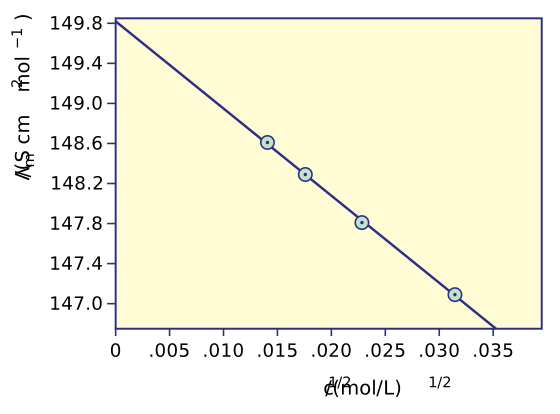
Concept: Molar Conductivity — For strong electrolytes, Kohlrausch's law states Λm=Λm0−Ac, so a plot of Λm vs c should be linear.
Step 1: Compute c for each concentration
| c (mol L⁻¹) | c (mol¹/² L⁻¹/²) | Λm (S cm² mol⁻¹) |
|---|---|---|
| 0.000198 | 0.01407 | 148.61 |
| 0.000309 | 0.01758 | 148.29 |
| 0.000521 | 0.02283 | 147.81 |
| 0.000989 | 0.03145 | 147.09 |
Step 2: Check linearity — Λm decreases uniformly as c increases, confirming a straight-line relationship (as c rises, Λm falls; equivalently Λm increases on dilution).
Step 3: Determine A (slope) and Λm0 (intercept)
Slope =−A=0.03145−0.01407147.09−148.61=0.01738−1.52≈−87.46
So A=87.46 S cm2mol−1/(mol L−1)1/2.
Extending the straight line to c=0, the graphical intercept read from the plot is Λm0=150.0 S cm2mol−1.
The plot of Λm vs c is a straight line; from it, Λm0=150.0 S cm2mol−1 and A=87.46 S cm2mol−1/(mol L−1)1/2 for KCl at 298 K.
NCERT reads Λm0=150.0 from its graphical extrapolation. A full least-squares fit of the four data points gives Λm0≈149.8 S cm2mol−1 and A≈87.5 — essentially identical; the small difference is only graphical rounding of the intercept.
For strong electrolytes like KCl, molar conductivity varies linearly with the square root of concentration (Kohlrausch's law). Plotting Λm vs c1/2 gives a straight line; the book reads its intercept as Λm0=150.0 S cm2 mol−1 and its slope gives A=87.46 S cm2 mol−1 (mol L−1)−1/2.
The key idea here is Kohlrausch's law of independent migration of ions. For strong electrolytes, as you dilute the solution, ions move more freely because interionic attractions weaken. The molar conductivity Λm therefore increases on dilution — and, plotted against the square root of concentration, it decreases linearly as c rises. This linear relationship is the hallmark of a strong electrolyte.
Why c? Because the Debye–Hückel theory shows that the ionic atmosphere dragging on a moving ion has a radius proportional to 1/c. So the retarding effect scales with c, and conductivity rises as c falls.
The equation is:
Λm=Λm0−Ac
where Λm0 is the limiting molar conductivity (at infinite dilution) and A is a constant for the electrolyte.
Let's test this with the given data.
-
Convert the data to c values.
c (mol L⁻¹) c (mol L⁻¹)1/2 Λm (S cm² mol⁻¹) 0.000198 0.01407 148.61 0.000309 0.01758 148.29 0.000521 0.02283 147.81 0.000989 0.03145 147.09 -
Plot Λm against c.
The points fall on a straight line: as c increases, Λm decreases linearly. This confirms Kohlrausch's law for KCl.
-
Find A (slope magnitude).
The slope of the line is −A:
slope=0.03145−0.01407147.09−148.61=0.01738−1.52=−87.46 S cm2 mol−1 (mol L−1)−1/2
So A=87.46 S cm2 mol−1 (mol L−1)−1/2.
- Find Λm0 (the intercept). Extending the straight line to c=0 (infinite dilution), NCERT reads the intercept from the graph as:
Λm0=150.0 S cm2 mol−1
You don't need to draw the graph perfectly in an exam — just show that the points satisfy a linear relation by computing the slope between successive pairs. If the slopes are nearly constant, the plot is a straight line.
A common mistake is to plot Λm against c instead of c. That curve is not linear — it bends. Always use c for strong electrolytes.
NCERT reads Λm0=150.0 from its graphical extrapolation. If you instead fit the four points algebraically (least squares, or point-slope from the first point: 148.61+87.46×0.01407=149.84), you get Λm0≈149.8 S cm2 mol−1 and A≈87.5 — essentially identical to the printed values; the difference is only graphical rounding of the intercept.
The plot of Λm vs c1/2 is a straight line, giving Λm0=150.0 S cm2 mol−1 and A=87.46 S cm2 mol−1 (mol L−1)−1/2 for KCl at 298 K.
Method: Kohlrausch's Law (Empirical Debye–Hückel–Onsager Plot)
Kohlrausch observed that for strong electrolytes, molar conductivity varies linearly with the square root of concentration at low concentrations:
Λm=Λm0−Ac
Here:
- Λm0 = limiting molar conductivity (intercept)
- A = Kohlrausch constant (magnitude of the slope; the slope of the line is −A)
Steps
Step 1: Compute c for each concentration
| c (mol L⁻¹) | c (mol L⁻¹)^(1/2) | Λm (S cm² mol⁻¹) |
|---|---|---|
| 0.000198 | 0.01407 | 148.61 |
| 0.000309 | 0.01758 | 148.29 |
| 0.000521 | 0.02283 | 147.81 |
| 0.000989 | 0.03145 | 147.09 |
Step 2: Plot Λm vs c
Put c on the x-axis and Λm on the y-axis. The points fall on a straight line with negative slope.
Step 3: Determine A (slope)
Take two well-separated points:
- Point 1: (0.01407, 148.61)
- Point 2: (0.03145, 147.09)
slope=0.03145−0.01407147.09−148.61=0.01738−1.52≈−87.46
Since Λm=Λm0−Ac, the constant is:
A=87.46 S cm2mol−1(mol L−1)−1/2
Step 4: Determine Λm0 (intercept)
Extend the line to c=0. NCERT reads the intercept from the graph as:
Λm0=150.0 S cm2mol−1
Final Result
- Method: Kohlrausch's empirical law (linear Λm vs c plot)
- Λm0 = 150.0 S cm² mol⁻¹
- A = 87.46 S cm² mol⁻¹ (mol L⁻¹)^(−1/2)
The straight-line nature confirms KCl behaves as a strong electrolyte at these dilutions.
NCERT reads Λm0=150.0 graphically. A least-squares fit of the four points gives Λm0≈149.8 and A≈87.5 — essentially the same; the difference is only graphical rounding of the intercept.
1. ✗ Mistake: Forgetting to convert concentration units
Students often take c directly in mol L−1 and then compute c1/2 without realising that the Kohlrausch law uses c in mol L−1 — but the square root is fine as given.
The real trap: they forget that Λm is already in S cm2 mol−1 and try to convert it unnecessarily.
✓ How to avoid:
- Check units at the start. Here, both c and Λm are given in standard units.
- Only convert if the problem explicitly asks for SI units (e.g., S m2 mol−1). For this problem, use as given.
2. ✗ Mistake: Plotting Λm vs c instead of Λm vs c1/2
This is the most common error. The Kohlrausch law is:
Λm=Λm0−Ac
So the x-axis must be c, not c.
✓ How to avoid:
- Always write the law first before plotting.
- Compute a new column: c for each concentration.
- Plot Λm on y-axis, c on x-axis.
3. ✗ Mistake: Errors in calculating c
Students sometimes:
- Take square root of the number without the unit.
- Miscalculate powers of 10 (e.g., 0.000198=0.01407, not 0.1407).
✓ How to avoid:
- Use scientific notation: 0.000198=1.98×10⁻⁴ Then c=1.98×10⁻²≈1.407×10⁻²
- Double-check each value with a calculator.
4. ✗ Mistake: Drawing a rough freehand graph and guessing intercept/slope
Students often sketch a line by eye and read Λm0 from the y-intercept inaccurately.
✓ How to avoid:
- Use graph paper or plotting software.
- Draw the best-fit straight line (not just connecting dots).
- Read Λm0 as the y-intercept (where c=0).
- Read slope =−A from two far-apart points on the line.
5. ✗ Mistake: Confusing A with the slope directly
The Kohlrausch law is:
Λm=Λm0−Ac
So the slope of the line = −A. Students often take slope = A and get sign wrong.
✓ How to avoid:
- Write the equation in y = mx + c form:
- y=Λm
- x=c
- m=−A
- c=Λm0
- So if slope =−50, then A=50.
6. ✗ Mistake: Forgetting units for Λm0 and A
Students report Λm0=150 without units, or give A in wrong units.
✓ How to avoid:
- Λm0 has same units as Λm: S cm2 mol−1
- A has units: S cm2 mol−1⋅(mol L−1)−1/2 (Often written as S cm2 mol−1⋅L1/2 mol−1/2)
7. ✗ Mistake: Not checking linearity properly
Students assume the plot is a straight line without verifying.
✓ How to avoid:
- After plotting, check if points lie close to a straight line.
- For strong electrolytes like KCl, it should be linear at low concentrations.
- If one point deviates, recheck calculation of c for that point.
Quick Summary Table
| Mistake | How to Avoid |
|---|---|
| Plotting Λm vs c | Always plot vs c |
| Wrong c values | Use scientific notation, double-check |
| Freehand inaccurate graph | Use graph paper / software, best-fit line |
| Slope = A (wrong sign) | Slope = −A |
| No units for Λm0, A | Always attach correct units |
| Not checking linearity | Verify points lie on a line |
Final tip: Before you start, write the Kohlrausch law clearly. Then compute c, plot, find intercept (Λm0) and slope (−A). This structured approach eliminates most errors.
- KEAM 2026Set eng-2026-04214 marksMCQQ.The molar conductivity of a weak mono basic acid, HA at 298 K is 70 Scm2mol−1. What is the percentage ionisation of HA at 298 K? [At infinite dilution λH+=340 Scm2mol−1 and λA−=80 Scm2mol−1] (A) 8.35 % (B) 16.7 % (C) 20 % (D) 32.5 % (E) 15.3 %
›Reveal solutionSolution
α=Λm/Λm∘=70/420=16.7.
Limiting molar conductivity of HA:
Λm∘=λH+∘+λA−∘=340+80=420,Scm2mol−1.
Degree of ionisation:
α=Λm∘Λm=42070=0.167=16.7
✓Final answerThe correct option is (B).
- KEAM 2026Set pha-2026-0418F4 marksMCQQ.The limiting molar conductance for aqueous solution of CaCl2 at 298K is 271.6 S cm2 mol−1. If the limiting ionic conductance of Ca2+ ion at the same temperature is 119 S cm2 mol−1 what is the limiting ionic conductance of Cl− ion? (A) 152.6 S cm2 mol−1 (B) 76.3 S cm2 mol−1 (C) 135.8 S cm2 mol−1 (D) 228.7 S cm2 mol−1 (E) 114.35 S cm2 mol−1
›Reveal solutionSolution
Kohlrausch: Λm∘(CaCl2)=λ∘(Ca2+)+2λ∘(Cl−).
271.6=119+2λ∘(Cl−)
2λ∘(Cl−)=152.6⇒λ∘(Cl−)=76.3 S cm2mol−1.
✓Final answerThe correct option is (B). Subtract the Ca2+ contribution and halve for two Cl−.
- KEAM 2025Set eng-2025-04254 marksMCQQ.The molar conductivity (Λm) acetic acid is 78.1 S cm2 mol−1. Its degree of dissociation (α) is (Λm0) for acetic acid = 390.5 S cm2 mol−1 (A) 0.12 (B) 0.40 (C) 0.02 (D) 0.20 (E) 0.04
›Reveal solutionSolution
Degree of dissociation of a weak electrolyte α=Λm0Λm=390.578.1=0.20.
For a weak electrolyte such as acetic acid, the degree of dissociation is the ratio of the molar conductivity at the given concentration to the molar conductivity at infinite dilution:
α=Λm0Λm
Substituting Λm=78.1 S cm2 mol−1 and Λm0=390.5 S cm2 mol−1:
α=390.578.1=0.20
✓Final answerThe correct option is (D).
- KEAM 2025Set pha-2025-0424F4 marksMCQQ.The ion with the highest limiting molar conductance at 298 K is (A) H+ (B) Na+ (C) K+ (D) Ca2+ (E) Mg2+
›Reveal solutionSolution
The proton conducts by the Grotthuss (hopping) mechanism, giving H+ by far the largest limiting molar conductivity (≈350 S cm2 mol−1).
Limiting molar conductivities at 298 K (in S cm2 mol−1) are roughly:
- H+≈349.8
- K+≈73.5
- Ca2+≈119 (but per mole of charge ≈59.5)
- Na+≈50.1
- Mg2+≈106 (per mole of charge ≈53)
The proton is anomalously mobile because it moves through water by the Grotthuss mechanism — successive H+ transfers along hydrogen-bonded water molecules rather than bodily migration of a hydrated ion. Hence H+ has the highest limiting molar conductance.
✓Final answerThe correct option is (A).
- KEAM 2024Set eng-2024-06074 marksMCQQ.The conductivity of 0.02 mol L−1 KCl solution is 0.248 S m−1. Its molar conductivity is (A) 20 S m2 mol−1 (B) 1.24×10⁻³ S m2 mol−1 (C) 1.24×10⁻⁴ S m2 mol−1 (D) 2.48×10⁻² S m2 mol−1 (E) 1.24×10⁻² S m2 mol−1
›Reveal solutionSolution
Molar conductivity Λm=κ/c. With κ=0.248 S m−1 and c=0.02 mol L−1=20 mol m−3, Λm=1.24×10⁻² S m2 mol−1.
Molar conductivity is related to conductivity by
Λm=cκ.
Using SI units, the concentration must be in mol m−3:
c=0.02 mol L−1=0.02×1000=20 mol m−3.
Therefore
Λm=20 mol m−30.248 S m−1=0.0124=1.24×10⁻² S m2mol−1.
✓Final answerThe correct option is (E).
- KEAM 2024Set eng-2024-06084 marksMCQQ.The limiting molar conductances of NaCl, HCl and CH3COONa at 300 K are 126.4, 425.9 and 91.0 S cm2 mol−1 respectively. The limiting molar conductance of acetic acid at 300 K is (A) 266 S cm2 mol−1 (B) 390.5 S cm2 mol−1 (C) 461.3 S cm2 mol−1 (D) 208 S cm2 mol−1 (E) 108 S cm2 mol−1
›Reveal solutionSolution
Kohlrausch's law of independent ion migration lets the limiting molar conductance of acetic acid be built from those of sodium acetate, HCl and NaCl: 91.0+425.9−126.4=390.5 S cm2 mol−1.
Acetic acid dissociates into CH3COO− and H+. Combining known limiting conductances:
Λm∘(CH3COOH)=Λm∘(CH3COONa)+Λm∘(HCl)−Λm∘(NaCl).
The Na+ and Cl− contributions cancel, leaving the ions CH3COO− and H+. Substituting:
Λm∘=91.0+425.9−126.4=390.5 S cm2mol−1.
✓Final answerThe correct option is (B).
- KEAM 2021Set eng-2021-P1-A14 marksMCQQ.The SI unit of molar conductivity is (A) S m3 mol−1 (B) S m mol−1 (C) S m mol−2 (D) S m2 mol−1 (E) S m2 mol−2
›Reveal solutionSolution
The SI unit of molar conductivity is S m2 mol−1.
Concept and Intuition
Molar conductivity is the conductivity per unit molar concentration, defined as Λm=κ/c. Its unit follows directly from the units of conductivity and concentration in SI.
Step-by-Step Solution
- Conductivity κ has SI unit S m−1.
- Concentration c in SI is mol m−3.
- Λm=κ/c= (S m−1)/(mol m−3) = S m2 mol−1.
Common Mistakes
- Using concentration in mol dm−3 (giving S cm2 mol−1) instead of the SI mol m−3.
✓Final answerThe correct option is (D) — S m2 mol−1.
ANSWER: D
🎓Unlock everything free for 14 days
- ✓Full step-by-step solutions
- ✓Concept-first explanations
- ✓Methods, shortcuts & mistakes
- ✓PYQ mapping + timed mock tests
Full access for 14 days. No credit card required.