Q.Refer to Exercise 32. Maximum of F - Minimum of F=
(A) 60
(B) 48
(C) 42
(D) 18
🔒You're viewing a preview — the full solution, concept, methods & PYQ mapping are locked.
🔒 Start your 14-day free trial to unlock the full solution →Concept understanding — Corner Point Theorem
The Corner Point Theorem: Why the Best Answer Hides at the Edges
Imagine maximising profit for a factory that makes two products, with limited raw materials, machine hours, and labour. Every combination that doesn't break a limit is a feasible solution. Plot them all on a graph and they form a shape — always a polygon if your constraints are straight lines.
Where is the best (maximum profit) point? You might think anywhere inside the shape. But the Corner Point Theorem says something surprising: the best point is always at a corner — a vertex of the polygon. Never floating in the middle of an edge or inside.
This theorem is the backbone of linear programming — the method for solving optimisation problems with straight-line constraints.
The Intuition: Why Corners Win
Think of profit as a line you slide across the polygon; each position represents a profit level. You push the line as far as possible (higher profit) while still touching the polygon. The last point of contact before the line escapes is always a corner.
Why? Because both the profit line and the polygon's edges are straight, and the farthest point in any straight-line direction from a polygon is always a vertex. This holds for any flat-sided shape.
Solving a linear programming problem by hand, you only need to check the corners — usually just 3–5 points, not the infinite points inside.
The Precise Statement
Corner Point Theorem (Fundamental Theorem of Linear Programming):
If a linear programming problem has an optimal solution, then that optimal solution occurs at at least one corner point (vertex) of the feasible region.
Three key parts:
-
"If it has an optimal solution" — sometimes the problem is unbounded (profit increases forever) or infeasible (no point satisfies all constraints). The theorem applies only when a best answer exists.
-
"At least one corner point" — several corners can give the same optimal value. If the profit line is parallel to an edge, every point on that edge is optimal, including both endpoints (corners).
-
"Of the feasible region" — the polygon formed by all constraints. Corners are where two constraint lines intersect.
Why This Matters for Exams
To solve a linear programming problem:
- Find all corner points (solve pairs of constraint equations).
- Plug each corner into the objective function.
- Pick the best value.
The theorem guarantees you haven't missed a better answer hiding in the middle. …
This is a corner-point evaluation. The referenced NCERT Exemplar feasible region has corner points (0,2), (3,0), (6,0), (6,8), (0,5) and objective F=4x+6y. Evaluate F at every corner and take the largest minus the smallest.
F(0,2)=12,F(3,0)=12,F(6,0)=24,F(6,8)=72,F(0,5)=30. …
Evaluating F=4x+6y at the corner points gives a maximum of 72 and a minimum of 12, so Max − Min =60 — option (A).
What the question refers to
This item follows on from the earlier exercise whose feasible region has the corner points
(0,2),(3,0),(6,0),(6,8),(0,5),
with objective function F=4x+6y. By the Corner-Point Theorem, the largest and smallest values of a linear objective over a feasible region are always found at these vertices, so we simply test each one.
Evaluate F at every corner
| Corner (x,y) | F=4x+6y |
|---|---|
| (0,2) | 0+12=12 |
| (3,0) | 12+0=12 |
| (6,0) | 24+0=24 |
Method: Extracting (max − min) or (max + min) from a feasible region
For a question asking for a spread or sum of extremes, run one corner-point pass and harvest both ends together.
Steps
Step 1: Evaluate F=ax+by at each vertex.
F=ax+by
For a bounded polygon the Corner Point Theorem guarantees both the maximum and minimum appear in this vertex list.
Step 2: Identify Fmax and Fmin simultaneously. …
Common Mistakes
Mistake 1: Finding only the maximum (or only the minimum).
Why it's wrong: the answer needs both, since it asks for Fmax−Fmin. Correct approach: evaluate F=4x+6y at every corner in one pass and pick out both extremes (72 and 12).
Mistake 2: Forgetting the minimum is shared by two corners. …
- KEAM 2026Set eng-2026-04174 marksMCQQ.The minimum of the following linear programming problem occurs at: Minimize C=7x+10y subject to x+y≥3, x+2y≥4, x,y≥0 (A) (3,0) (B) (4,0) (C) (0,2) (D) (2,1) (E) (0,3)
›Reveal solutionSolution
Evaluate C at the feasible corner points of the region.
Constraints: x+y≥3, x+2y≥4, x,y≥0. The feasible corners are where the boundary lines meet the axes or each other:
- (4,0): satisfies both; C=7(4)+10(0)=28.
- (0,3): satisfies both; C=7(0)+10(3)=30.
- Intersection of x+y=3 and x+2y=4: y=1, x=2, i.e. (2,1); C=7(2)+10(1)=24. …
- KEAM 2026Set eng-2026-04184 marksMCQQ.If the constraints of a Linear Programming Problem are: x+y≤6, 2x+y≤8, x≥0, y≥0, then a corner point of the feasible region is (A) (6,0) (B) (0,8) (C) (2,4) (D) (4,2) (E) (1,5)
›Reveal solutionSolution
The intersection of the two boundary lines x+y=6 and 2x+y=8 is (2,4), which satisfies all constraints and is a vertex; the other listed points are infeasible.
Solve x+y=6 and 2x+y=8: subtracting gives x=2, then y=4, so (2,4). Check: 2+4=6≤6 and 2(2)+4=8≤8, with x,y≥0 — feasible, and being the meeting point of two active constraints it …
- KEAM 2026Set eng-2026-04224 marksMCQQ.Consider the Linear Programming Problem: Maximize Z=x+2y Subject to 2x+3y≤12,x≥0,y≥0. The optimal value is (A) 3 (B) 7 (C) 8 (D) 10 (E) 12
›Reveal solutionSolution
Evaluate Z at the corner points of the feasible region bounded by 2x+3y≤12, x,y≥0.
Corner points: (0,0), (6,0) and (0,4). …
- KEAM 2025Set eng-2025-04234 marksMCQQ.In the graphical method of a linear programming problem, the optimal solution lies (A) at the centre of the feasible region (B) at a corner point of the feasible region (C) [AMBIGUOUS] (D) [AMBIGUOUS] (E) [AMBIGUOUS]
›Reveal solutionSolution
[!TLDR]
By the corner-point (fundamental extreme-point) theorem of linear programming, the optimum of the linear objective occurs at a corner point of the feasible region.
Concept
In the graphical method, the constraints define a convex feasible region (a polygon or unbounded polygonal region). A linear objective Z=ax+by has no interior critical point, so its extreme values over a convex polygon are reached at the vertices — this is the Corner-Point Theorem in the NCERT/CBSE linear-programming chapter that KEAM's syllabus follows.
Solution …
- KEAM 2025Set eng-2025-04264 marksMCQQ.The maximum value of the objective function z=2x+3y, when the corner points of the feasible region are (0,0), (5,0), (4,1) and (0,2), is (A) 0 (B) 6 (C) 10 (D) 11 (E) 16
›Reveal solutionSolution
The optimum of a linear objective lies at a corner point; test all four.
Evaluate z=2x+3y:
- (0,0): 0
- (5,0): 10
- (4,1): 8+3=11
- (0,2): 6 …
- KEAM 2024Set eng-2024-06094 marksMCQQ.Given the Linear Programming Problem: Maximize z=11x+7y subject to the constraints: x≤3, y≤2, x,y≥0. Then the optimal solution of the problem is (A) (3,2) (B) (3,0) (C) (0,2) (D) (1,0) (E) (0,1)
›Reveal solutionSolution
Both x and y have positive coefficients and independent upper bounds, so the optimum is the top corner (3,2), giving z=47.
The feasible region is the rectangle 0≤x≤3, 0≤y≤2. Evaluate z=11x+7y at the corners: …
- KEAM 2022Set eng-2022-P2-B14 marksMCQQ.The feasible region for a L.P.P. is shown in the figure below. Let z=50x+15y be the objective function, then the maximum value of z is [FIGURE: feasible region with vertices C(0, 60), B(10, 50), A(20, 0), and origin] (A) 900 (B) 1000 (C) 1250 (D) 1300 (E) 1520
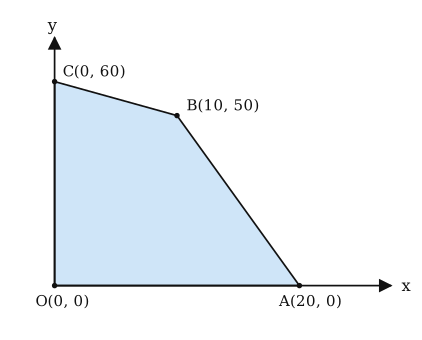
›Reveal solutionSolution
The objective z = 50x + 15y is largest (1250) at the vertex B(10, 50).
Concept and Intuition
For a linear programming problem the optimum of a linear objective over a convex feasible polygon occurs at a corner (vertex). So we just evaluate z at each vertex and pick the biggest.
Step-by-Step Solution
- O(0,0): z = 0.
- C(0,60): z = 50(0) + 15(60) = 900.
- A(20,0): z = 50(20) + 15(0) = 1000. …
🎓Unlock everything free for 14 days
- ✓Full step-by-step solutions
- ✓Concept-first explanations
- ✓Methods, shortcuts & mistakes
- ✓PYQ mapping + timed mock tests
Full access for 14 days. No credit card required.