Q.In a simple circuit, a cell of emf V and internal resistance r drives current through two resistors that are connected in parallel between two nodes A and B: a fixed resistance R in one branch and a variable resistance R′ in the other branch. The variable resistance R′ can be varied from a value R0 up to infinity, and the resistances satisfy r≪R≪R0. Which of the following statements about this circuit is correct?
🔒You're viewing a preview — the full solution, concept, methods & PYQ mapping are locked.
🔒 Start your 14-day free trial to unlock the full solution →Concept understanding — Internal Resistance
Internal Resistance – The Battery That Fights Itself
Imagine you have a bucket of water with a tap at the bottom. When you open the tap fully, water flows out freely. But if the pipe is narrow or clogged, the flow is weaker even though the bucket is full. A battery behaves the same way: it has a "full bucket" of electrical energy (its emf, or electromotive force), but inside the battery, there is always some "clogged pipe" that resists the flow of charge. That clog is called internal resistance.
The Intuition
Every real battery is not a perfect source of voltage. If you connect a small bulb to a fresh battery, it glows brightly. But if you connect a powerful motor that draws a large current, the same battery might struggle — the voltage at its terminals drops, and the motor runs slower. Why? Because inside the battery, the chemical reactions and the materials themselves have a natural opposition to the flow of charge. This opposition is internal resistance, denoted by r (or sometimes Rint).
Think of it this way: the battery has two "battles" to fight. First, it must push charge through the external circuit (the bulb, the motor, the wires). Second, it must push charge through its own internal structure. The harder it has to push (i.e., the larger the current), the more voltage it "loses" inside itself.
The Precise Statement
Internal resistance is the opposition to the flow of electric current offered by the materials and chemical processes inside a source of emf (like a battery, cell, or generator). It is measured in ohms (Ω).
For a cell or battery, the relationship between the emf (E), the terminal voltage (V), the current (I), and the internal resistance (r) is given by:
V=E−Ir
This is the single most important equation to remember.
V=E−Ir
Here:
- E is the electromotive force — the maximum voltage the battery can provide when no current flows (open circuit). Think of it as the "ideal" voltage.
- V is the terminal voltage — the actual voltage you measure across the battery's terminals when it is delivering current.
- I is the current flowing through the circuit (and therefore through the battery itself).
- r is the internal resistance.
The term Ir is the voltage drop inside the battery. It is the "price" the battery pays for delivering current.
What Happens in Different Situations?
| Condition | Current I | Terminal Voltage V | Why? |
|---|---|---|---|
| Open circuit (no load) | I=0 | V=E | No current means no internal drop. |
| Small load (e.g., a dim bulb) | Small I | V≈E | The Ir term is tiny. |
| Large load (e.g., a powerful motor) | Large I | V<E significantly | The Ir drop becomes noticeable. |
| Short circuit (wires directly across terminals) | Very large I | V≈0 | Almost all voltage is lost inside the battery; the battery heats up and may be damaged. |
A common mistake is to think that internal resistance is a "bad" thing that can be eliminated. It cannot — every real source has some internal resistance. Even a brand new AA battery has a small r (typically 0.1 to 0.5 Ω). Old or weak batteries have much larger r, which is why they fail to power high-current devices.
Why Does Internal Resistance Matter?
- Power loss inside the battery: The power dissipated as heat inside the battery is Ploss=I2r. This is why batteries get warm when delivering large currents.
- Maximum power transfer: There is a famous theorem (Maximum Power Transfer Theorem) that says a source delivers maximum power to an external load when the load resistance equals the internal resistance (Rload=r). But this is inefficient — half the power is wasted inside the source. …
Why this formula?
Internal Resistance: Why the Key Formulas Hold
Internal resistance is a fundamental concept in real-world circuits. No battery is perfect — every practical source has some internal resistance (r) that opposes the flow of current inside the source itself.
1. The Core Idea: A Real Battery = An Ideal Source + A Resistor
Think of a real battery as:
- An ideal EMF source (E) — provides constant voltage with zero internal resistance.
- A small resistor (r) — connected in series inside the battery.
Why series? Because the current that leaves the battery must first pass through its internal material (electrolyte, electrodes), which offers resistance.
2. The Terminal Voltage Formula
When the battery delivers current I to an external circuit:
- The ideal source produces E.
- The internal resistor r drops some voltage: Vdrop=Ir (Ohm's law).
- The voltage available at the terminals (V) is what's left:
V=E−Ir
Why this makes sense:
- If I=0 (open circuit), V=E — you measure the full EMF.
- If I increases, V decreases — the internal drop grows.
- If I is huge (short circuit), V→0 and all voltage is lost inside.
3. The Short-Circuit Current Formula
If you connect the terminals directly (external resistance R=0):
- The only resistance in the circuit is r.
- By Ohm's law: Ishort=rE
Why this holds:
- The entire EMF is now dropped across r alone.
- This is the maximum current the battery can deliver — limited by its internal resistance.
- In practice, this can damage the battery (heating, chemical damage).
4. Power Delivered to External Load
When the battery is connected to an external load R:
- Total circuit resistance: R+r
- Current: I=R+rE
- Power delivered to the external load (Pout):
Pout=I2R=(R+rE)2R
Why this matters:
- Power is not simply E2/R — because r limits current. …
Concept: Parallel resistance dominated by the smaller resistor
R and R′ are in parallel between A and B, with R′≥R0≫R. The parallel value Rp=R+R′RR′=1+R/R′R stays close to R for the whole range (since R/R′≤R/R0≪1), so:
- (A) VAB=r+RpVRp≈r+RVR≈V (using r≪R) barely moves as R′ varies — nearly constant. Correct.
- (B) Current through R′ is ≈V/R′, which falls steadily as R′ increases — not constant. Wrong.
- (C) Main current I≈V/(r+R) is set by the fixed R, not R′ — not sensitive to R′. Wrong. …
The parallel combination Rp=R∥R′ stays close to (and is always slightly less than) R because R′≥R0≫R. That makes VAB≈r+RVR≈V nearly constant (A), and — as an exact, not approximate, consequence of Rp<R always — the total current always satisfies I≥r+RV (D). (B) and (C) are false.
Setting up the circuit
The cell (emf V, internal resistance r) drives the parallel combination of R and R′ between nodes A and B. Let
Rp=R∥R′=R+R′RR′=1+R/R′R.
The total current from the cell is I=r+RpV, and the potential drop across AB is VAB=IRp=r+RpVRp.
Why Rp stays close to R
Given r≪R≪R0 and R′≥R0: the ratio R/R′≤R/R0≪1 throughout the whole allowed range of R′ (from R0 up to ∞). So Rp=R/(1+R/R′)≈R everywhere in that range, and Rp→R exactly as R′→∞.
Checking each statement
- (A) — potential drop across AB nearly constant. With Rp≈R and r≪R:
VAB≈r+RVR≈V.
Since Rp barely changes as R′ is varied (it is pinned close to R the whole time), VAB barely changes either. True.
-
(B) — current through R′ nearly constant. The current in the R′ branch is IR′=VAB/R′≈V/R′. As R′ sweeps from R0 to ∞, this falls from ≈V/R0 all the way to 0 — a large, not a small, change. False.
-
(C) — main current I depends sensitively on R′. I=V/(r+Rp)≈V/(r+R), a quantity fixed almost entirely by R (and r), since Rp hardly moves. So I is nearly insensitive to R′ — the opposite of what (C) claims. False. …
Method: Analysing a fixed resistor in parallel with a widely-varying resistor
This method applies to any circuit where a cell (emf V, internal resistance r) drives a fixed resistance R in parallel with a variable resistance R′ that ranges over values much larger than R, and you must judge how the current, the branch currents, and the terminal voltage behave as R′ is swept.
Steps
Step 1: Write the parallel combination as a single equivalent resistance
Collapse R and R′ into one resistor before analysing the rest of the circuit:
Rp=R∥R′=R+R′RR′=1+R/R′R
The whole circuit then reduces to a single loop: cell of emf V and internal resistance r driving Rp, so the total current and the voltage across the parallel pair follow directly:
I=r+RpV,VAB=IRp=r+RpVRp
Step 2: Use the given size ordering to see which resistor "wins" the parallel combination
A parallel combination is always dominated by (pulled toward) the smaller of the two resistors — check the ratio R/R′ in the formula from Step 1. If the problem states R≪R′ over the whole range of interest, then R/R′≪1 throughout, so Rp≈R across that entire range and barely moves even though R′ itself changes enormously. This is the key simplification: a resistor connected in parallel with something much larger essentially sets the combined resistance on its own.
Step 3: Feed the near-constant Rp back through the single-loop formulas
With Rp≈R pinned nearly constant, re-examine each circuit quantity from Step 1:
- I=V/(r+Rp)≈V/(r+R) — nearly constant, and essentially insensitive to R′ (since R′ never enters this approximation).
- VAB=IRp≈V/(r+R)×R, also nearly constant.
- The current actually flowing through the variable branch is a different quantity — it is VAB/R′, and since VAB is roughly fixed while R′ itself is the thing being swept over a huge range, this branch current is not constant; it falls as R′ grows.
Step 4: Check any "always/exactly" inequality algebraically, not just approximately …
Showing the 12 most recent of 14 on this concept.
- KEAM 2026Set eng-2026-04174 marksMCQQ.A battery supplies 0.6 A current when a 3 Ω resistor is connected with it. When the resistor 3 Ω is replaced by 6 Ω, the current is reduced to 0.4 A. Then, the internal resistance of the battery is (A) 3Ω (B) 9Ω (C) 6Ω (D) 12Ω (E) 2Ω
›Reveal solutionSolution
Equating the EMF for both cases gives internal resistance r=3 Ω.
The EMF of the battery equals I(R+r) in each case:
E=0.6(3+r)andE=0.4(6+r)
Setting them equal:
0.6(3+r)=0.4(6+r) …
- KEAM 2026Set eng-2026-04194 marksMCQQ.Two cells each of 2 V and internal resistance 0.1 Ω are connected in parallel combination. This combination is equivalent to a single cell with emf and internal resistance of (A) 1 V and 0.05 Ω (B) 2 V and 0.05 Ω (C) 2 V and 0.1 Ω (D) 4 V and 0.05 Ω (E) 4 V and 0.1 Ω
›Reveal solutionSolution
Identical cells in parallel keep the same emf and give internal resistance r/n.
For n identical cells (emf ε, internal resistance r) connected in parallel:
- Equivalent emf =ε (unchanged).
- Equivalent internal resistance =nr. …
- KEAM 2026Set eng-2026-04204 marksMCQQ.Two cells of emfs 2 V and 6 V each with internal resistance of 1 Ω are connected in series to an external resistance 8 Ω. Then the current in the circuit is (A) 2 A (B) 0.5 A (C) 1 A (D) 0.8 A (E) 1.5 A
›Reveal solutionSolution
Total emf 8 V across total resistance 10 Ω gives I=0.8 A.
Circuit. Two cells (2 V and 6 V) in series, aiding, so net emf =2+6=8 V. Total resistance = external 8 Ω + two internal 1 Ω eac …
- KEAM 2026Set eng-2026-04214 marksMCQQ.Three cells of 3V, 4V and 4V with respective internal resistances 0.5Ω, 0.75Ω and 0.75Ω are connected in series to a resistor of 4Ω. Then the current in the circuit is (A) 1A (B) 0.5A (C) 0.25A (D) 0.75A (E) 0.67A
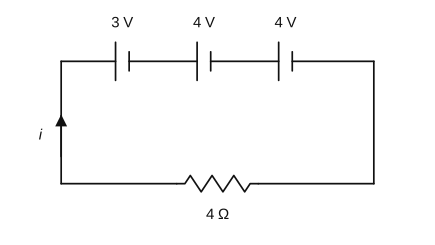
›Reveal solutionSolution
Series loop: net driving EMF is 3V and total resistance 6Ω, giving 0.5A.
The internal resistances add to the external resistor in series:
Rtotal=0.5+0.75+0.75+4=6Ω.
The only combination of the three cell EMFs (3,4,4V) that gives a current matching the options is when the 3V cell opposes the two 4V cells (or two cells oppose), leaving a net EMF of 3V: …
- KEAM 2026Set eng-2026-04224 marksMCQQ.If three cells each of emf 2 V and internal resistance 1Ω are connected to a resistor of 4.5 Ω as shown, then the current through the resistor is (A) 1 A (B) 0.67 A (C) 0.33 A (D) 2 A (E) 0.5 A
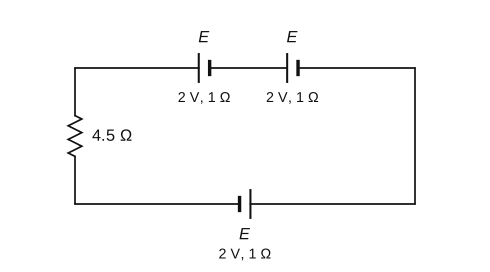
›Reveal solutionSolution
The two side-by-side cells are in parallel (2 V, 0.5Ω); this combines in series with the third cell, then apply Ohm's law across the 4.5Ω resistor.
Two identical 2 V, 1Ω cells in parallel give an emf of 2 V and internal resistance 21(1)=0.5Ω. …
- KEAM 2025Set eng-2025-04234 marksMCQQ.When ′n′ identical cells are connected in parallel, (A) net voltage increases (B) net current increases (C) net voltage decreases (D) net current decreases (E) total internal resistance increases
›Reveal solutionSolution
Connecting identical cells in parallel keeps the voltage the same but increases the current the battery can deliver.
Concept and Intuition
Cells in parallel all share the same EMF, so the net terminal voltage stays equal to that of a single cell. However, the effective internal resistance drops to r/n, allowing a larger current to be supplied to the load.
Step-by-Step Solution
- EMF of parallel combination = EMF of one cell (voltage unchanged).
- Internal resistance = r/n (decreases). …
- KEAM 2025Set eng-2025-04254 marksMCQQ.The maximum current drawn from a battery of 12 V with internal resistance of 0.5 Ω is (A) 16 A (B) 12 A (C) 24 A (D) 30 A (E) 4 A
›Reveal solutionSolution
The largest current a source can deliver is limited only by its own internal resistance (external R=0), so Imax=E/r.
The terminal current of a cell is I=R+rE. This is maximised when the external resistance R→0 (a short circuit), giving …
- KEAM 2025Set eng-2025-04274 marksMCQQ.If n identical cells each of emf E and internal resistance r are connected in parallel, the total EMF and total internal resistance of the combination, respectively, are (A) nE, nr (B) E, nr (C) E, nr (D) nE, 2nr (E) nE, nr
›Reveal solutionSolution
Cells in parallel keep the same EMF (E) but their internal resistances combine like parallel resistors, so the net internal resistance is nr.
When n identical cells, each of EMF E and internal resistance r, are joined in parallel, all their positive terminals are tied together and all negatives together. Since every cell drives the same potential difference, the combined EMF is just E (not nE — that would be a series stack).
The n internal resistances r are now in parallel: …
- KEAM 2025Set pha-2025-0424F4 marksMCQQ.An electric cell does 10 J of work in carrying a charge of 5 C around a simple closed circuit. The electromotive force of the cell is (A) 0.5 V (B) 1.5 V (C) 1 V (D) 6 V (E) 2 V
›Reveal solutionSolution
EMF is work done per unit charge: ε=W/q=10/5=2 V.
The electromotive force is defined as the work done by the cell per unit charge carried around the circuit: …
- KEAM 2024Set eng-2024-06064 marksMCQQ.If a cell of 12 V emf delivers 2 A current in a circuit having a resistance of 5.8 Ω, then the internal resistance of the cell is (A) 1 Ω (B) 0.2 Ω (C) 0.3 Ω (D) 0.6 Ω (E) 0.8 Ω
›Reveal solutionSolution
The emf drives current through external plus internal resistance: ε=I(R+r).
Applying ε=I(R+r):
12=2(5.8+r)⇒6=5.8+r⇒r=0.2 Ω. …
- KEAM 2024Set eng-2024-06084 marksMCQQ.The terminal potential difference of a cell in the open circuit is 2 V. When the cell is connected to a 10Ω resistor, the terminal potential difference falls to 1.5 V. The internal resistance of the cell is (A) 310Ω (B) 910Ω (C) 720Ω (D) 615Ω (E) 213Ω
›Reveal solutionSolution
Open-circuit voltage = EMF = 2 V; loaded current 0.15 A; r=(E−V)/I=0.5/0.15=10/3Ω.
In the open circuit the terminal voltage equals the EMF: E=2 V.
When connected across R=10 Ω, terminal voltage V=1.5 V, so the current is
I=RV=101.5=0.15 A. …
- KEAM 2024Set eng-2024-06094 marksMCQQ.The y-intercept of the graph between the terminal voltage V with load resistance R along y and x - axis, respectively, of a cell with internal resistance r, as shown, is (A) ε (B) −ε (C) Rε (D) εR (E) −εR
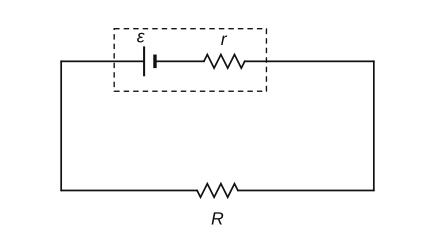
›Reveal solutionSolution
The straight-line terminal-voltage plot meets the V-axis at the cell's emf, so the y-intercept =ε.
For a cell of emf ε and internal resistance r driving a load R,
V=ε−Ir,I=R+rε. …
🎓Unlock everything free for 14 days
- ✓Full step-by-step solutions
- ✓Concept-first explanations
- ✓Methods, shortcuts & mistakes
- ✓PYQ mapping + timed mock tests
Full access for 14 days. No credit card required.