Skip to content
Question of 67

Q.a) All free charges are integral multiple of a basic unit charge e. Then the quantization rule of electric charge implies: A) Q = e B) Q = 1/e C) Q = ne D) Q = e^2
(1)
b) Match the following quantities in Column A with their units in Column B — Column A: i) Force, ii) Charge, iii) Electric field, iv) Dipole moment. Column B: a) Coulomb (C), b) N/C or V/M, c) Coulomb metre (Cm), d) Newton (N).
(2)
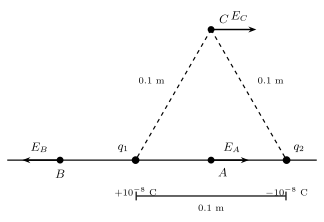
c) Electric field is an important way of characterising the electrical environment of a system of charges. Two point charges q1 and q2 of magnitude +10^-8 C and -10^-8 C respectively are placed 0.1 m apart. Calculate the electric fields at points A, B and C shown in the figure. (3)
two point charges q1 and q2 of plus and minus 10^-8 C separated by 0.1 m with points A, B and C and the electric field at each — Class 12 Physics electrostatics question
Figure
Kerala DhseKerala DHSE Plus Two Board 2014Subjective· 6mImportance★★★★★
0% · 0/67 Questions
🔒 Locked · start free trial →

You're viewing a preview — the full solution, concept, methods & PYQ mapping are locked.

Start your 14-day free trial to unlock the full solution →

Charge quantisation gives Q = ne; matching units: Force–N, Charge–C, Electric field–N/C (V/m), Dipole moment–C·m; and for the two point charges 0.1 m apart, E_A = 7.2×10⁴ N/C, E_B = 3.2×10⁴ N/C, E_C = 9×10³ N/C.

a) Quantisation of charge

All observed free charges are integral multiples of the elementary charge e (the charge on an electron/proton). This is the quantisation rule:

Q=ne,n=0,±1,±2,…Q = ne, \quad n = 0, \pm1, \pm2, \ldots

So the correct choice is C) Q = ne.

b) Matching units

  • i) Force → d) Newton (N)
  • ii) Charge → a) Coulomb (C)
  • iii) Electric field → b) N/C or V/m
  • iv) Dipole moment → c) Coulomb·metre (Cm)

c) Electric field at A, B, C

Given q1=+10−8q_1 = +10^{-8} C, q2=−10−8q_2 = -10^{-8} C, separated by d=0.1d = 0.1 m, and k=9×10⁹k = 9\times10^9 N·m²/C².

At A (midpoint, 0.05 m from each charge):

Field due to q1q_1 (positive) points AWAY from q1q_1, i.e. towards q2q_2. Field due to q2q_2 (negative) points TOWARDS q2q_2 — the same direction. So the two fields add:

E1=E2=kqr2=9×109×10−8(0.05)2=3.6×10⁴ N/CE_1 = E_2 = \frac{kq}{r^2} = \frac{9\times10^9 \times 10^{-8}}{(0.05)^2} = 3.6\times10^4\ \text{N/C}

EA=E1+E2=7.2×10⁴ N/C, directed from q1 to q2E_A = E_1 + E_2 = 7.2\times10^4\ \text{N/C, directed from } q_1 \text{ to } q_2

At B (0.05 m to the left of q1q_1, so 0.15 m from q2q_2):

Field due to q1q_1 points away from q1q_1 (further left, away from q2q_2). Field due to q2q_2 points towards q2q_2 (to the right at B) — opposite directions, so they subtract:

E1=9×109×10−8(0.05)2=3.6×10⁴ N/C (left)E_1 = \frac{9\times10^9\times10^{-8}}{(0.05)^2} = 3.6\times10^4\ \text{N/C (left)}

E2=9×109×10−8(0.15)2=4×10³ N/C (right)E_2 = \frac{9\times10^9\times10^{-8}}{(0.15)^2} = 4\times10^3\ \text{N/C (right)}

EB=3.6×10⁴−0.4×104=3.2×10⁴ N/C, directed away from the charges (towards the left)E_B = 3.6\times10^4 - 0.4\times10^4 = 3.2\times10^4\ \text{N/C, directed away from the charges (towards the left)}

…

Unlock everything free for 14 days

  • Full step-by-step solutions
  • Concept-first explanations
  • Methods, shortcuts & mistakes
  • PYQ mapping + timed mock tests

Full access for 14 days. No credit card required.