Question of 67
Q.(a) What is an electric dipole?
(1)
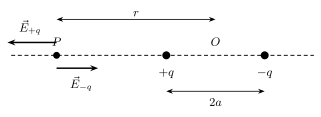
(b) Obtain the expression for the electric field intensity at a point on the axial line of an electric dipole. (3)
Kerala DhseKerala DHSE Plus Two Board 2023Subjective· 4mImportance★★★★★
0% · 0/67 Questions
You're viewing a preview — the full solution, concept, methods & PYQ mapping are locked.
Start your 14-day free trial to unlock the full solution →An electric dipole is two equal and opposite point charges separated by a small distance; its axial field, derived by summing the fields of the two charges, works out to for points far from the dipole, directed along the dipole moment.
- Electric dipole: An electric dipole is a system of two equal and opposite point charges, and , separated by a small distance . Its strength is characterised by the electric dipole moment, a vector: directed from the negative charge to the positive charge, with SI unit coulomb-metre (C·m).
- Field at an axial point: Let be at point A () and at point B (), with the dipole centre at O. Consider a point P on the axial line at distance from O (with ). Field at P due to (distance ), directed away from the dipole (in the +x direction): Field at P due to (distance ), directed towards , i.e. in the −x direction: Both fields act along the axis but is larger (P is closer to ), so the resultant is along 's direction (i.e. along ): …
Unlock everything free for 14 days
- Full step-by-step solutions
- Concept-first explanations
- Methods, shortcuts & mistakes
- PYQ mapping + timed mock tests
Full access for 14 days. No credit card required.