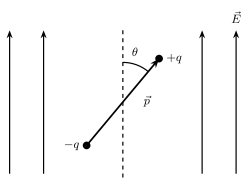
Q.A permanent electric dipole of dipole moment p is placed in a uniform external electric field E, as shown in Figure.
🔒You're viewing a preview — the full solution, concept, methods & PYQ mapping are locked.
🔒 Start your 14-day free trial to unlock the full solution →Concept understanding — Electric Dipole in a Field
Electric Dipole in a Uniform Field — First Look
Imagine you have a tiny bar magnet. If you place it in a uniform magnetic field, it doesn't get pulled anywhere — but it does twist to align with the field. An electric dipole behaves in exactly the same way when placed in a uniform electric field.
An electric dipole is simply a pair of equal and opposite charges, +q and −q, separated by a small distance d. Think of it as a tiny "stretched" charge. The dipole has a dipole moment p, a vector that points from the negative charge to the positive charge, with magnitude p=qd.
Now place this dipole in a uniform electric field E. Uniform means the field has the same strength and direction everywhere in that region.
What happens? Two forces, one twist
The positive charge feels a force F+=+qE in the direction of the field. The negative charge feels a force F−=−qE opposite to the field. These two forces are equal in magnitude but opposite in direction — so they cancel out as far as net force is concerned. The dipole as a whole does not accelerate linearly.
But the forces are not along the same line. They are separated by the distance d, so they form a couple — a pair of equal, opposite, parallel forces that produce a torque. This torque tries to rotate the dipole so that its dipole moment p aligns with the field E.
No net force means the centre of mass of the dipole stays put. Only rotation happens.
The torque formula
Let the dipole make an angle θ with the field direction (so θ=0 when p and E point the same way). The lever arm for each force about the centre is (d/2)sinθ. The torque from each force is F×lever arm=qE⋅(d/2)sinθ. Since both forces contribute in the same rotational sense, the total torque is:
τ=2⋅qE⋅2dsinθ=qdEsinθ
But qd=p, the dipole moment. So:
τ=pEsinθ
The direction of the torque is such that it tries to reduce θ — to bring p into alignment with E. In vector form:
τ=p×E
What does this mean physically?
- When θ=0 (dipole aligned with field), sin0=0, so torque is zero. This is the stable equilibrium position.
- When θ=90∘ (dipole perpendicular to field), torque is maximum: τmax=pE. …
In a uniform external field, each charge of the dipole feels a force F=qE along or against the field direction, and because these two forces act at different points, they combine into a couple rather than cancelling entirely.
…
The two equal and opposite forces on the dipole's charges form a couple (net force zero) whose torque is τ=p×E.
(a) Forces on the charges: In the uniform field E (pointing vertically upward in the figure), the positive charge +q (on the right) experiences a force
F+=qE(along E, i.e. upward)
and the negative charge −q (on the left) experiences
F−=−qE(opposite to E, i.e. downward)
Both forces have the same magnitude qE but point in opposite directions. Redrawing the figure, you would show an upward arrow of length qE at the +q end and a downward arrow of the same length at the −q end. Since the forces are equal and opposite, the net force on the dipole is zero, but because they act at different points (separated by the dipole length), they form a couple, which produces a net torque (tending to rotate p towards E).
…
Showing the 12 most recent of 16 on this concept.
- CBSE 2026Set ANNUAL1 markMCQQ.The size of ideal dipole is :(a) Zero(b) Infinite(c) One(d) None of the above
›Reveal solutionSolution
An ideal dipole is the point-dipole limit: separation → 0 with dipole moment finite, so its size is zero.
An electric dipole consists of two equal and opposite charges +q and −q separated by a small distance 2a, with dipole moment p = q(2a). An 'ideal' (or point) dipole is the mathematical limit in which the separation 2a is made vanishingly small (2a → 0) while simultaneously making q very large …
- CBSE 2025Set X11 markQ.An electric dipole placed in a uniform electric field experiences a net ________.
›Reveal solutionSolution
torque In a uniform field the forces on the two charges of the dipole are equal and opposite, so the net force is zero, but they act along different lines and constitute a couple that produces a …
- CBSE 2025Set ANNUAL1 markQ.[Case/Source-based passage] An electric dipole consists of two charges +q and −q separated by a small distance 2a. Its total charge is zero. It is characterized by a dipole moment vector p whose magnitude is q×2a and which points in the direction from −q to +q.(i) Write the unit of electric dipole moment.
›Reveal solutionSolution
Dipole moment p=q×2a has units of charge × distance.
The electric dipole moment is defined as p=q×(2a), the product of the magnitude of either charge and the separation between the two charges. Since charge is measured in coulombs (C) and separation in metres (m), the SI unit …
- CBSE 2025Set ANNUAL1 markQ.[Case/Source-based passage] An electric dipole consists of two charges +q and −q separated by a small distance 2a. Its total charge is zero. It is characterized by a dipole moment vector p whose magnitude is q×2a and which points in the direction from −q to +q.(iii) What is polar molecule?
›Reveal solutionSolution
Polar molecules have a built-in charge asymmetry that gives them a permanent dipole moment.
A polar molecule is one in which the centre of the positive charge distribution and the centre of the negative charge distribution do not coincide, due to the asymmetric arrangement of atoms and the unequal sharing of electrons between them (unequal electronegativities). As a result, such a molecule possesses a permanent (built-in) electric dipole moment, which exists even in the absence of any external electric field. Common examples include water (H₂O), HCl, and NH₃. This is in contrast to a non-polar molecule (like O2 or CO2), where the positive and negative charge centres coincide, giving zero perma …
- CBSE 2025Set ANNUAL1 markQ.Define the electric dipole moment.
›Reveal solutionSolution
An electric dipole moment measures the strength and orientation of a pair of equal and opposite charges separated by a small distance.
An electric dipole consists of two equal and opposite point charges +q and −q separated by a small distance 2a. Its electric dipole moment is defined as the vector:
p=q(2a)
…
- CBSE 2025Set ANNUAL1 markMCQQ.What orientation of an electric dipole in uniform electric field is said to be in stable equilibrium ?(a) θ = 0(b) θ = 90(c) θ = 120(d) θ = 180
›Reveal solutionSolution
A dipole is in stable equilibrium when its dipole moment is parallel to the field, i.e. θ = 0°.
The torque on a dipole in a uniform field is τ=pEsinθ, and its potential energy is U=−pEcosθ.
Both θ = 0° and θ = 180° give zero torque (equilibrium positions), but they are not equally stable:
- At θ = 0°, U=−pE (minimum energy) → any small angular displacement creates a restoring torque that brings p back to alignment with E. This is stable equilibrium. …
- CBSE 2024Set A11 markMCQQ.The electric dipole placed in uniform electric field is unstable, if the angle between electric field and dipole moment is(a) 0∘(b) 60∘(c) 90∘(d) 180∘
›Reveal solutionSolution
- CBSE 2024Set IMPROVEMENT1 markMCQQ.Assertion (A): In water molecule H2O there is permanent dipole moment even in absence of external electric field. Reason (R): In some molecules the centres of negative and positive charges do not coincide.(a) Both A and R are correct and R is the correct explanation of A.(b) Both A and R are correct but R is not the correct explanation of A.(c) A is correct but R is incorrect.(d) Both A and R are incorrect.
›Reveal solutionSolution
Water is a polar molecule because its bent geometry separates the centres of positive and negative charge, giving it a permanent dipole moment.
Assertion (A) is correct: the water molecule H2O possesses a permanent electric dipole moment even without any external field, because it is a polar molecule. Reason (R) is also correct: a permanent dipole moment arises in molecules whose positive and negative charge centres do not coincide — in H2O, the bent (non-linear) shape of the molecule means the centre of the negative charge (near the oxygen) does …
- CBSE 2023Set F1 markMCQQ.What is the angle between the electric dipole moment P and the electric field strength E when the dipole is in a stable equilibrium? (A) pi/4 (B) pi (C) pi/2 (D) 0
›Reveal solutionSolution
Stable equilibrium ⇒ P parallel to E ⇒ angle = 0.
The potential energy of a dipole in a uniform field is U=−pEcosθ, and the torque is τ=pEsinθ.
- At θ=0: τ=0 and U=−pE (minimum energy) → stable equilibrium. …
- CBSE 2022Set M1 markQ.Define 'electric dipole moment'.
›Reveal solutionSolution
Dipole moment = charge × separation, directed −q → +q.
An electric dipole is a pair of equal and opposite charges +q and −q separated by a small distance 2a.
The electric dipole moment is defined as the product of the magnitude of either charge and the distance of separation between them:
p=q(2a) …
- CBSE 2022Set ANNUAL1 markQ.Write SI unit and dimensional formula of electric dipole moment.
›Reveal solutionSolution
Electric dipole moment p = q × 2a; its unit follows directly from charge × length, and its dimensional formula follows from [charge] = [A T] and [length] = [L].
The electric dipole moment of a pair of equal and opposite charges +q and −q separated by a distance 2a is defined as
p=q×2a
directed from the negative to the positive charge.
SI unit: Since q is in coulomb (C) and 2a is in metre (m), the unit of p is coulomb-metre (C·m).
…
- CBSE 2021Set ANNUAL1 markQ.Whether electric dipole moment is a vector or a scalar quantity? Write the SI unit of electric dipole moment.
›Reveal solutionSolution
Dipole moment has both magnitude and direction (from negative to positive charge), so it is a vector, measured in C·m.
An electric dipole consists of two equal and opposite charges +q and −q separated by a distance 2a. Its dipole moment is defined as
p=q(2a)n^ …
🎓Unlock everything free for 14 days
- ✓Full step-by-step solutions
- ✓Concept-first explanations
- ✓Methods, shortcuts & mistakes
- ✓PYQ mapping + timed mock tests
Full access for 14 days. No credit card required.