Question of 56
Q.An equipotential surface is a surface with constant value of potential at all points on the surface.
(a) What is the amount of work done in moving a 2 µc charge between two points at 3 cm apart on an equipotential surface ? (Score : 1)
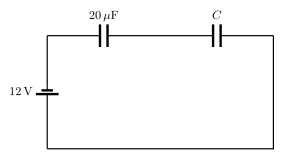
(b) Two capacitors are connected as shown in figure below [circuit: 20 µF and C in series, connected across a 12 V battery]. If the equivalent capacitance of the combination is 4 µF
(i) Calculate the value of C.
(ii) Calculate the charge on each capacitor.
(iii) What will be the potential drop across each capacitor ? (Scores : 3)
(c) Two metallic spheres of same radii, one hollow and one solid, are charged to the same potential. Which will hold more charge ?
(i) Solid sphere
(ii) Both will hold same charge
(iii) Hollow sphere
(iv) Cannot predict (Score : 1)
Kerala DhseKerala DHSE Plus Two Board 2016Subjective· 5mImportance★★★★★
0% · 0/56 Questions
You're viewing a preview — the full solution, concept, methods & PYQ mapping are locked.
Start your 14-day free trial to unlock the full solution →Moving a charge along an equipotential surface does zero work; for the series combination C = 5 µF with 48 µC on each plate (2.4 V and 9.6 V drops); and two conducting spheres of equal radius always hold equal charge at equal potential, hollow or solid.
- Work done by the electric field in moving a charge q between two points is W = q(V_A − V_B). On an equipotential surface every point is at the same potential, so V_A = V_B and ΔV = 0 regardless of the 3 cm separation. Hence W = (2×10⁻⁶ C)(0) = 0 J.
- The two capacitors 20 µF and C are in series, and their equivalent capacitance is given as 4 µF.
For series capacitors: 1/C_eq = 1/20 + 1/C
1/4 = 1/20 + 1/C → 1/C = 1/4 − 1/20 = 5/20 − 1/20 = 4/20 = 1/5
So C = 5 µF.
- C = 5 µF.
- In a series combination every capacitor carries the same charge (equal to the charge delivered by the battery through the single current path): Q = C_eq × V = 4 µF × 12 V = 48 µC on each capacitor.
- Potential drop across each capacitor = Q/C for that capacitor: Across 20 µF: V₁ = 48 µC / 20 µF = 2.4 V Across C = 5 µF: V₂ = 48 µC / 5 µF = 9.6 V Check: 2.4 V + 9.6 V = 12 V, matching the battery voltage. ✓ …
Unlock everything free for 14 days
- Full step-by-step solutions
- Concept-first explanations
- Methods, shortcuts & mistakes
- PYQ mapping + timed mock tests
Full access for 14 days. No credit card required.