Question of 56
Q.(a) Obtain an expression for the equivalent capacitance when two capacitors C1 and C2 are connected in parallel.
(2)
(b) Given graph shows variation of charge 'q' with potential difference 'V' for two capacitors C1 and C2. Both the capacitors have same plate separation but plate area of C2 is greater than that of C1. Which line (X or Y) corresponds to C1 and why? (2)
Kerala DhseKerala DHSE Plus Two Board 2025Subjective· 4mImportance★★★★★
0% · 0/56 Questions
You're viewing a preview — the full solution, concept, methods & PYQ mapping are locked.
Start your 14-day free trial to unlock the full solution →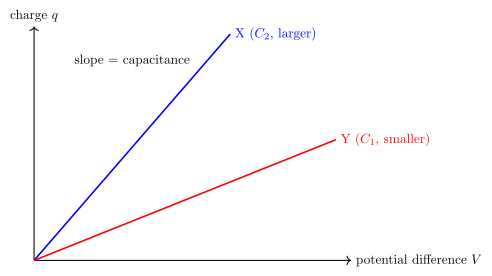
Capacitors in parallel share the same voltage but split the total charge, giving Ceq = C1 + C2; since the slope of a q–V line equals C, and C2 (larger area) has the larger capacitance, the steeper line X is C2 and the shallower line Y is C1.
(a) Parallel combination: When and are connected in parallel across a potential difference V, both capacitors have the same voltage V across them, but carry different charges:
The total charge drawn from the source is . If a single equivalent capacitor replaces the combination, it must store the same total charge for the same V: . Comparing:
…
Unlock everything free for 14 days
- Full step-by-step solutions
- Concept-first explanations
- Methods, shortcuts & mistakes
- PYQ mapping + timed mock tests
Full access for 14 days. No credit card required.