Q.Depending on the magnetic property, the materials are classified into diamagnetic, paramagnetic and ferro magnetic.
You're viewing a preview — the full solution, concept, methods & PYQ mapping are locked.
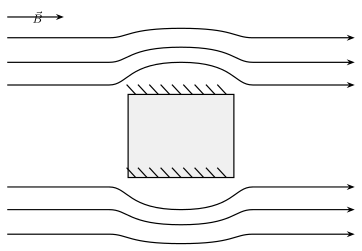
Start your 14-day free trial to unlock the full solution →Field lines bowing OUT of a material signal a diamagnetic substance; Curie's law says a paramagnetic material's susceptibility falls as ; and paramagnetism (weak, induced) is much weaker than ferromagnetism (strong, spontaneous, domain-based).
a) Identifying the material
When field lines approaching a material bend AWAY from it and bow outward, avoiding the interior (the field inside is weaker/excluded), the material is repelling the external field — this is the signature of a diamagnetic material (e.g. bismuth, copper, water), which develops a weak magnetisation OPPOSITE to the applied field.
b) Curie's law
For a paramagnetic material, the magnetisation is directly proportional to the applied field and inversely proportional to the absolute temperature :
where is the magnetic susceptibility and is the Curie constant. Physically: the applied field tries to align the atomic magnetic dipoles, while thermal agitation randomises them; at higher , thermal motion wins more, so the net alignment (and hence ) falls as .
c) Paramagnetism vs Ferromagnetism
| Paramagnetic | Ferromagnetic | |
|---|---|---|
| Strength | Weak attraction to field | Strong attraction to field |
| Without external field | No net magnetisation (dipoles randomly oriented) | Spontaneous magnetisation persists (domains stay aligned) |
Unlock everything free for 14 days
- Full step-by-step solutions
- Concept-first explanations
- Methods, shortcuts & mistakes
- PYQ mapping + timed mock tests
Full access for 14 days. No credit card required.