Q.(A) The following is a choice question :
You're viewing a preview — the full solution, concept, methods & PYQ mapping are locked.
Start your 14-day free trial to unlock the full solution →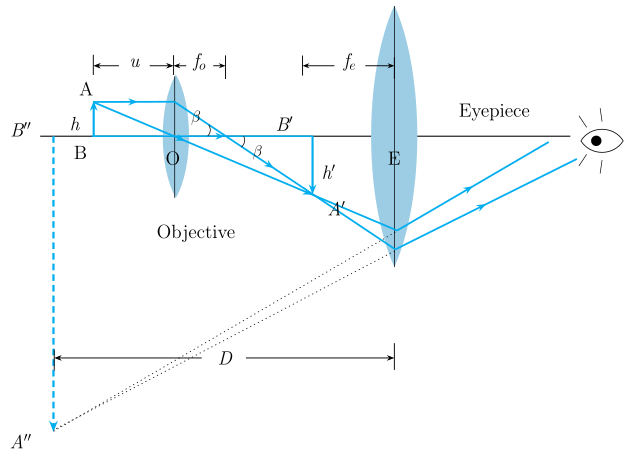
The lens maker's formula gives n = 1.5 for the described double convex lens; and in a compound microscope, since the overall magnification M = (L/f₀)(D/f_e), making both the objective's and the eyepiece's focal lengths small is exactly what boosts the magnifying power.
(a) Lens maker's formula: 1/f = (n−1)(1/R₁ − 1/R₂)
For a double convex lens with light travelling left to right, using the standard sign convention, the first (left) surface is convex toward the incoming light so R₁ = +10 cm, and the second (right) surface is also convex outward (bulging away from the incident light, centre of curvature on the incident side) so R₂ = −15 cm.
1/12 = (n−1)(1/10 − 1/(−15)) = (n−1)(1/10 + 1/15)
1/10 + 1/15 = 3/30 + 2/30 = 5/30 = 1/6
1/12 = (n−1)/6
n − 1 = 6/12 = 0.5
n = 1.5
(b)(i) Ray-diagram description for a compound microscope: The object AB is placed just beyond the focal point F₀ of the objective lens (a short-focal-length convex lens). The objective forms a real, inverted and magnified image A′B′ a little inside the focal point F_e of the eyepiece. This intermediate image A′B′ then acts as the object for the eyepiece (a second convex lens, used essentially as a simple magnifier), which forms the final image A″B″ — virtual, further magnified, and inverted with respect to the original object — typically located at the near point of the eye (or at infinity in "normal adjustment"), which the observer views by placing the eye close to the eyepiece.
…
Unlock everything free for 14 days
- Full step-by-step solutions
- Concept-first explanations
- Methods, shortcuts & mistakes
- PYQ mapping + timed mock tests
Full access for 14 days. No credit card required.