Q.(a) Speed of light in glass is 2 × 10^8 m/s. Refractive index of glass is ______. (Score : 1)
You're viewing a preview — the full solution, concept, methods & PYQ mapping are locked.
Start your 14-day free trial to unlock the full solution →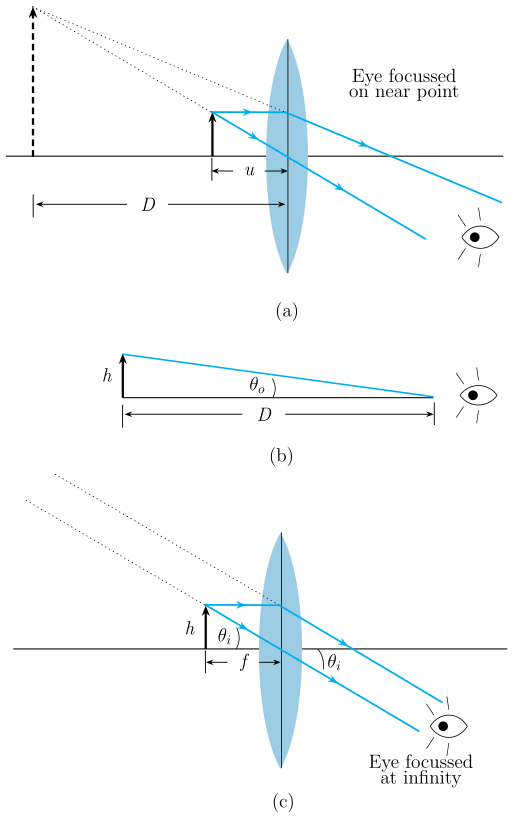
(a) n = c/v = 1.5. (b) For an equilateral prism (A=60°) with n=√2, the minimum-deviation formula gives Dm = 30°. (c) A simple microscope is a single convex lens with the object inside its focal length; its angular magnification is m = 1 + D/f.
(a) Refractive index of glass
(b) Angle of minimum deviation for an equilateral prism
For an equilateral prism the prism angle . The prism formula relating refractive index n, prism angle A and the angle of minimum deviation is
Given and , so , :
(c) Simple microscope — ray diagram and magnification
A simple microscope is just a single convex (converging) lens of short focal length, used to view small objects by placing them within the focal length of the lens, so the lens forms a virtual, erect, magnified image.
Ray diagram (described): The object O is placed between the lens's optical centre and its focus F (i.e. at a distance ). Two rays are drawn from the top of the object: one travels parallel to the principal axis and, after refraction, appears to come from the focus F on the object's side; the other passes straight through the optical centre undeviated. Both refracted rays diverge on the object's side of the lens, and tracing them backward (with dashed lines), they appear to meet at a point behind the object — this locates the virtual, erect, magnified image I, at distance v from the lens (v is negative and |v| > u by sign convention, with u also negative).
…
Unlock everything free for 14 days
- Full step-by-step solutions
- Concept-first explanations
- Methods, shortcuts & mistakes
- PYQ mapping + timed mock tests
Full access for 14 days. No credit card required.