Question of 46
Q.(A) The following questions has choice :
(a) Unpolarized light is incident on a plane glass surface. What should be the angle of incidence so that the reflected and refracted rays are perpendicular to each other ? (Given n = 1.5) (Scores : 2)
(b) Using Huygen's concept of wave front, derive Snell's law of refraction. (Scores : 3)
OR
(B)
(a) Light waves from two coherent sources having intensities I and 2I cross each other at a point with a phase difference of 60°. What is the resultant intensity at the point ? (Scores : 2)
(b) With the help of a diagram obtain an expression for finding the distance between two consecutive bright or dark fringes in the interference pattern produced by double slits. (Scores : 3)
Kerala DhseKerala DHSE Plus Two Board 2016Subjective· 5mImportance★★★★★
0% · 0/46 Questions
You're viewing a preview — the full solution, concept, methods & PYQ mapping are locked.
Start your 14-day free trial to unlock the full solution →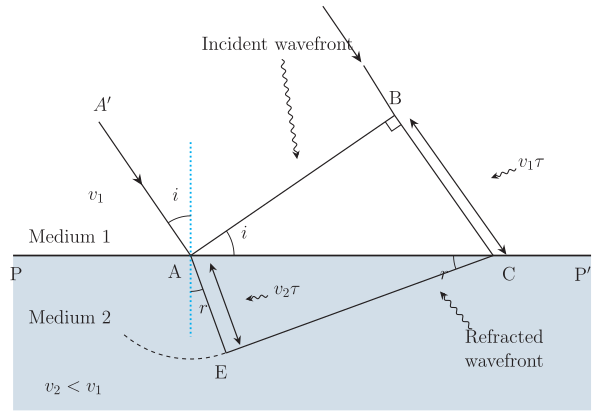
The reflected and refracted rays are perpendicular exactly at the Brewster angle, tan θ_B = n = 1.5 → θ_B ≈ 56.3°; and Huygens' wavefront construction — comparing the two triangles formed by the incident and refracted wavefronts at the interface — directly yields Snell's law, sin i/sin r = v₁/v₂ = constant.
- When unpolarised light is incident on a surface at an angle such that the reflected and refracted rays are exactly perpendicular to each other, that angle of incidence is called the Brewster angle θ_B, and the reflected light is then completely (linearly) polarised. Brewster's law gives: tan θ_B = n (refractive index of the second medium relative to the first, here glass w.r.t. air) tan θ_B = 1.5 θ_B = tan⁻¹(1.5) ≈ 56.3°
- Huygens' construction to derive Snell's law of refraction: Consider a plane wavefront AB of monochromatic light incident on a plane interface XY separating medium 1 (speed v₁) from medium 2 (speed v₂), the ray making angle of incidence i with the normal. Let the wavefront AB touch the interface first at A, while end B is still travelling and reaches the interface at C after time t, so BC = v₁t. By Huygens' principle, as B travels to C, the secondary wavelet from A (already at the interface at t=0) spreads into medium 2 with speed v₂, so in the same time t it has travelled a distance AD = v₂t into medium 2. The new refracted wavefront is the common tangent CD from this secondary wavelet. In right triangle ABC (right angle at B): sin i = BC/AC = v₁t/AC In right triangle ADC (right angle at D): sin r = AD/AC = v₂t/AC (r = angle of refraction, between the refracted wavefront's normal and the interface normal) Dividing the two: sin i / sin r = v₁/v₂ Since v₁ and v₂ are fixed (characteristic of the two media) for a given pair of media, this ratio is a constant, called the refractive index of medium 2 with respect to medium 1, n₂₁: sin i / sin r = v₁/v₂ = n₂₁ = n₂/n₁ i.e. n₁ sin i = n₂ sin r — this is Snell's law of refraction. …
Unlock everything free for 14 days
- Full step-by-step solutions
- Concept-first explanations
- Methods, shortcuts & mistakes
- PYQ mapping + timed mock tests
Full access for 14 days. No credit card required.