Q.(a) State Huygens principle.
You're viewing a preview — the full solution, concept, methods & PYQ mapping are locked.
Start your 14-day free trial to unlock the full solution →Huygens' principle treats every point of a wavefront as a fresh source of spherical wavelets; applying this construction to a wavefront crossing a refracting boundary reproduces Snell's law of refraction.
(a) Huygens' Principle:
- Every point on a given wavefront (a surface of constant phase) acts as a source of new secondary disturbances called secondary wavelets, which spread out in all directions with the speed of the wave in that medium.
- The new wavefront, at any later instant, is given by the forward envelope (the common tangent surface) of all these secondary wavelets.
This construction lets one geometrically determine the shape and position of a wavefront at any time, given its shape at an earlier time, and explains laws of reflection and refraction from a wave standpoint.
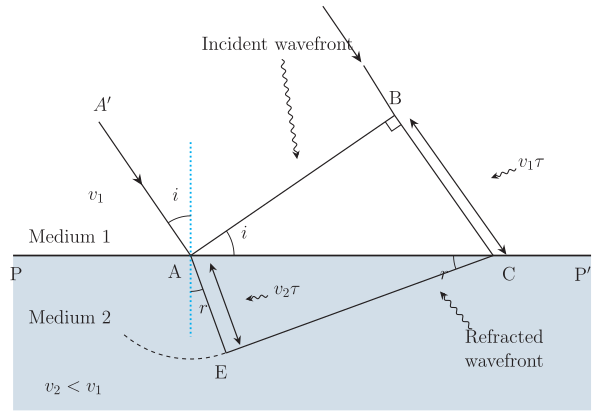
(b) Refraction of a plane wave using Huygens' construction: Consider a plane wavefront AB incident on a plane interface XY separating medium 1 (speed ) from medium 2 (speed ), with angle of incidence (angle between the wavefront and the surface, equal to the angle between the incident ray and the normal).
Let the wavefront take a time for the point B (which is still in medium 1 when A has just touched the surface) to reach the surface at point C, travelling a distance:
Meanwhile, from the instant A touches the interface, a secondary wavelet from A spreads into medium 2 with speed ; by the time B's wavelet reaches C, A's wavelet in medium 2 has radius:
The new refracted wavefront is the tangent line CD (drawn from C to the wavelet of radius centred at A).
From the right triangle ABC (right angle at B), with AC as hypotenuse:
From the right triangle ACD (right angle at D):
(where is the angle of refraction, between the refracted wavefront CD and the surface, equal to the angle between the refracted ray and the normal.)
…
Unlock everything free for 14 days
- Full step-by-step solutions
- Concept-first explanations
- Methods, shortcuts & mistakes
- PYQ mapping + timed mock tests
Full access for 14 days. No credit card required.