Q.Using Huygens wave theory derive Snell's law.
You're viewing a preview — the full solution, concept, methods & PYQ mapping are locked.
Start your 14-day free trial to unlock the full solution →Applying Huygens' construction to a wavefront refracting at a boundary between two media, and using the different wave speeds , in the two media, gives , i.e. Snell's law.
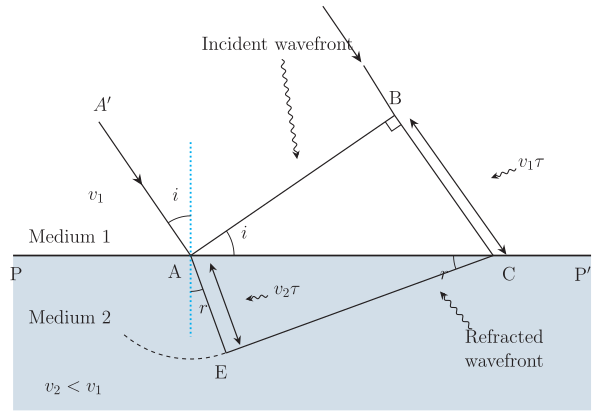
Setup: Let a plane wavefront AB be incident on a plane boundary XY separating medium 1 (speed ) from medium 2 (speed ), making angle of incidence with the normal. Let be the time taken for the disturbance to travel from B to C along the surface in medium 1.
Huygens' construction: While the wave from B travels to C (a distance ) in medium 1, the wave from A (which reaches the boundary first) has already started travelling into medium 2, producing a secondary wavelet that expands to a radius in medium 2 by the time τ has elapsed. The tangent (envelope) CE from C to this wavelet gives the refracted wavefront, making angle of refraction with the boundary's normal.
Geometry: From right triangle ABC (right angle at B):
From right triangle AEC (right angle at E):
Dividing the two:
…
Unlock everything free for 14 days
- Full step-by-step solutions
- Concept-first explanations
- Methods, shortcuts & mistakes
- PYQ mapping + timed mock tests
Full access for 14 days. No credit card required.