Q.Assertion: Nitration of chlorobenzene leads to the formation of m-nitrochlorobenzene.
Reason: – group is a m-directing group.
You're viewing a preview — the full solution, concept, methods & PYQ mapping are locked.
Start your 14-day free trial to unlock the full solution →The assertion is wrong because nitration of chlorobenzene gives ortho- and para-nitrochlorobenzene, not meta. The reason is correct: the –NO₂ group is indeed meta-directing. So the correct choice is (iv).
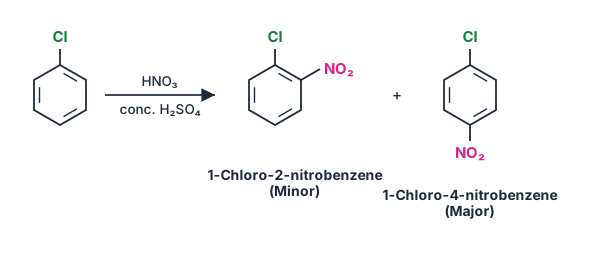
The key here is to separate two different substituents: chlorine (on the benzene ring in the starting material) and the nitro group (which is the incoming group in the reaction). The reason talks about the directing effect of the –NO₂ group, but the assertion involves the directing effect of chlorine. Mixing these up is the classic trap.
Let’s break it down.
-
What does the assertion claim?
Nitration of chlorobenzene means we take chlorobenzene (C₆H₅–Cl) and treat it with a nitrating mixture (HNO₃ + H₂SO₄). The product is said to be m-nitrochlorobenzene.
But is that true? Chlorine is an ortho-para director (it activates the ring by resonance, though it deactivates by induction — the net effect is ortho/para orientation). So nitration of chlorobenzene gives a mixture of o-nitrochlorobenzene and p-nitrochlorobenzene, with very little m-isomer.
Therefore, the assertion is false.
-
What does the reason state?
The –NO₂ group is a meta-directing group. This is absolutely correct. The nitro group is strongly electron-withdrawing (by both induction and resonance), which deactivates the ring and directs incoming electrophiles to the meta position.
So the reason is true.
-
Does the reason explain the assertion? …
Unlock everything free for 14 days
- Full step-by-step solutions
- Concept-first explanations
- Methods, shortcuts & mistakes
- PYQ mapping + timed mock tests
Full access for 14 days. No credit card required.