Q.An open topped box is to be constructed by removing equal squares from each corner of a metre by metre rectangular sheet of aluminium and folding up the sides. Find the volume of the largest such box.
You're viewing a preview — the full solution, concept, methods & PYQ mapping are locked.
Start your 14-day free trial to unlock the full solution →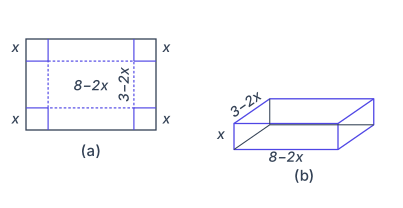
We model the box volume as , find its maximum on the feasible domain by setting , and obtain the maximum volume cubic metres when metre.
This is a classic optimisation problem from calculus — you have a fixed rectangular sheet, you cut identical squares of side from each corner, fold up the flaps, and get an open-top box. The question asks: what size square gives the largest possible volume?
The key insight is that the box's dimensions are completely determined by . The original sheet is m by m. After cutting squares from each corner, the base of the box becomes a rectangle of length and width . The height of the box is exactly , the side of the cut-out square. So the volume is simply:
We want the value of that maximises , but cannot be any number — it must be positive and small enough that the base dimensions stay positive. That gives the feasible domain: (since ). Within this interval, is a smooth cubic, and its maximum occurs either at a critical point (where ) or at an endpoint. The endpoints give , so the maximum is interior.
Let's work through it step by step.
- Write the volume function and simplify.
Multiply the two linear factors first:
Then multiply by :
- Differentiate to find critical points.
Set :
Divide through by 4 to simplify:
- Solve the quadratic.
Using the quadratic formula:
So the two roots are:
-
Check which root lies in the feasible domain.
is outside , so it is not physically possible. The only feasible critical point is metre.
-
Confirm it gives a maximum.
You can use the second derivative test. Compute . At :
…
Unlock everything free for 14 days
- Full step-by-step solutions
- Concept-first explanations
- Methods, shortcuts & mistakes
- PYQ mapping + timed mock tests
Full access for 14 days. No credit card required.