Q.Name the following halides according to IUPAC system and classify them as alkyl, allyl, benzyl (primary, secondary, tertiary), vinyl or aryl halides:
Classification depends on the carbon holding the halogen: sp3 in a chain (alkyl), sp3 one carbon from a C=C (allylic), sp3 directly on a benzene ring (benzylic), sp2 on a C=C itself (vinyl), or sp2 directly on the ring (aryl). Alkyl/allylic/benzylic carbons are further ranked 1 degree/2 degree/3 degree by how many other carbons they are bonded to.
This problem tests IUPAC naming and halide classification together. The rule that decides classification: look only at the carbon that is actually bonded to the halogen.
- Bonded to an sp3 carbon in a plain chain: alkyl halide.
- Bonded to an sp3 carbon that sits one carbon away from a C=C double bond: allylic halide.
- Bonded to an sp3 carbon that is directly attached to a benzene ring: benzylic halide.
- Bonded directly to an sp2 carbon of a C=C double bond: vinyl halide.
- Bonded directly to an sp2 carbon of the benzene ring itself: aryl halide.
Within alkyl/allylic/benzylic, the carbon is 1 degree, 2 degree or 3 degree by how many OTHER carbons it is bonded to (1, 2 or 3).
IUPAC naming always uses the longest chain through the halogen-bearing carbon (never a shorter chain just because it looks simpler), and when two numbering directions give the same locant set, the substituent that comes first alphabetically gets the lower number.
(i)
Longest chain: 4 carbons. Numbering from the end nearer Cl gives Cl at C2, methyl at C3: 2-chloro-3-methylbutane. The Cl-bearing carbon (C2) is bonded to C1 and C3, two carbon neighbours, so it is a secondary alkyl halide.
(ii)
The longest chain runs through the ethyl branch, not around it: CH3-CH2-CH(CH3)-CH(Cl)-CH2-CH3, six carbons. Both numbering directions give the locant set {3,4} for Cl and methyl; chloro precedes methyl alphabetically, so Cl takes the lower number: 3-chloro-4-methylhexane. The Cl carbon (C3) is bonded to C2 and C4, so it is a secondary alkyl halide.
(iii)
Longest chain: 4 carbons (going through either gem-dimethyl branch gives the same length). Numbering from the I end: 1-iodo-2,2-dimethylbutane. The I-bearing carbon (C1, ) is bonded to only C2, so it is a primary alkyl halide.
(iv)
The carbon bearing Br is , and it is bonded directly to the phenyl ring with no in between, which is exactly the definition of benzylic. Longest chain (4 carbons, numbered from the Br/phenyl end for the lower locant set {1,1,3,3}): 1-bromo-3,3-dimethyl-1-phenylbutane. That C1 is bonded to the ring carbon and to C2, two carbon neighbours, so it is a secondary benzylic halide.
(v)
Longest chain: 4 carbons. Bromo precedes methyl alphabetically, so on the tied locant set Br takes C2: 2-bromo-3-methylbutane. The Br carbon (C2) is bonded to C1 and C3, so it is a secondary alkyl halide.
(vi)
The longest chain runs through both ethyl groups (5 carbons), leaving the original and as branches on the middle carbon: 3-(bromomethyl)-3-methylpentane. The Br carbon is the terminal carbon of the bromomethyl branch, bonded to only the ring carbon of the main chain, so it is a primary alkyl halide.
(vii)
The longest chain again runs through both ethyl groups (5 carbons), with the original methyl left as a branch on the central carbon: 3-chloro-3-methylpentane. That carbon is bonded to three other carbons, so it is a tertiary alkyl halide.
(viii)
Six-carbon chain (extending through the isopropyl end); the double bond gets the lowest possible locant, C2: 3-chloro-5-methylhex-2-ene. Cl sits directly on the sp2 double-bond carbon (C3), so it is a vinyl halide.
(ix)
Five-carbon chain (extending through one of the two methyls on the Br carbon); double bond at C2: 4-bromo-4-methylpent-2-ene. The Br carbon (C4) is sp3, one carbon from the C2=C3 double bond, and bonded to three other carbons, so it is a tertiary allylic halide.
(x)
Cl sits directly on the ring, para to the isobutyl side chain, so this is an aryl halide: 1-chloro-4-(2-methylpropyl)benzene.
(xi)
The Cl is on a group that is itself attached to the ring (meta to the other side chain), not on the ring directly, so this is a primary benzylic halide: 1-(chloromethyl)-3-(2,2-dimethylpropyl)benzene.
(xii)
Br sits directly on the ring, ortho to the sec-butyl side chain, so this is an aryl halide: 1-bromo-2-(1-methylpropyl)benzene.
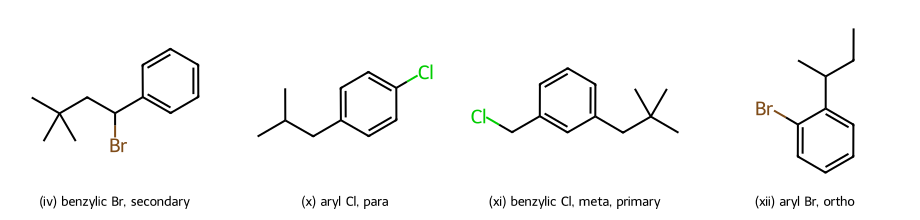
The diagram is the fast way to tell aryl from benzylic: if the halogen (or its substituent label) sits directly on a ring vertex, it is aryl; if it sits on a chain carbon drawn just outside the ring, it is benzylic. The ring position (ortho/meta/para) only matters for naming, not for the alkyl/aryl/benzylic call itself.
- 2-chloro-3-methylbutane, secondary alkyl;
- 3-chloro-4-methylhexane, secondary alkyl;
- 1-iodo-2,2-dimethylbutane, primary alkyl;
- 1-bromo-3,3-dimethyl-1-phenylbutane, secondary benzylic;
- 2-bromo-3-methylbutane, secondary alkyl;
- 3-(bromomethyl)-3-methylpentane, primary alkyl;
- 3-chloro-3-methylpentane, tertiary alkyl;
- 3-chloro-5-methylhex-2-ene, vinyl;
- 4-bromo-4-methylpent-2-ene, tertiary allylic;
- 1-chloro-4-(2-methylpropyl)benzene, aryl; (xi) 1-(chloromethyl)-3-(2,2-dimethylpropyl)benzene, primary benzylic; (xii) 1-bromo-2-(1-methylpropyl)benzene, aryl.
Unlock everything free for 14 days
- Full step-by-step solutions
- Concept-first explanations
- Methods, shortcuts & mistakes
- PYQ mapping + timed mock tests
Full access for 14 days. No credit card required.