Q.Out of and , which is more easily hydrolysed by aqueous KOH.
You're viewing a preview — the full solution, concept, methods & PYQ mapping are locked.
Start your 14-day free trial to unlock the full solution →
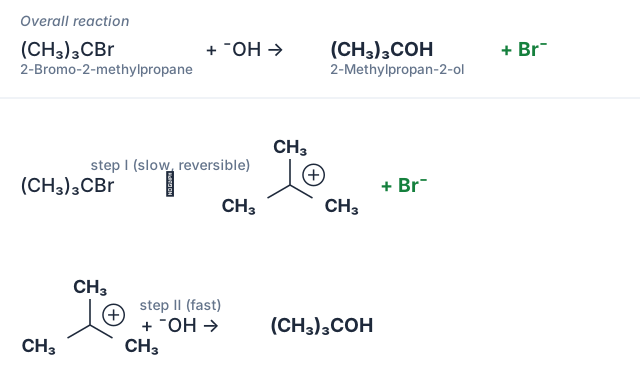
The key idea is that SN1 reactivity depends on carbocation stability. forms a more stable, resonance-delocalized carbocation than , so it hydrolyses faster. The answer is .
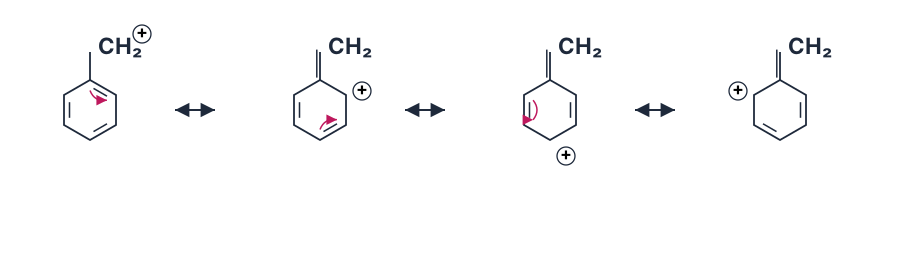
This question is about SN1 hydrolysis — a reaction where the leaving group (Cl) departs first, forming a carbocation intermediate, which is then attacked by water (or OH⁻ from KOH). The rate depends entirely on how stable that carbocation is. Aqueous KOH provides a polar, protic environment that favours SN1 over SN2 for these benzylic halides.
Let’s compare the two compounds.
-
Identify the leaving group and the potential carbocation.
Both are benzylic chlorides. In , the carbon bearing Cl is attached to one phenyl ring and two hydrogens. In , it is attached to two phenyl rings and one hydrogen.
-
Think about carbocation stability.
A carbocation is stabilised by resonance with adjacent π-systems (like phenyl rings) and by hyperconjugation from alkyl groups. The more resonance contributors you can draw, the more the positive charge is delocalised, and the more stable the carbocation.
- For : The carbocation formed is (benzyl carbocation). The positive charge can be delocalised into the phenyl ring — you can draw resonance structures where the charge moves to the ortho and para positions. This is moderately stable.
- For : The carbocation formed is (diphenylmethyl carbocation, also called benzhydryl carbocation). Here, the positive charge is delocalised into two phenyl rings simultaneously. That means twice as many resonance structures and much greater charge dispersal.
Carbocation stability order:
-
Relate stability to SN1 rate.
In SN1, the rate-determining step is the formation of the carbocation. The more stable the carbocation, the lower the activation energy for its formation, and the faster the reaction. So the compound that gives the more stable carbocation will hydrolyse more easily. …
Unlock everything free for 14 days
- Full step-by-step solutions
- Concept-first explanations
- Methods, shortcuts & mistakes
- PYQ mapping + timed mock tests
Full access for 14 days. No credit card required.