Mathematics and Statistics · Ch 5 — Locus and Straight Line
Distance of a Point from a Line
Distance of a Point from a Line
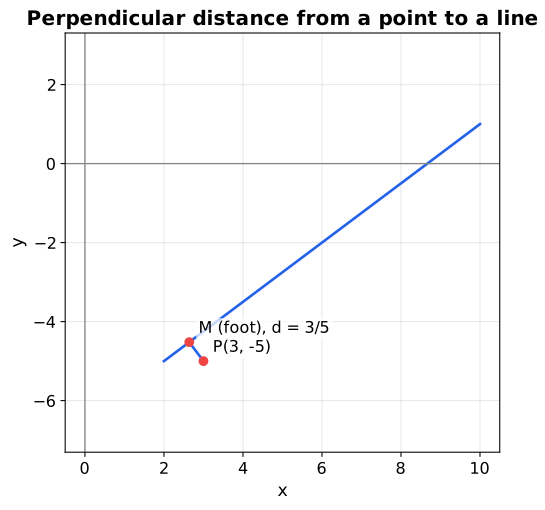
The distance of a point from a line means the shortest distance — the length of the perpendicular dropped from the point onto the line. For a line written in general form and a point , this has a clean formula:
Distance of a Point from a Line
The perpendicular distance of from the line is
The method is mechanical, but two points must be respected. First, the line must be in general form (everything on one side, zero on the other) before the coefficients , , are read off — a common error is to use a line still written as . Second, the numerator carries absolute-value bars, because a distance can never be negative; substitute the point, then take the modulus.
A closely related quantity is the distance between two parallel lines. Two parallel lines can always be written with identical - and -coefficients as and . The distance between them is
Distance Between Two Parallel Lines
…
from point to line (line must be in g …
for and — the coefficients must be m …