Q.Explain the importance of the depletion region in a p-n junction diode.
You're viewing a preview — the full solution, concept, methods & PYQ mapping are locked.
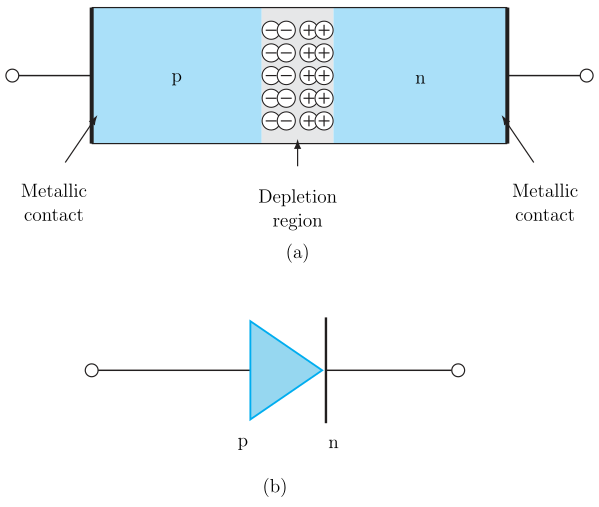
Start your 14-day free trial to unlock the full solution →When a p-n junction first forms, diffusion of electrons from the n-side and holes from the p-side leaves behind fixed, oppositely-charged ions on either side of the junction -- positive donor ions on the n-side, negative acceptor ions on the p-side. Because free charge carriers cannot survive within a region containing this exposed ionic charge, the region straddling the junction becomes essentially empty of any mobile carriers: this is the DEPLETION REGION. The accumulated ionic charge across this region is exactly what creates the junction's POTENTIAL BARRIER (about 0.6-0.7 V for silicon, 0.3-0.35 V for germanium), which exists permanently even with no external voltage connected, and which any carrier must have enough energy to overcome before it can cross the junction.
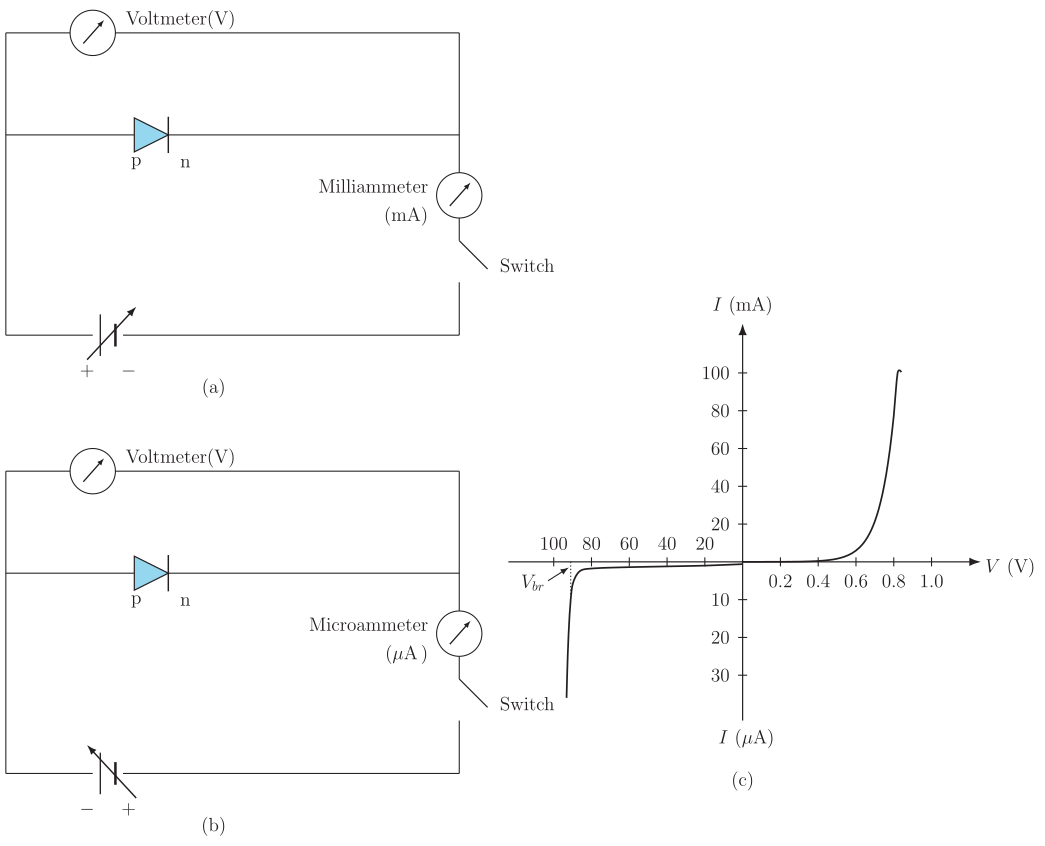
The depletion region's importance comes from the fact that its WIDTH -- and therefore the height of the barrier a carrier must cross -- can be controlled externally, by biasing. Under FORWARD bias, the applied voltage opposes the junction's built-in potential, so the depletion region NARROWS and the barrier is reduced; carriers are also pushed toward the junction, so both effects together let a large current flow easily. Under REVERSE bias, the applied voltage instead adds to the built-in potential, so the depletion region WIDENS and the barrier is increased, while carriers are pulled away from the junction, so almost no current can flow. …
Unlock everything free for 14 days
- Full step-by-step solutions
- Concept-first explanations
- Methods, shortcuts & mistakes
- PYQ mapping + timed mock tests
Full access for 14 days. No credit card required.