Chemistry · Ch 4 — Chemical Thermodynamics
Enthalpy of phase transition
Enthalpy of phase transition
In a phase transition, one phase of a substance is converted into another at constant temperature and pressure, without a change in chemical composition.
i. Enthalpy of fusion () : The enthalpy change that occurs when one mole of a solid is converted into liquid without change in temperature at constant pressure is the enthalpy of fusion. For example,
When 1 mole of solid ice melts at 0 C and 1 atm pressure, the change in enthalpy is 6.01 kJ. The same amount of heat is absorbed by the ice during the melting. The reverse of fusion is the freezing of the solid:
Thus, when one mole of liquid water freezes at 0 C, heat is evolved. (The freezing enthalpy is written with the book's own subscript abbreviation, .)
ii. Enthalpy of vaporization () : It is the enthalpy change accompanying the vaporization of one mole of liquid without changing its temperature at constant pressure. For example,
Thus, when one mole of water is vaporised at 1 atm pressure, the enthalpy change is +40 kJ at 100 C and +44 kJ at 25 C. On the other hand, the condensation to vapour is accompanied with a release of heat:
(The condensation enthalpy carries the book's own abbreviation .)
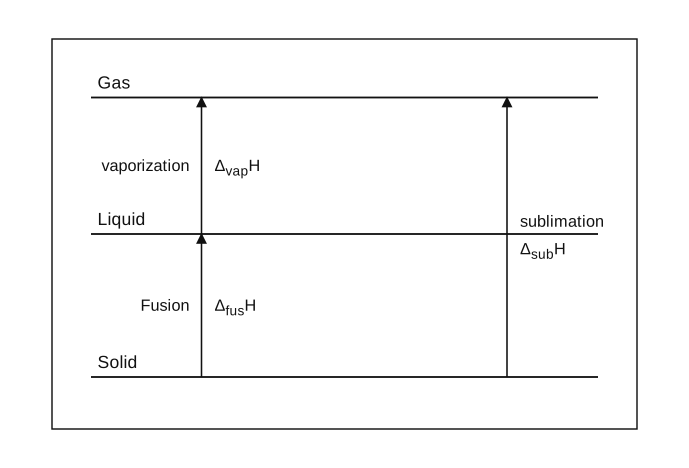
iii. Enthalpy of sublimation () : It is the enthalpy change for the conversion of one mole of solid directly into vapour at constant temperature and pressure. Consider
The conversion of solid to vapour occurs in one or two steps — first the melting of the solid into liquid, and second its vaporization. The enthalpy change is the same, since enthalpy is a state function. At 0 C:
Adding the two (the book sums them above a horizontal rule, Hess-style):
It follows that . (See Fig. 4.9) …
Drawn by us to help you understand the concept clearly, and verified to make sure it's accurate. For exams, practice from your textbook's own diagram.
What this figure shows. Three horizontal energy levels labelled, top to bottom, Gas, Liquid and Solid, inside a rectangular box. An upward arrow from Liquid to Gas is labelled vaporization (); a lower upward arrow from Solid to Liquid is labelled Fusion (); and at the right one long upward arrow runs from Solid all the way to Gas, labelled sublimation (). Because enthalpy is a state function, the one-step climb equals the two-step climb: . *(The book captions this figure 'Fig. 4.10' even though the text above it says 'See Fig. 4.9' — and its e …