Chemistry · Ch 4 — Chemical Thermodynamics
Expression for pressure-volume (PV) work
Expression for pressure-volume (PV) work
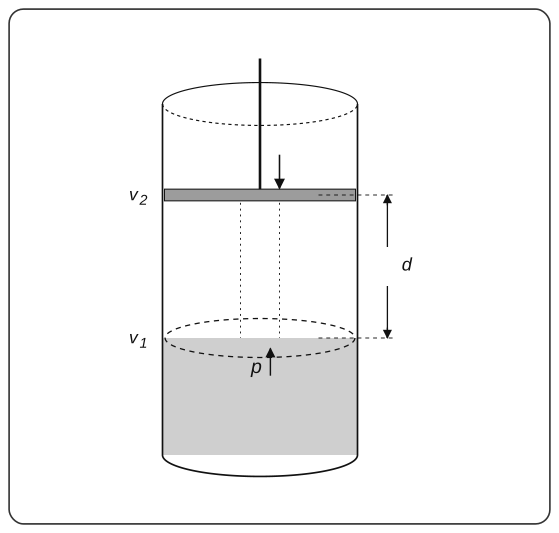
Consider a certain amount of gas at constant pressure enclosed in a cylinder fitted with a frictionless, rigid movable piston of area . This is shown in Fig. 4.7. Let the volume of the gas be at temperature .
Drawn by us to help you understand the concept clearly, and verified to make sure it's accurate. For exams, practice from your textbook's own diagram.
What this figure shows. One cylinder drawn in 3D perspective. The piston (grey disc with rod) sits at its final, upper level marked v; a dashed ellipse below marks its initial level v. Paired arrows at the right bracket the displacement d between the two levels, and a small p with an upward arrow inside the cylinder shows the gas pressure driving the piston out. The work is the force () times this displacement — which is exactly . (The figure's own labels ar …
On expansion, the force exerted by the gas is equal to the area of the piston multiplied by the pressure with which the gas pushes against the piston. This pressure is equal in magnitude and opposite in sign to the external atmospheric pressure that opposes the movement, whose value is . Thus,
where is the external atmospheric pressure.
If the piston moves out a distance , then the amount of work done is equal to the force multiplied by the distance:
Substitution from Eq. (4.1) gives
The product of the area of the piston and the distance it moves is the volume change in the system:
Combining equations (4.3) and (4.4), we write
where is the final volume of the gas. (The book prints the subscript as in the Eq. (4.5) lines and elsewhere on the same page — the same external pressure throughout; we keep each printed form in its place.)
When the gas expands, work is done by the system on the surroundings. Since , is negative. When the gas is compressed, work is done on the system by the surroundings: in this case , and , or , is positive. …