Chemistry · Ch 4 — Chemical Thermodynamics
Expression for the maximum work
Expression for the maximum work
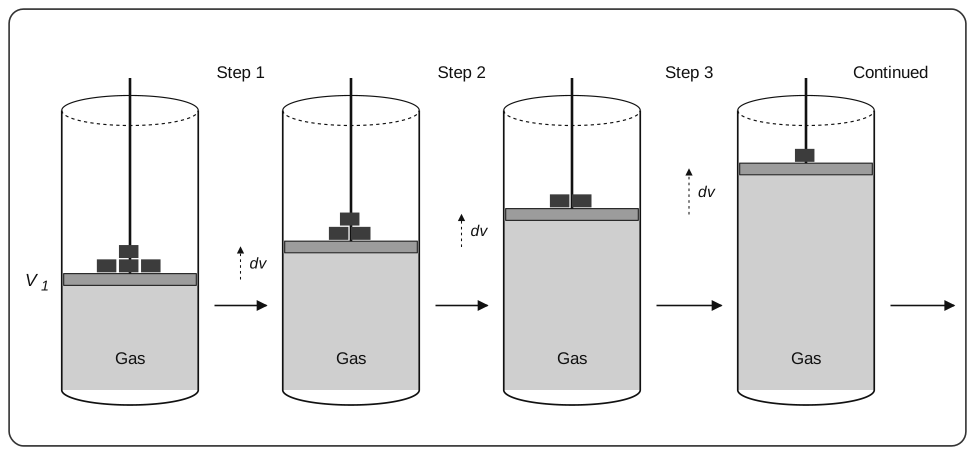
Consider moles of an ideal gas enclosed in a cylinder fitted with a frictionless movable rigid piston. It expands isothermally and reversibly from the initial volume to the final volume at temperature . The expansion takes place in a number of steps, illustrated in Fig. 4.8.
Drawn by us to help you understand the concept clearly, and verified to make sure it's accurate. For exams, practice from your textbook's own diagram.
What this figure shows. Four cylinders of Gas, read left to right as Step 1, Step 2, Step 3 and Continued (arrows between them). Each piston carries a cluster of small masses; step by step the cluster shrinks (masses are removed gradually) and the piston stands a little higher, the increment between successive piston levels annotated dv. The first cylinder's piston level is marked V. Because each step lowers only infinitesimally below the gas pressure, the expansion passes through a serie …
During each step the external pressure is made infinitesimally smaller than the pressure of the gas, with a gradual removal of masses from the piston. The gas expands slowly and its pressure would decrease. The expansion continues until the pressure of the gas falls to ; beyond this, no further expansion occurs and the system attains mechanical equilibrium with its surroundings. The volume of the gas is increased by an infinitesimal quantity in each single step.
The process is repeated in such a way that every time is lowered infinitesimally, the gas undergoes a series of infinitesimal increments in volume until the volume is attained.
When the volume of a gas increases by an infinitesimal amount in a single step, the small quantity of work done is
As the expansion is reversible, is greater than by a very small quantity, . Thus, (this sentence prints in the book with its own mixed lower-case forms, "dp than p")
Combining equations (4.6) and (4.7),
Neglecting the product , which is very small, we get
The total amount of work done during the entire expansion from volume to would be the sum of the infinitesimal contributions of all the steps. The total work is obtained by integration of Eq. (4.8) between the limits of the initial and final states. This is the maximum work, the expansion being reversible. Thus,
Hence,
Using the ideal gas law, , …