Chemistry · Ch 4 — Chemical Thermodynamics
Nature of work (W)
Nature of work (W)
In mechanics, work is defined as the energy by which a body is displaced through a distance by an application of force . Thus,
In thermodynamics the type of work involved is pressure-volume or work — that is, work is done when the system (gas) expands or contracts against the external opposing force.
It may be realized that the product of pressure and volume is equal to work. Pressure is defined as force per unit area. If is the distance, then the area and the volume . Then
Now let us explore the work with two chemical reactions carried out in a cylinder equipped with a frictionless movable piston attached with a certain mass on its outer surface.
i. Decomposition of HO
Consider
Drawn by us to help you understand the concept clearly, and verified to make sure it's accurate. For exams, practice from your textbook's own diagram.
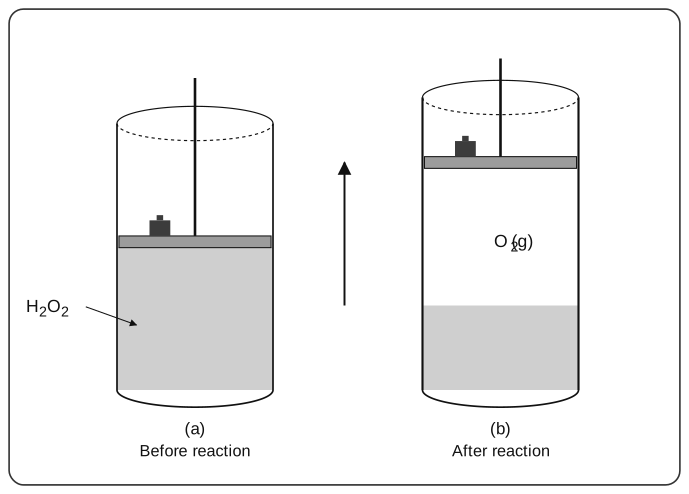
What this figure shows. Two cylinders fitted with mass-loaded pistons. In panel (a) Before reaction the piston sits low on the liquid, labelled . In panel (b) After reaction the decomposition has produced a gas space labelled above the liquid, and the piston (with its mass) has been pushed up — the upward arrow between the panels marks the r …
The gas produced in the above reaction pushes the piston upwards, so that the mass in the surroundings is raised, as shown in Fig. 4.4. In lifting the mass, the system loses energy to the surroundings — it performs work on the surroundings. With no heat being transferred, the loss of energy by the system is equal to the work done by the system on the surroundings. This is expansion.
ii. Reaction between NH gas and HCl gas
Now, consider
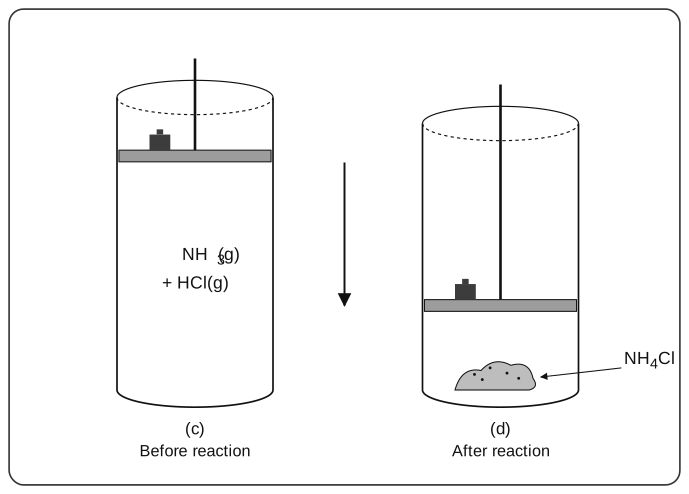
As the reaction progresses, the gases are consumed, resulting in a decrease of volume. The piston moves down. The decrease in the height of the mass is shown in Fig. 4.5.
Drawn by us to help you understand the concept clearly, and verified to make sure it's accurate. For exams, practice from your textbook's own diagram.
What this figure shows. The companion sketch to Fig. 4.4 — its panels are lettered (c) 'before reaction' and (d) 'after reacton' [the second caption is the book's own misprint of 'reaction'], continuing Fig. 4.4's (a)/(b). In (c) the cylinder holds the gas mixture, labelled + , with the piston high. In (d) the reaction has consumed the gases into the speckled solid deposit labelled at the bottom, and the piston has …
…