Chemistry · Ch 4 — Chemical Thermodynamics
State functions
State functions
As shown in Fig. 4.1, a certain amount of a gas is enclosed in a cylinder fitted with a movable piston. Suppose the pressure of the gas is 1 bar , its volume is 1 dm and its temperature is 300 K in the beginning. This initial state of the system is fully defined by specifying the values of these properties. Such properties defining the state of a system are state functions.
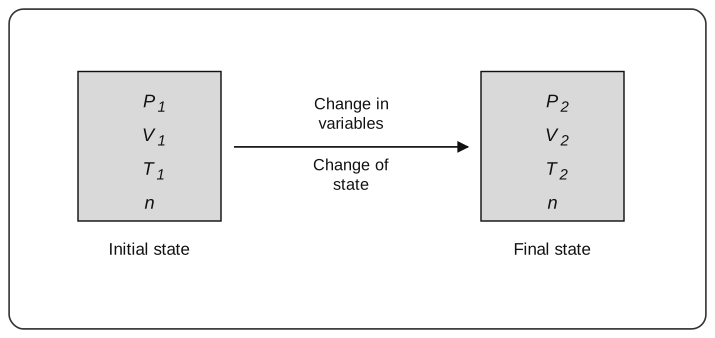
Suppose the pressure of the system is increased to 2 bar , the volume changes to 0.5 dm , and the temperature is maintained at 300 K . This is the final state of the system, which is different from the initial state. A change in the state functions of the system brings forth a change of its state. This is shown in Fig. 4.3.
Drawn by us to help you understand the concept clearly, and verified to make sure it's accurate. For exams, practice from your textbook's own diagram.
What this figure shows. Two grey state boxes joined by a single rightward arrow. The left box stacks the initial-state variables , , and (labelled Initial state beneath); the right box stacks , , and (Final state). The arrow carries Change in variables above it and Change of state below it: changing the values of the sta …
The final state of the system in Fig. 4.3 is described by pressure 2 bar , volume 0.5 dm and temperature 300 K . A system continues to be in such a state as long as the state functions are unchanged. How the pressure of 2 bar is attained — whether by increasing from 1 bar to 2 bar, or by decreasing from 5 bar to 2 bar — would not matter.
The property which depends on the state of a system and is independent of the path followed to attain it, is called the state function. …