Chemistry · Ch 15 — Introduction to Polymer Chemistry
PHBV
PHBV
PHBV -- poly(beta-hydroxybutyrate-co-beta-hydroxyvalerate) -- is a biodegradable aliphatic polyester copolymer built from two different bifunctional beta-hydroxy carboxylic acid monomers: beta-hydroxybutyric acid (systematically, 3-hydroxybutanoic acid) and beta-hydroxyvaleric acid (systematically, 3-hydroxypentanoic acid). During polymerization, the -OH (hydroxyl) group of one monomer molecule condenses with the -COOH (carboxyl) group of another, forming an ester linkage and eliminating water at every step, exactly as in any condensation polyester; because two distinct monomers are used, PHBV is properly described as a copolymer rather than a simple homopolymer. Once discarded, PHBV is readily broken down by microbes present in the environm …
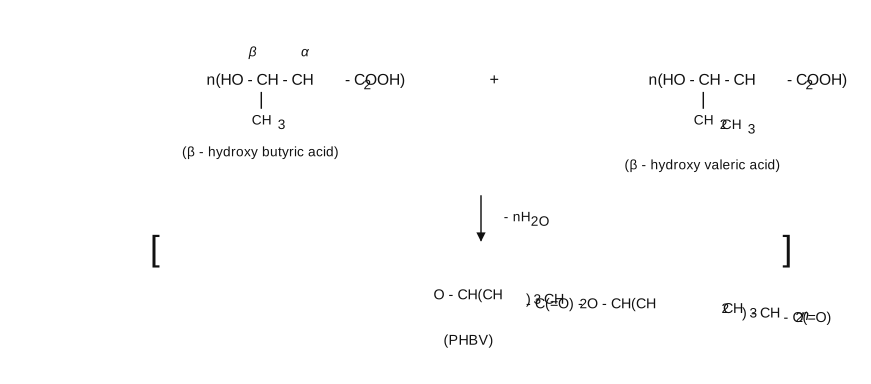
Drawn by us to help you understand the concept clearly, and verified to make sure it's accurate. For exams, practice from your textbook's own diagram.
A biodegradable copolyester. beta-Hydroxy butyric acid and beta-hydroxy valeric acid (Greek position labels as printed) condense through their -OH and -COOH ends, losing nH2O, into an alternating ester-linked repeat unit. Because microbial esterases hydrolyse those ester links, PHBV degrades after disposal — the property tha …