Physics · Ch 6 — Superposition of Waves
Sonometer
Sonometer
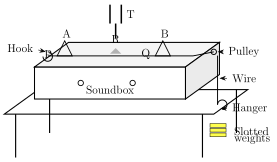
A SONOMETER is the standard laboratory apparatus for studying and verifying the three laws of a vibrating string. It consists of a hollow rectangular wooden SOUND BOX, whose purpose is to set a much larger mass of surrounding air vibrating in sympathy with the (much lighter) vibrating wire, thereby amplifying the sound -- exactly the same principle used in the resonating bodies of stringed instruments such as the violin, guitar, or tanpura. Along the top of the box runs a single metal wire of uniform cross-section, passing over two BRIDGES P and Q that can be slid along the box's length; the wire is fixed at one end, while its other end passes over a small pulley and hangs down carrying a weight hanger, so that the TENSION in the wire can be varied simply by adding or removing slotted weights, and the VIBRATING LENGTH AB (the portion of wire between bridges P and Q) can be changed simply by sliding the bridges.
Plucking the wire midway between P and Q sets up transverse stationary waves in the length AB, by exactly the reflection-and-superposition mechanism of section 6.7.5. The wire can also be excited instead by holding a vibrating tuning fork's stem in contact with the sound box: if the fork's frequency happens to match one of the wire's own natural frequencies, the wire responds with a large-amplitude stationary wave (resonance). To DETECT this resonance precisely, a small, light paper RIDER is balanced on the wire at the midpoint of AB; when the length AB is adjusted (by moving the bridges) until the wire's own fundamental frequency exactly equals the tuning fork's frequency, the midpoint sits at an ANTINODE of large amplitude and the paper rider is thrown clear off the wire -- a clean, visible signal that resonance has been achieved. …
Drawn by us to help you understand the concept clearly, and verified to make sure it's accurate. For exams, practice from your textbook's own diagram.
What this figure shows. A sonometer: a metal wire runs along a hollow wooden sound box over two movable bridges P and Q (which fix the vibrating length AB). One end is fixed; the other passes over a pulley and carries a hanger with slotted weights to set the tension. A tuning fork T sets the wire vibrating, and a small paper rider R on the wire flies off when th …