Q.A copper wire of length 2.2 m and a steel wire of length 1.6 m, both of diameter 3.0 mm, are connected end to end. When stretched by a load, the net elongation is found to be 0.70 mm. Obtain the load applied.
🔒You're viewing a preview — the full solution, concept, methods & PYQ mapping are locked.
🔒 Start your 14-day free trial to unlock the full solution →Concept understanding — Youngs Modulus
Young’s Modulus: The Stretchiness of a Solid
When you pull on a rubber band, it stretches easily. When you pull on a steel rod of the same size, it barely moves. Both are elastic — they return to their original shape when you let go — but they resist stretching very differently. Young’s modulus is the number that tells you exactly how much a material resists being stretched or compressed lengthwise.
The Intuition: Stiffness per Unit Size
Think of a spring. A stiff spring requires a large force to stretch it a little. A soft spring stretches a lot with a small force. Young’s modulus is like the “stiffness” of a material, but it’s cleverly designed to be independent of the object’s shape and size.
If you take a thick steel rod and a thin steel wire of the same length, the rod is harder to stretch. That’s because you’re pulling on more material. Young’s modulus removes this size effect — it tells you the stiffness of the material itself, not the particular piece you’re holding.
The Precise Definition
Young’s modulus (E or Y) is defined as the ratio of tensile stress to tensile strain, as long as the material obeys Hooke’s law (the deformation is reversible and proportional to the force).
Y=Tensile StrainTensile Stress
Let’s break down the two parts.
Tensile Stress (σ) is the force per unit area. If you pull with a force F on a rod of cross-sectional area A, the stress is:
σ=AF
Stress has units of pressure — pascals (Pa) or N/m2. It tells you how “intense” the pulling is, regardless of the rod’s thickness.
Tensile Strain (ε) is the fractional change in length. If the original length is L0 and it stretches by ΔL, the strain is:
ε=L0ΔL
Strain is a pure number — it has no units. A strain of 0.01 means the rod stretched by 1% of its original length.
Putting it together:
Y=ΔL/L0F/A=AΔLFL0
What the Number Tells You
A high Young’s modulus means the material is very stiff — it takes a huge stress to produce even a tiny strain. Steel has Y≈200×109 Pa. A low Young’s modulus means the material is easily stretched. Rubber has Y≈0.01×10⁹ Pa — about 20,000 times smaller than steel.
Young’s modulus is only valid in the elastic region — where the material returns to its original shape after the force is removed. If you stretch too far (past the elastic limit), the material deforms permanently or breaks, and Young’s modulus no longer applies.
A Worked Example
A steel wire of length 2.0 m and cross-sectional area 1.0×10⁻⁶ m2 is pulled by a force of 100 N. How much does it stretch? (Young’s modulus of steel = 2.0×10¹¹ Pa)
From Y=AΔLFL0, rearrange:
ΔL=AYFL0=(1.0×10−6)×(2.0×1011)100×2.0=2.0×105200=1.0×10⁻³ m=1.0 mm …
Concept: Young’s modulus — the ratio of tensile stress to longitudinal strain. For wires in series, the total elongation is the sum of the individual elongations under the same load.
Step 1 — Write the elongation formula
For a wire of length L, cross-sectional area A, and Young’s modulus Y, elongation under load F is
ΔL=AYFL.
Step 2 — Apply to both wires
Area A=4πd2=4π(3.0×10⁻³)2=7.069×10⁻⁶m2.
For copper: Yc=1.1×10¹¹Pa, Lc=2.2m.
For steel: Ys=2.0×10¹¹Pa, Ls=1.6m.
Total elongation:
ΔLtotal=AF(YcLc+YsLs).
Step 3 — Solve for F
Given ΔLtotal=0.70×10⁻³m, …
The two wires carry the same load F but stretch by different amounts. Using ΔL=AYFL for each and adding, the applied load is F≈1.8×10² N (about 177 N).
The copper and steel wires are joined end to end (in series), so both carry the same tension F. Because they have the same diameter, they share the same cross-sectional area A, but each elongates according to its own length and Young's modulus. The total elongation is the sum of the two.
ΔLtotal=AF(YCuLCu+YsteelLsteel)
Given data
- Copper: LCu=2.2 m, YCu=1.1×10¹¹ N/m2
- Steel: Lsteel=1.6 m, Ysteel=2.0×10¹¹ N/m2
- Diameter d=3.0 mm=3.0×10⁻³ m
- Net elongation ΔLtotal=0.70 mm=0.70×10⁻³ m
Step 1 - Cross-sectional area
A=4πd2=4π(3.0×10⁻³)2=7.07×10⁻⁶ m2
Step 2 - Sum of length-to-modulus ratios
YCuLCu=1.1×10112.2=2.0×10⁻¹¹ m2/N …
Step 1: series wires, same F and A (equal diameters). A=pid^2/4~=7.07e-6 m^2. Step 2: deltaL_Cu=FL_Cu/(AY_Cu), deltaL_steel=FL_steel/(AY_steel). Step 3: total deltaL=(F/A)(L_Cu/Y_Cu+L_steel/Y_steel). Step 4: L_Cu/ …
- Council of Higher Secondary Education, Manipur (Higher Secondary 1st Year) 2026Set ANNUAL1 markMCQQ.The modulus of rigidity(shear modulus) of an ideal liquid is –(a) infinity(b) some finite small non zero constant value zero(c) unity(d) zero
›Reveal solutionSolution
The shear modulus (modulus of rigidity) of an ideal liquid is zero.
Shear modulus G is defined as G = shear stress / shear strain. A liquid (unlike a solid) has no fixed shape; when a tangential (shear) force is applied to a liquid layer, it does not develop a restoring elastic shear stress — it simply flows/deforms continuously. Since a liquid offers essentially zero resistance to shape-changing (shear) deformation whil …
- Council of Higher Secondary Education, Manipur (Higher Secondary 1st Year) 2026Set ANNUAL1 markQ.Draw the Force–Displacement graph for a body obeying the relation (F = kx), where (k) is a constant and(x) is the displacement.
›Reveal solutionSolution
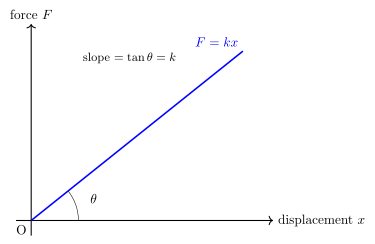
Figure — Force-Displacement graph for F=kx The Force–Displacement graph for F = kx is a straight line passing through the origin, with slope equal to k.
Given F = kx, F is directly proportional to x (k is a constant, e.g., a spring/elastic constant, as in Hooke's Law).
To draw the graph:
- Put displacement x on the horizontal axis and force F on the vertical axis.
- Since F = kx is a linear equation in x with zero intercept, the graph is a straight line that starts at the origin (0,0) and rises with a constant slope equal to k, i.e., for every unit increase in x, F increases by k. …
- Council of Higher Secondary Education, Manipur (Higher Secondary 1st Year) 2023Set ANNUAL1 markQ.State Hooke's law.
›Reveal solutionSolution
Within the elastic limit, the stress produced in a body is directly proportional to the strain it undergoes.
When a deforming force is applied to an elastic body, it develops an internal restoring force per unit area called stress, and undergoes a fractional change in dimension called strain. Hooke's law states that as long as the deformation stays within the elastic limit of the material (i.e., the body can still fully recover its original shape when the force is removed), the stress developed is directly proportional to the strain produced:
Stress∝Strain⇒Stress=k×Strain
…
- Council of Higher Secondary Education, Manipur (Higher Secondary 1st Year) 2022Set ANNUAL1 markQ.How are we able to break a wire by repeated bending ?
›Reveal solutionSolution
Bending a wire repeatedly at the same point strains it beyond its elastic limit again and again, causing progressive internal damage (elastic fatigue) until it fractures, even though one such bend alone would not break it.
When a wire is bent, the material on the outer side of the bend is stretched (tensile strain) while the material on the inner side is compressed. If the bend is sharp, the strain at that point can exceed the elastic limit of the material, so the material does not fully return to its original state when straightened — some permanent (plastic) deformation and internal microscopic damage remains.
When this bending is repeated again and again at the same point, each cycle adds a little more damage: microscopic cracks form and grow within the material, and the local heating produced by the repeated internal friction/deformation further reduces the wire's elastic strength at that spot. This cumulative loss of strength through repeated stress cycles is called elastic fatigue.
…
- Council of Higher Secondary Education, Manipur (Higher Secondary 1st Year) 2021Set ANNUAL1 markQ.How are we able to break a wire by repeated bending ?
›Reveal solutionSolution
Bending a wire back and forth repeatedly causes elastic fatigue — the metal at the bend loses its elasticity and develops cracks, so it eventually breaks even without a large single force.
When a wire is bent, the layer on the outside of the bend is stretched (put under tensile stress) and the layer on the inside is compressed. If the bend is sharp enough, the local stress at the fold can exceed the material's elastic limit even though the wire as a whole isn't under much load.
Each time we bend the wire back and forth, the material at that point undergoes this stress reversal again. Every cycle produces tiny, permanent internal deformations (dislocations) that the material cannot fully recover from — this cumulative loss of elastic strength with repeated stress cycles is called elastic fatigue. Over many cycles, microscopic cracks form at the bend and grow with each further flex, until the cross-section remaining is too weak to bear even the wire's own handling force, and it snaps.
…
🎓Unlock everything free for 14 days
- ✓Full step-by-step solutions
- ✓Concept-first explanations
- ✓Methods, shortcuts & mistakes
- ✓PYQ mapping + timed mock tests
Full access for 14 days. No credit card required.