Q.Prove that the radius of the right circular cylinder of greatest curved surface area which can be inscribed in a given cone is half of that of the cone.
You're viewing a preview — the full solution, concept, methods & PYQ mapping are locked.
Start your 14-day free trial to unlock the full solution →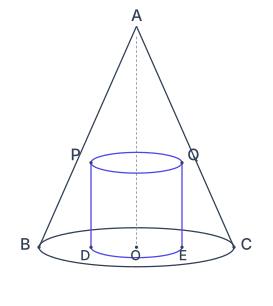
The problem asks for the cylinder radius that maximises its curved surface area inside a cone. Using similar triangles to express the cylinder’s height in terms of its radius, we form the surface area function . Differentiating and setting the derivative to zero gives , proving the cylinder’s radius is half the cone’s radius.
This is a classic optimisation problem where a geometric constraint (the cylinder must fit inside the cone) links the two variables — radius and height — so we can write everything in terms of one variable. The curved surface area of a cylinder is , so once height is expressed in terms of radius, we have a single-variable function to maximise.
Let the cone have base radius and height . Let the inscribed cylinder have radius and height . The cylinder sits with its base on the cone’s base and its top rim touching the cone’s sloping surface.
- Relate to using similar triangles. Look at a vertical cross-section through the axis. The cone appears as a triangle with base and height . The cylinder appears as a rectangle of width and height , with its top corners touching the sloping sides of the triangle. Consider the smaller triangle formed by the cone’s apex, the top edge of the cylinder, and the axis. Its height is and its base radius is . This triangle is similar to the whole cone triangle (height , base radius ). Hence:
Solving for :
- Write the curved surface area as a function of . The curved surface area of a cylinder is . Substituting :
The domain is (the cylinder must be inside the cone, not degenerate).
- Maximise using differentiation. Differentiate with respect to :
Set : …
Unlock everything free for 14 days
- Full step-by-step solutions
- Concept-first explanations
- Methods, shortcuts & mistakes
- PYQ mapping + timed mock tests
Full access for 14 days. No credit card required.